By Ketaki Mathur, Class of 2020

By Ketaki Mathur, Class of 2020
Devika Jamkhedkar, Class of 2021
The Creators is a fortnightly series of artist profiles of Ashokans who are actively involved in different creative fields including music, photography, creative writing, and visual or performing arts.
“Where there is a quill, there is a way” is a witticism of unknown origin, but it might as well be the trademark of Abhyanshi Tripathi, seventeen-year-old author. Writing is highly lauded as an intellectual craft and is imbued in fidgety children from the very start of learning. In spite of this initial phase of encouragement, writing to publish is often viewed as an ancient erudite’s task. All such preconceptions were shattered when we stumbled upon Abhyanshi, who’s impressive repertoire spans a published research paper, Crexert (a creative literature blog), and Collectio that made her a young poetic success.
While coming to Ashoka may have temporarily put her plans to write on halt, Abhyanshi has no plans to stop. I spoke with Abhyanshi to gain an insight into her journey through writing, and the ins and outs of her identity as a budding literati.
Devika: Your story is an exceptionally refreshing one — not many Ashokans can flaunt being published authors at sixteen! I’m curious to know the history of your writing. When and why did you first pick up the pen?

Abhyanshi: Thank you! Well, it all started with when I attended a Junior Youth Empowerment Programme in sixth grade. We had to teach people moral science, and I went through training there. In one of the activities, we were given words to create lyrical poems, which I had never done before. I received a lot of praise and motivation from my teachers when I recited them aloud, which was surprising because I never thought I could write poetry!
I started writing poems, then gradually moved on to articles. I really enjoy writing essays and editorials and write them more than poetry.
As for the history, the book, Collectio, was a project we started in eleventh grade. My co-author and I collaborate by curating our work. Before it was published, we honestly thought, “We’re new authors, no one’s gonna read this.” So, we decided to conduct a survey to understand what people typically want to read in literature, so that it reaches that target audience.
That’s a pretty elaborate process! What were some of your findings?
We came to several conclusions. We learnt that people want the title of the book they read to be catchy. So, when we visited schools to promote it, we began with writing “Collectio” on the board. Everyone wondered why it had an “n” missing until we told them that it was the Latin word for “collection”. That’s how we realised that such interesting tricks will get people to question the title and remember it as something new that they learnt.
We also found that most readers don’t like complex language, but like it to be simple and light. So, if you go through my poems and stories, you’ll notice that they are relatively simple. The aim was to reach the maximum audience.
These findings, along with many others, were not just for the book but were published in a research journal— “An Insight into the Ascendancy of Factors Inflicting upon a Reader’s Choice in Literature” in the International Journal for Interdisciplinary Research, a Finland based organisation.
That’s really quite a story! What was the reception like?
Collectio was released on Amazon in September and became an international best-seller in two days. At first, it was in the top 30 list, and then, fifteenth. It reached first place on the second day itself, so I guess it worked — the research worked!

It most certainly did! What do you think it made it number one?
I guess the research findings helped a lot. The title for instance, because obviously when you get to know something you didn’t know before, it excites you more. So people tended to think, “if the title is so interesting, the content would be more so.”
What do you think gave Collectio that “it” quotient, so to speak, that gave it an edge over the other books online?
I think it was mostly in the poems, that contain personal content. Like in “Dark Reality”, I talk about the dark nature of humans that we regularly experience, like hatred, jealousy and also immunity to such kind of treachery. That’s something that relates you to most of the crowd. “26/11” was also about a phenomenon that everybody observed. So, it makes it relatable to pick up real-life events and present them in the form of writing.
Clearly, a lot of extensive work went into finding out the correct audience for your book. Having read your poetry collection as well as your article “The Armour”, there is a clear growth, retaining inklings of your characteristic style. What was your creative process while writing the poems, as compared to while writing the article? How would you say it has evolved?
Initially, when I started writing poems, I simply tried to follow a rhyme scheme. My motive was simply to find the word rhyming with the last one in a sentence. There were particular ideas, but they were expressed mainly within the framework of the rhyme scheme.
This was the way I worked on poems. I switched to article writing because I was finding it hard to get words to rhyme. I recognised poetry as something that rhymes. Articles are more flexible in that way, as they are not guided by the need to make rhymes. If you’ve seen “The Armour”, you’ll know that I prefer writing about personal content and what affects me the most.
As for articles, I usually just pour whatever I’m feeling without being guided by certain lines. Frankly, poetry took a lot of time searching for what rhymes, whereas articles are easier. Another thing I do is that I never really create a second draft, but stick to the first one. I do edit to check for mistakes, but usually, I keep in mind that I’m not going to change it, so it has to be perfect.
That’s pretty unconventional. Do you think that takes more time then?
It does. But I think its better because the next time I think, I come up with different thoughts and feel like orienting the piece in a different way.
So, you tend to stick with your first frame of mind.
Yes. If I feel like I’m gonna change something, I start a new article, but never change the old one. Even if it’s of the same topic.
How does that help you?
Well, it definitely helps me contain my ideas, and come up with new ones. When I start with new articles, it’s not that I am discarding the old ones in any way.
I really appreciate your writing style; it’s very evocative and emotionally driven. Your poems discuss various intense topics, comprising harrowing truths about the darkness in the world. However, there are sparks of unyielding optimism as well, as seen in “Because peace begins with a smile”.
I’ll tell you a story about that one. My music teacher believed I could write well, and asked me to write a song for a competition. “I don’t write songs!” I said. “Poems don’t mean you can call me a songwriter.” But eventually I wrote it and it was sung in a competition. That’s why “Because peace begins with a smile” is repeated, it’s a verse.
Since you cover a range of topics, what inspires you to conceive of them?
Well, in reference to “Dark Reality”, it talks about when I moved to an integrated programme for JEE preparation. I didn’t like it there because I didn’t like what I was studying. I had been a good student in studies and academics alike, but my “sudden downfall” in studies came because of the subjects. Of course, there were some people who were happy about it, and I got tired of their smirks and laughs. I couldn’t tell my parents, so I just wrote it down. I performed it in an assembly. The next day, everyone whom it was about were extremely kind to me- they knew they were the ones!
You’ve evidently been precocious in your literary endeavours, with Crexert and an elaborate literature research paper under your belt! What was the family and peer influence on your work?
My mother writes in Hindi. She used to write about philosophical topics and read to me, so I think I get that from her. I actually didn’t tell her that I write and this book was getting published, so when I told her that it was a bestseller two days after it’s release she was shocked. “When did you start writing?” She had no idea. My co-author is working on a novel right now, and this project was actually his idea. Being in such an environment definitely influences you positively.
Which poets and writers do you enjoy and admire? What are your literary influences?
I really love Paulo Coelho and The Alchemist. I think the whole idea of finding sparks of joy among the darkness that I often write about is inspired by him. There’s a lot of pessimism involved, but points of optimism as well. His philosophical style has definitely rubbed off on me. Daniel Kahneman’s book Thinking Fast and Slow helped me add psychological notions to my articles. I’ve never particularly followed a poet, but I quite enjoyed Nissim Ezekiel, especially “Enterprise”.
“The Armour” encapsulates your tumultuous journey as a young writer. What was the factor that fuelled your drive and passion to continue writing amidst all the hurdles, criticisms and chaos?
So, when I started writing, practically nobody around me was interested in it. When I was praised for my work, my friends somewhat neglected me because they were rather jealous. Somehow that motivated me to continue since I was doing it in spite of them trying to downgrade me.
Most of all, it was how my ideas and thoughts flowed while writing. It gave me a unique sense of confidence in what I had created. People believed that my grades dropped because I was too invested in writing, that I would merely waste away as a poet. I hate the notion in people’s minds that poets simply sit idle. Regarding others’ opinions, I just told myself “you may not like seeing me write, but when you read it, you’re gonna you love it. You’re gonna come up to me and tell me how much you love it.”
I agree with you on that: writers are misunderstood. I strongly identified with your statement about your poetry shaping your identity, as an armour that has rusted but garnered maturity and resilience. What is your personal message to the poets out there, struggling in a society that overlooks their merit and worth?
I would say, don’t be influenced by what people around you are telling you about your work. Just take whatever positive things they say, and leave the rest. If it’s something about your style, then accept constructive feedback.
Finally, when it comes to writing poetry, just don’t look to follow a rhyme scheme! In essays and editorials, try to pour out your feelings and thoughts in a polite rather than arrogant manner.
It’s been rather enlightening talking to you! To wrap up, what’s the latest thing you’re working on?
I’m working on a project, based on the common actions and behaviours of people in certain situations, and putting it down in the form of a story. I still have to start it — Ashoka isn’t giving me a lot of time! But that’s the idea: literature and psychology combined.
It’s been a pleasure interviewing you, thank you for your time. All the best on future projects!
Thank you!
Kanishk Devgan, Class of 2020
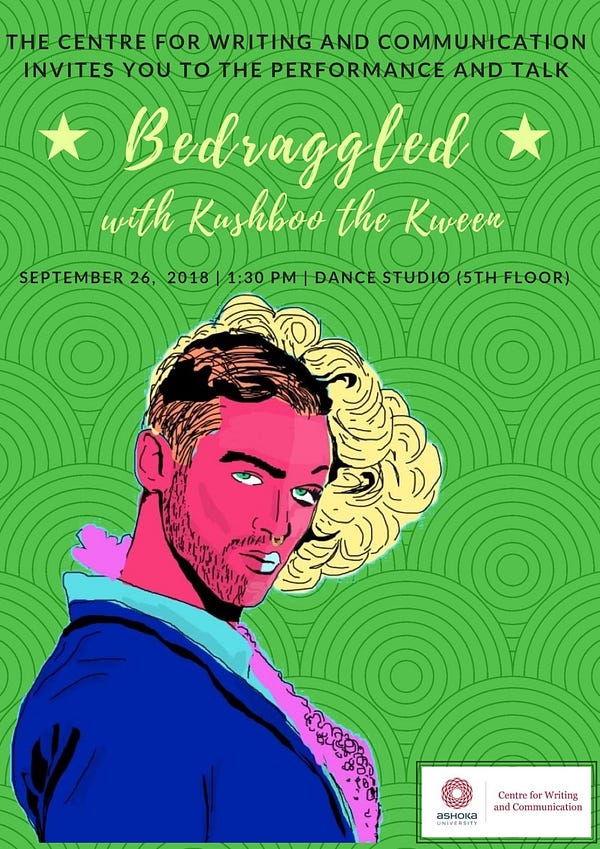
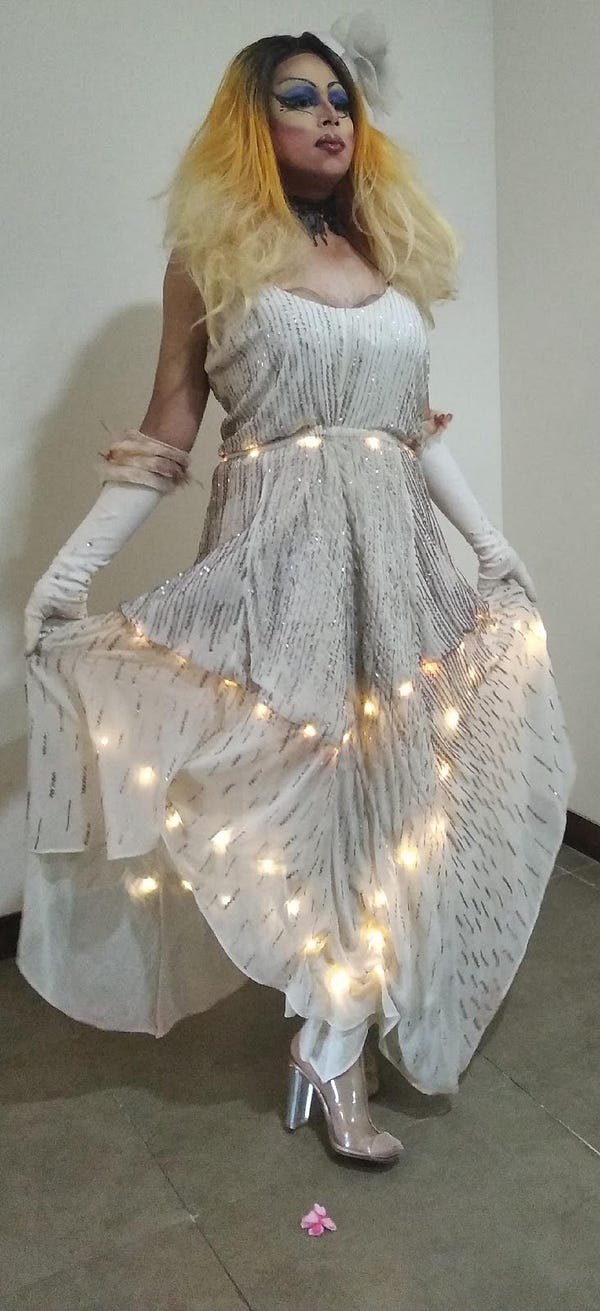
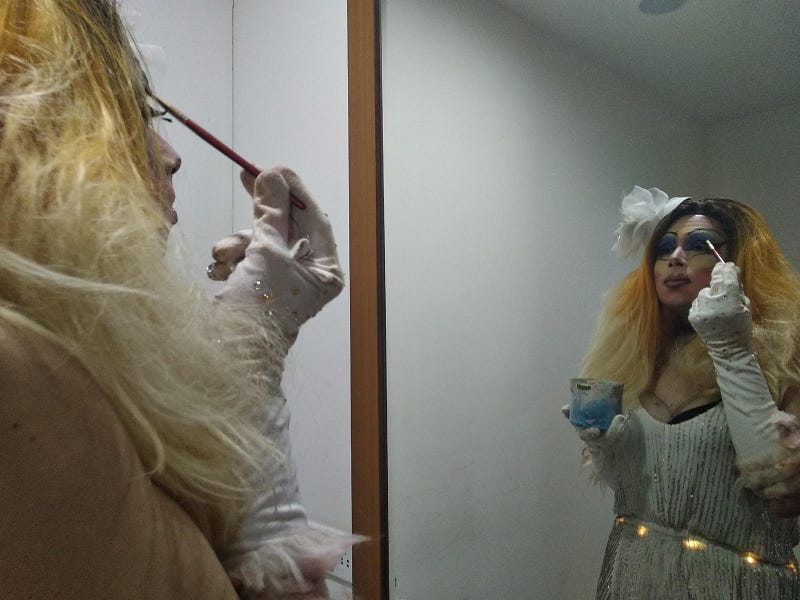
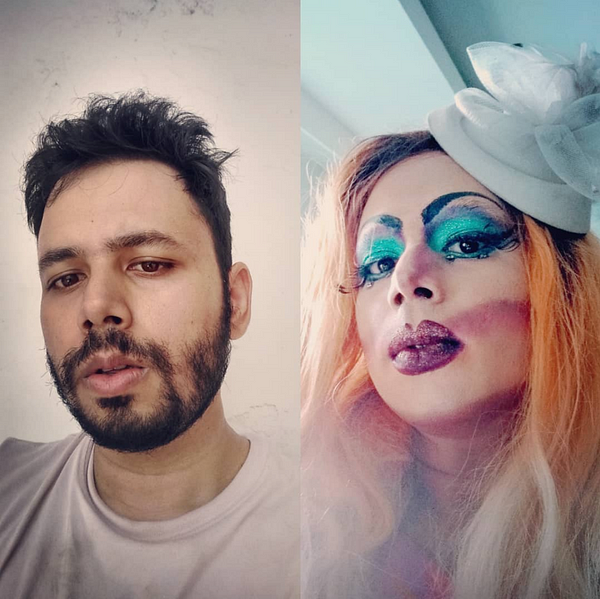
On a fairly ordinary afternoon at Ashoka, a roomful of people had the opportunity to meet someone quite extraordinary. Kushboo, the drag persona of Ikshaku Bezbaroa, conducted a one and a half hour session, accompanied by two dazzling performances, to share the experience of being a drag queen, from personal liberation and deconstructing gender to crafting outfits and designing performances. Afterwards, a few of us stayed back to chat with Ikshaku, a human rights lawyer by profession. I had the privilege of conducting an in-depth interview where we talked about the art and commerce of drag, controversial issues, make-up and costumes, media, gender, family, boyfriends, and much more.
Be sure to follow her on Instagram!
The Birth Of Kushboo
Q. Starting off with the normal, boring questions that I have to ask: what is drag? Like, how would you explain it to someone?
A. From my point of view, drag is an art form that lets me take out the imagination that I have in my mind, the creativity, and put it out there on a canvas. And the best canvas I have is myself. So, I can do the painting on myself as well as perform as I want to — it’s got theatre. I can put the very elements of my imagination into one place.
It’s also very important to me that drag is one thing that’s resource intensive and flexible. You can use whatever props you have around you to create that fantasy, to become that superhero you want to be. For me, it’s to be my best superhero self.
Q. How did the persona that you’ve created — Kushboo — come about? How did she become your best superhero self?
Kushboo is a vulnerable person and I speak of her in the third person, but she’s very much a part of me. She’s vulnerable, sweet and wants to spread love and community. That’s her goal. As Khush, I’ve had to play various roles but Kushboo gets to be who she wants to be — her beautiful self. Her personality has a got a lot to do with my name “Khush”, which is what I was called as a boy — it was my “boy nickname”. And in school, they would call me Kushboo to tease me. So, I took that and turned it around. I took that soft, sweet delicate person who would not pick fights and made them a drag queen.
Ah, so it’s reclaiming that name for yourself. Like, no one else would know this but for you.
A. Yeah, I was very much like this back in school. I would never pick fights and that’s one of the biggest reasons you get picked on in a boys’ school. If you’re not a fighting type, you get bullied.
Q. Were you in a hostel?
A. No, but an all-boys school. And I was the type to you know, read my book and I would go to the theatre — but that was very not acceptable at school. I reached back into my childhood and brought that person out.
Yeah, you get forced into your classmates’ culture, doing their things. I was in an all-boys school for two years, my cousins for 12 years…
Yeah, I was there for 12 years, and it’s horrible because I remember being a person who was much more innocent; who was nicer, simpler, and brighter. Who had more fun. Who enjoyed things in a different way than I do now. Kushboo is a part of bringing that back. You know, it’s very personal. I feel I grew up too fast.
Drag culture in Delhi
Q. Do other drag queens, who you know, also take something so personal to create their name and image, or is it about creating a more divorced artistic creation — a character. What are the different methods of going about it?
I personally think that it’s a bit of . . . a mixture. What is personal does become art and is the best form of art. All the names I’m thinking of right now are very personal. These names are connected to who they want to be, what they want the image to be. That’s the art aspect but also the personal. Can I drop names?
There’s Lush Monsoon — she’s a friend. Her name is literally “lush” and she’s about body positivity and focuses on celebrating your body. Lush Monsoon makes sense because it’s like a tropical forest.
Yeah, it gives you that image.
Exactly. And then there’s “Betta Non/Naan Stop”. There are various connotations to her name. I don’t want to speak on their behalf but this is what I know: she said it’s a species of fish and ‘fish’ is a term used in drag to denote femininity. It’s got to do with “fishiness”.
She told me ‘Betta’ is a kind of fish and fishiness refers to a very woman-woman, and she is like that — she’s very graceful and stuff. And you know “Betta Non-Stop” and “Betta Naan Stop”, so a reference to butter naan… then you have, Remy Heart and she did a pun on, well, it’s very sexual…
She did “Remy Heart” as “Rim-Me Hard”, which is also inspired by Roxy Heart from Chicago. Her drag is also very dainty and pretty.
Q. It’s pretty cool how the names are generally puns, and references, and representations of that person’s style. So when did this entire culture of drag — all these people you know — since when have they been doing this, who were the first people to start this, and when did it really take off?
A. It’s been happening in India for a long time. It’s been happening inside doors and in private spaces, because people have these gatherings and they do drag performances. There are people like Sandy Saha from Calcutta who was on Big Boss, and she’s kind of a drag queen. Her style is very different; for example, she’ll go to public places and offend people. She’ll ask them why don’t you want to take me home and they’ll get scandalised and she’ll take videos. It’s a very funny and outrageous drag. She’s sort of the oldest. Maya is one of the oldest queens; she’s been doing it for three years. I think all of these queens had started off before, in private, but it became a big deal last year — I think it was Kitty Su which was the impetus for it. They were the ones who did open up a new, you know…
They were the first mainstream club.
A. Yeah, they were the first mainstream club who took it seriously and invited drag queens from abroad. That’s when they realised there’s a huge drag culture in India, and they want to celebrate it, and local queens too. In fact, I was the first person to debut in Delhi, in Kitty Su, as a drag queen.
Oh, wow! That’s quite an honour to hold.
A. It really is. It feels great. It feels great to be in the first generation of drag queens after it’s become popular. I’m not the original drag queen but first generation.
Art, Advocacy and Academics
Q. You’ve worked and still do work as a human rights lawyer. You also talk about advocacy through art. I wanted to ask about how these two parts of your life intersect — when do they help each other and when do they come in conflict with each other?
A. Honestly, I think they’ve been more in conflict with each other, than the other way around (chuckles). My experience with the academic world has been different from what one might expect. They take to this culture very… differently. They have their own set of values. They exist in a completely different space. Drag tends to live, right now, through fashion and design, and in those spaces. Advocacy lives in rights and activists and academic circles. They’re very separated, but they’re beginning to meet now. You find activists visiting the nightclubs and the fashion industry talking more about rights and that discourse. These worlds are meeting but for me, personally, it’ll be great to mix it together because the main kind of advocacy I like to do is on gender, sexuality, and LGBT rights. Until now I’ve done various things: I’ve worked on environmental matters, land rights and matters so it’s been diverse but what I enjoyed working on most was women’s rights and LGBT rights and in that context, this makes sense. I know I’ll be able to talk about feminist theory and talk about various things in these spaces and it just needs to be simple and relatable. It needs to connect with feelings because activists tend to talk in lofty terms and it’s not relatable to the regular gay person. This, I think, would make that connection.
It’s important because it’s coming from experience. To have people from a culture represent that culture.
A. Yes, as a gay person and as a person who has studied something about feminism, it matters. My ideas are influenced by what I’ve studied. All these interesting books by feminist authors. It is interesting at the time, but then it becomes about how you put them into practice — the way you choose songs, build community. They’re the biggest lessons for me.
Q. How open are you about being a drag queen? For example, when you go to work does it become a point of conflict, do people know about it?
A. The only time I’ve not told people is when there’s been a power dynamic between them and me, and my interests are immediately threatened. I hadn’t told my boss because she, well, anyway didn’t like me, and I couldn’t tell her. I knew she wouldn’t let me stay in the office and if I didn’t work there, I couldn’t do drag so I had to think of the bigger picture.
With my parents, I didn’t tell them initially because I knew they would make life difficult for me. But it just happened, it came out, and after that, I decided not to lie because it gets exhausting to maintain a double life. Even though you know that they’re going to mind that your name is in the newspaper I’ll be like “Mom, can you please get me the paper, my name’s written and I want to see it” because I can’t lie about it, it’s just too much. And she’ll mind, she’ll make a scene and I’m like “it’s fine”. I’m pretty open, I’ve told my friends and the whole world knows. I mean, there is no such thing as a secret drag queen. You have to be completely out there. And now the office people know. I’m sure my boss knows.
Q. It’s great that you can be open about it now — there’s just so many ways for us to be inhibited and something like this is so important to you on a personal level — to get away from and break down expectations but it also helps others. Have you had interactions with people who’ve come up to you and said they’ve felt better, in whatever way, just even slightly more comfortable with themselves?
A. This was the main reason I enjoy this art-form — it connects with people. There are many who are much more visibly queer than I am. Apart from this, I really pass, like, I’m taken more seriously wherever I go, say with shop owners. If I go with someone else, to the same place, they won’t be taken seriously simply because they might be more feminine in their manners or more visibly queer. So, I realise through this, those people are telling me you look great, you’re awesome, you’re rocking it. But the point is they feel inspired by this, they feel it gives them permission to do it. Personally, it’s not easy because the minute you do this you give up those privileges, people take you less seriously. Everyone at the guest house I’m staying at currently keep looking at my nails — you know, little things in the way people treat you. If you act a certain way they’ll run and give you service and if you put on nail polish they don’t. It’s weird. I don’t even know what women must feel like.
Costumes and Design
Q. Talking about clothing — how did you learn to design your costumes?
A. It’s all self-taught. I got the material, stitched it together. It was messy but it worked. I used to do arts and crafts as a kid, and use those books with little cut-outs to make your own little windmill or whatever. So, I think my aptitude for working with my hands came from when I was very little. I never really got a chance to apply it because all I was doing was legal stuff — writing, writing, writing. It was very boring and this was fun.
Q. What about the design? Do you sketch out ideas beforehand or make it up along the way? What’s the process of visualisation?
A. Yes, I have to sketch. When I’m doing reveals, I need to sketch out how it’ll look both ways. I need to foresee because then I’ll stitch it and realise that something’s showing wrong. You need to plan it out. I have a little booklet where I draw these two-way costumes. The one thing I didn’t do by drawing — just made it straight out of my mind — was this dress made of blue, plastic trash bags. It was a full-on gown.
(Here’s a link to her plastic dress reveal.)
What it had was a paper cage and plastic bags stuck on it. It took me a whole day to make. I did it last year sometime, in my early days. It’s great for reveals. Plastic is such a beautiful material, it moves so nicely. It’s also reusable. I can tear the top off and make another one.
The Commericial Side
Q. What’s the industry side of drag like? You had mentioned during the talk that professionally, you can be paid lakhs for shows. Has a culture for the professional side of things been demarcated — for example, do those in the industry consider XYZ particular things as sell-out-ish and ABC particular things more true to drag? Do people accept each other’s way of going about it, is there competition? Basically, how has this professional side to drag affected drag itself?
A. In general, the only place I know where there’s been an extension of the professional side to an extent where it might be competitive and such is the US. There’s a culture of making drag queens compete on TV. Typical reality TV shows. So, those competitions drive skill. It makes queens pull out really classy looks, top-notch art, being quick and adaptable. That excellence comes in because of shows like that. Drag, in a sense though, has always been competitive. It started as a poor person’s art-form because it’s been in small clubs, it’s very taboo, always underground. It’s only now because of the show it’s become so mainstream. RuPaul gets Emmy awards and really is quite popular. The industry has come afterwards. The fashion industry, for example, has realised that there are very good makeup artists here, design people. In India, however, the industry side is still developing. It’s very, very new. Nothing has happened yet because we’re still pushing all the boundaries.
Yeah, now that you mention the fashion industry, I was thinking about the film industry where there’s a need for those skills.
A. Yeah, there’s serious application in those places. This is theatrical makeup. In places like makeup academies, they teach this as theatre makeup. I’ve learnt it entirely from YouTube, along with my fellow drag queens. We’re all self-taught. And I can teach others now, like contouring, for example, is my strong point, but I want to learn even more professionally. It’s a lot of fun though to just experiment.
My mom does something called image consultancy and they have these finishing schools but the application is so different. This is taboo. You can’t use the greens and blues there. You need to blend and make it subtle. I’ve had people tell me to make it a little softer to look more feminine. What they don’t get is that I’m not trying to do that, this is creating beyond reality — a fantasy.
Pushing Boundaries, or Being Yourself
Q. (from a fan of Kushboo, sitting nearby) I don’t know how you do it. It’s so tough to even push boundaries within my gender, you’re pushing gender boundaries.
The weird thing is sometimes reality gets blurred. I don’t even know what I’m doing that’s pushing buttons. It’s all pretty simple.
Q. I hate when people judge others for being extra, for example. Like why would someone be against that? It’s fun.
A. I know! It’s the best things. But honestly, I’d remember a time, when I had these notions. You think fashion is flimsy and frivolous and why do you want to do it. Growing up as a guy my dressing was simple, sober — all muted. I had to unlearn these things. I had the benefit of people pushing that in my face asking like, “why are you being judgmental about it?” That’s what we need to do. Talk to people by doing it in front of them.
Drag Queens, Transgenders, Women and Media
Q. I wanted to ask about some issues in the drag community. You had mentioned, in the talk, about the transgender community feeling misrepresented. At the other end, it’s also people’s fault for not taking the time to understand the distinctions between being transgender and being a drag queen. In India, especially, it gets harder and harder for people to understand anything that’s a little deeper into queer culture. All of it is still quite alien to many. How do you maintain this fine line? What part do you feel is their responsibility, yours or anyone else’s in preventing the transgender community from feeling misrepresented?
A. That’s a very real, recent thing, in fact. I have felt this very personally. It’s been confusing for me. I get very frustrated with conventional, heteronormative society because I feel they should take that effort, move outside their comfort zone and limited knowledge to question their own understanding of things to not stick with that perspective. We do this from our point of view. On the other hand, I’ve attended events where the performances are slotted — so you’ll have a lesbian-themed play and you know, some gay performance and then you’ll have a drag performance, and a trans ‘giddha’ performance. You’ll see the attention is all on the drag queens — they’re the most glamorous. And we enjoy it but when the ‘hijra’ community comes on and perform, it’s given a little bit less (attention). And we’re still in the hall, in drag, so people are flocking around us and taking selfies while their show is happening. I felt that we’re totally stealing their thunder. It’s not a nice feeling, and they don’t like it either. I wouldn’t like it. I’ve seen it happen multiple times. Honestly, I don’t know how to navigate that.
It’s a grey area for me — it doesn’t belong to us. From our side, the responsibility is to not intrude on their space. In shows like that, we shouldn’t stay in the hall or maybe de-drag once the performance got over. At the end of the day, it’s a conversation. We hang out with them, talk to them. Initially, I don’t think they were accepting of us but they did as soon as we said we’re gay, then they felt we were like them. They didn’t even realise we’re gay; they thought we were straight men just caricaturing women.
Because we’re so used to seeing that. In so much of our media cross-dressing is just a joke.
Talking about the media’s representations of drag, referring to misinformation in articles by leading newspapers, Kushboo said, “Who owns and runs these newspapers?” All straight people who have never been in queer culture. You can be straight and be involved in queer culture and give a shit about it. These people are very new to it; they just want a scoop. They just want to capture a quick photo and story.
A lot of newspapers feel like they are from an outsider’s perspective for outsiders.
A. That’s exactly the way it is. Just yesterday I had a fight with a person who featured me on a major media publication and I liked the article but they misspelt my drag name, attributed a song to me that I’ve never performed, said that one of my drag sisters is my mother. They called her my sister and mother. You can’t really be both. The house doesn’t work like that. They put Lush Monsoon’s name and my photo. They just do these things and I pointed them out because this is far more problematic. And she responded by saying that calling it more problematic was a bit rich and she should never have pushed for it. I’m like do you not want me to tell you — just say thank you for covering me. They feel like they’re doing us a huge favour. They get paid for every scoop, they get attention. We get nothing — apart from the fame, which is good but that doesn’t mean anything goes.
You’ll have some queer journalists who’ll do a nice documentary on you, in a more sensitive way. And that’s great and it makes me feel like we need more queer people in these spaces.
Q. So, another area that might be tough to navigate is what drag says about female stereotypes. I’m sure you’ve heard about this point of view that claims drag to focus on particular parts of female stereotypes for glamour. Another question that arises is that does gay men taking part in drag perpetuate stereotypes about gay men always being feminine? Or is drag a response to the patriarchy? Mocking the patriarchal mindset of just being closed and saying no to everything?
A. That’s definitely a great way to say it… it’s the latter. It’s only celebratory. When I said that as drag queens we portray strong women, it’s not just one type of women, it’s vulnerable women and emotional women too. My drag is like that; I’m always doing sad, sappy numbers. I like it. For me, that’s strong. It matters to cry after your break-up, for example, because you have to deal with that emotion and move on. That’s what women are like and men don’t cry. That’s generalising but men, like my Dad, for example, have this thing. He said that the first time he cried was when I came out to him. This whole idea of not crying is weird.
I don’t think it’s harmful because we’re saying that we are like this. Celebrate it, talk about it, rub it in your face. When you own that, then you only want to talk about it. If it perpetuates stereotypes, then even better. A lot of gay men find comfort in (this).
Families and Boyfriends: Taboo Here, Taboo There
Talking about conservative families: My family’s not conservative, they’re liberal. But it’s not just conservative families that don’t accept; it’s actually a big taboo in non-conservative families. There’s a lot more at stake. If you’re in academic circles or professional circles, you worry about what people say. You care more about your queer child in some ways. A friend told me his family doesn’t care — they’re not that well-off and more traditional — but they’re much more relaxed. The social element is more complicated than that. It’s easier for me, from where I’m coming, but in a different way. It’s all very grey.
Talking about boyfriends: My friend says he saw the signs long ago in my ex. He was right wing but I don’t judge people for their politics, that’s just my thing. But there would be things like him being pro-Mens’ Rights sometimes, or he would have these little elements which were not good. People would question how he could be like that. The proof in the pudding was that the minute I became a drag queen he couldn’t deal with it. He said he’s not attracted to me if I’m also a drag queen. I know people who are friends with drag queens but they wouldn’t ever date one. So, anyway, that’s what he told me. I never once doubted that I would give this up, and he even asked me if I would stop drag, and I said no. The heartbreak is real, and it’s painful but it happened for a good reason. We would have lived together and not understood each other. It’s hard to not be appreciated by your partner. When I met him six years ago, I wasn’t doing drag. We’ve been together six years and long distance also. But you don’t know why people are with you in a relationship sometimes. I realised he liked me because I was very cis-acting. I was a lawyer, he was a doctor — so great combination. I didn’t see it then, but now he worries about where this is going to go, social acceptance, not cis-gendered, so, you don’t even know why people are with you sometimes. When you move out of that then you realise that they don’t like you. With family, you’re forced to stay. I made the mistake of coming out when I was still living with them. So, that was horrible. I messed up one year of boards because of that. There’s a lot of people who say that you should counsel your parents but I don’t think you can take on all the burden. Maybe you need to get someone for support, like an aunt on your side.
And finally, Kushboo’s favourite drag queen
Q. What’s your favourite drag performance? Or your favourite performer?
A. Alaska. She’s just incredible. She transports you. What I like the most is that she’s happy and comfortable with whatever she does. A complete ‘I-don’t-give-a-damn-attitude’. She’s been criticised sometimes for being tacky. She’s crazy though; she got peed on stage once. It’s part of the show, she’s brave. Her makeup is pretty straightforward. She did a plastic dress too which inspired me. She’s from RuPaul. I met her in drag, here only, in India.
Thank you for spending this time with us!
Kushboo, the first debutante of a mainstream drag show in Delhi, now stands as an inspiring figure in her own right. Do look out for her next show in a city near you!
The author is an Arts and Culture staff writer for the Edict.
By Vaibhav Parik, (Class of 2020)
Last semester, as I approached the end of my first year at Ashoka, I realised a fundamental change that was inevitable as batches passed, the fact that there was a significant departure in our relationship with this place compared to our senior batches. After all, what we got when we came here was a certain established product, as opposed to them, who saw this place being built from scratch. There is no denying that this has led to a significant change in our relationship with this place.
But it is a bit jarring to see that relationship transform into a rising hostility between the students and the administration. I never thought that the finished product we are getting would create a relationship with the administration such that we hastily generalise and blame them for the slightest of flaws. Instead of contributing to fix any flaw, or pushing our boundaries to reach out to the administration, we hope that everything is fixed for us. In the light of the curfew, what we fundamentally need to realise is that instead of blaming the administration for the manner of the curfew’s imposition, it is far more important to look at the lack of genuine discussion around the culture of substance abuse at Ashoka, as a reason for this fallout. And that lack of discussion is something that can be attributed to our convenience and entitlement, alongside our inaction as a community.
In the beginning, we need to see why blaming the administration at this point of time does not make sense, because in doing that, we don’t realise how we are undermining the idea of the discourse on the culture of substance abuse that needs to happen. The Student Government’s(SG) mail saying that the argument about this action’s manner is not ancillary but rather important*, completely takes the element of the discourse (although not belittling it) and puts it as if it’s not a priority at this point of time. I do not see how this argument and pushing for student involvement as a consequence, given the current constraint, allows them to accommodate for the unheard voices that haven’t come up so far, because this only postpones the discourse mentioned above, that has needed to happen for a very long time.
I understand the concern that the SG might have, that this constant coercion is not something we should give in to. But as a community, instead of just trying to use their argument as a rallying point for more hate towards the administration, what does it mean for us to not engage in discourse creation? Not that I blame the SG, but is it so hard for us to see that we’re totally missing the point with all that distrust towards the administration? If discourse needs to be created, we need to be cognisant of its need and engage with it.
So why has this discourse genuinely been held back? Is there an honest answer for this delay apart from our convenience and our entitlement not to push our boundaries? Do we ever breach uncomfortable discourses beyond our convenience or rather, despite our inconvenience? What we have done so far is try to create a sort of image of the administration as this external threat, ignoring that they’re working to do things for us. We want to make this an us-against-them matter in, something which reeks of convenience. It abhors me to the greatest degree when narratives like “you’re just concerned about the reputation of the university” exist; trying to firstly say as if this is not your university and that its reputation does not affect you, while secondly just trying to show that the cause you are actually trying to fight for is about social justice.

That’s the biggest double standard we are setting for ourselves in this case. Breaking the law, but convincing ourselves that the fact that we might be in protest of it justifies our defiance. If that is what satisfies our moral conscience every Thursday night we go out there, then we truly have no integrity. It is undeniable that the protest of the law has absolutely nothing to do with breaking it in this case, and if protest is our main concern, I do not believe it is a concern that shall be reasonably highlighted or understood by anyone at a shack on a Thursday night.
Our convenience has often pushed us to take things for granted and feel that we deserve all that we need. After all, we pay so much. But here again, this is not just about one issue or fix for that matter. This is about the fact that we do not realise that this is merely a five-year old institution that is not perfect and may not have all the right systems in place. There is an implicit sense of expectation that there should exist no flaws in the structure, and if they do, the administration needs to work around them in such a way that it doesn’t infringe on our freedoms. How exactly will students ever be involved, if narratives exist to other the administration and the university from us?
This leads to the idea of inaction amongst us. We complain about the administration’s unresponsiveness. On how many occasions have any of us in the recent times, being unsatisfied with the administration’s response to a certain action, done something about it? The genuine lack of initiative at this point of time seems a fair concern, particularly because there is so much that can be established, but also because our preference for convenience has the tendency to translate to inaction.
I don’t want to limit this inaction just to initiative. It is something that can be extended to the fact that we need to push our own boundaries as individuals, in trying to go out and communicate with the administration. That is one of the biggest inactions I see, particularly within my own batch (the Class of 2020). It is amazing how we at times assume the administration’s inaction, and totally ignore our own.
In fact the administration members at times, push boundaries more than we do, which I think demands for a certain reciprocation from our part. If the VC and the erstwhile Pro-VC have been pushing their boundaries to communicate with us, why can’t we as students do the same? For instance, the Dhaba sessions they have been organising are opportunities where concerns can genuinely be voiced, as they keep asking us about our problems and the issues that need to be addressed.
Just because we have not been using mechanisms to communicate doesn’t mean they don’t exist. The entire curfew shows how the absence of discussion manifested into such a stringent action, and while that isn’t a failure solely on the students part, what I think needs to be made clear is that it is not entirely the administration’s failure either. It’s a collective repercussion of the lack of an inclusive discourse about the culture of substance abuse at Ashoka and deep down, we know that voices do exist on this issue, inside this space. It is our failure as the Ashokan community to create that discourse and sensitise ourselves that is definitely the biggest contributing factor of this fallout.
Fundamentally I do believe that the right way to go about this is through organised conversation early on and approaching this in a constructive manner. But as we approach a finalisation of this policy, let us get this conversation started, because deep down, the narratives we hope would be a mutual point of great deliberation and reason should not recede to take their place as small time conversations between concurring viewpoints anymore. Now is a good time to let them out and maybe that is exactly the fundamental rallying point this place needs right now.
*SG e-mail “Regarding VC’s town hall” Sep 26, 2018, 10:28 am
By Sakshi Agarwal, Class of 2020

Himali Thakur, Class of 2019
A couple of weeks ago, amidst a sea of coursework, I found myself procrastinating. I was mindlessly surfing Netflix, trying to catch a movie or show that I could watch with my brain switched off. Even though I had a long list of to–watch movies, I was too exhausted to watch anything as intense as The Bridge of Spies or The Boy in Striped Pyjamas.
It wasn’t too long before I stumbled across Kung Fu Panda. A nice, simple, children’s movie — it was just what I needed.
A few minutes into the movie, I realised that I was quite wrong.
Kung Fu Panda tells the story of a young panda, Po, who is accidentally chosen as the Dragon Warrior of kung fu over five other candidates who had been training for this honour their entire lives. Po is repeatedly told that he cannot be the Dragon Warrior because he is the son of a noodle shop owner with no background in kung fu. In the end, Po proves that he is more than just a “fat panda” and comes to the rescue of his village in the time of need. It’s a typical underdog story, except it deals sensitively with a host of issues like adoption, bullying, fat-shaming, and self-doubt — the issues that an average person is likely to face in life.

Above all, it deals with these ideas light-heartedly, with humour, but it does not take them lightly. For instance, Po does not magically transform into a panda with beastly muscles once he starts practising kung fu; the movie doesn’t tell children, especially those who may be dealing with body image issues, that a few days at the gym will make you look great and allow you to regain your confidence. Instead of teaching children to look outside for satisfaction and motivation, Kung Fu Panda asks them to look inside; “The secret ingredient is nothing!” exclaims Po’s father, towards the end of the film. “To make something special, you just have to believe it is special.” And for a child who may feel excluded, this could make a world of difference. To be honest, it does not make a difference to only a child. It may sound like poo-pah to some (or, maybe, many) readers, but there are days when I need that kind of positivity. Being reminded that I am not a complete failure and that the world will not end just because things did not turn out the way I expected helps me get through tough days.
Revisiting Kung Fu Panda made me want to go back to books, movies, and TV shows that I read and watched as a child. That was how I found myself re-watching Card Captor Sakura.
Often abbreviated as CCS, this anime was a part of the magical girl anime wave of the late 90s and early 2000s. The title character, Sakura, accidentally breaks the seal of the magic book of Clow Reed, releasing the Clow Cards inside this book. The quirky guardian of the book, Cerebrus (affectionately, Kero-chan), asks Sakura to retrieve and re-seal these cards, lest they wreak havoc.
Apart from its beautiful animation and fascinating story, CCS was a treat to re-watch for a number of reasons. The show sidesteps the happy nuclear family trope to gives us a real family in the Kinomotos. Later, Sakura and Syaoran’s romance is adorable. One thing that flew under the radar until recently (SPOILERS) was the fact that Touya, Sakura’s older brother, and Yukito (Touya’s best friend) are in love with each other. This is no crazy fangirl theory; Yukito tells Sakura that he “cares deeply” for Touya. In Japan, he may as well have said that he is head over heels for him. What makes this a great romantic subplot is that CCS doesn’t make a spectacle of the gay relationship. It does not collapse Yukito and Touya’s experience into the same category as so-called heterosexual desire but recognises their difference with a refreshing indifference.
There are many other shows, books, and movies that I now want to go back to: High School Musical, SWAT Cats, The Chronicles of Narnia, Courage the Cowardly Dog, Ben 10… the list goes on!
You may say that I am simply cherry-picking the good aspects of Kung Fu Panda and CCS, and this is nothing but a bout of nostalgia. You would be right — to a certain extent — on both counts. These stories are not perfect and do present certain problematic viewpoints. Kung Fu Panda draws on the West’s age-old Oriental conflation of China with kung fu. Card Captor Sakura often falls into the trap of using the delicate female trope with their adult female characters. These shows are reflective of an underlying tone deafness of their times, but today, even media produced for children are becoming more self-aware.
I will also not deny that nostalgia plays a huge role in this. Sometimes, I go back to musicians, like Owl City, that I listened to as a twelve-year-old. These stories and songs are familiar, and there is a sense of security attached them. When I’m procrastinating, I desperately crave a sense of comfort; I feel the need to go back to carefree times where I was not constantly worried about deadlines, relationships, and personal goals. There is also the added bonus that I can now spot jokes and references that I wouldn’t have understood before, like the “adult” jokes hidden in Spongebob Squarepants.
However, I believe that this sudden desire for re-watching/re-reading these stories is not limited to mere nostalgia. As in the case of Kung Fu Panda, a lot of these stories act like pick-me-ups when I need motivation and encouragement. Re-reading something like Roald Dahl’s The Magic Finger is a great way to de-stress in an environment like our university.
More importantly, these stories allow me to encounter entertainment and intellectual content in the same place, without being too brooding or dark (I’m looking at you, Stranger Things and Thirteen Reason Why). Yes, growing up is difficult, and I don’t need Stephen King to tell me that. However, that doesn’t mean that when Charlie and the Chocolate Factory waves the Golden Ticket in front of us, it ignores the difficulties that Charlie and his family face. These TV shows also avoid hyper-sexualising the male or the female characters — Gwen from Ben 10 or Kim Possible didn’t have to be hyper-sexualised to be powerful and popular. That is something I need to see after encountering too many movies that either give us only butt- and boob-shots of the female characters (thank you, Suicide Squad and Justice League), or outright deny female desire (I love you LOTR, but Galadriel). Moana and the first two movies of Despicable Me are recent instances of what well-thought out children’s media can do.
When children’s media can give you so much to like in one place, it’s difficult to not go back to them. Here, you can close your demanding, mind-boggling course readings to sit back and enjoy works that (for once) tell you, that despite all the reasons the world is a difficult place, things may actually turn out alright.
The author is the Arts & Culture Managing Editor for the Edict.
Rohini Sharma, Class of 2020
Zainab G. Firdausi, Class of 2019
In a town-hall held on 25 September, the Vice-Chancellor, in the presence of other senior members of the administration, informed the undergraduate student body about the institution of a curfew restricting student movement in and out of campus at night, starting from the first week of October.
The exact timings of the curfew are yet to be made official, but entry and exit are likely to be restricted from 12 am to 6 am. The document enlisting the details of and the exceptions to this rule is in process of being drafted by members of the administration. They will be communicated to the student body by the following week.

The curfew is being imposed in order to deter students from visiting establishments outside campus which serve alcohol illegally. The Vice-Chancellor took the occasion to explicate the reasons which forced the administration to take such a drastic step: safety of students and condemnation of a culture which promotes substance abuse and peer pressure.
Dr. Mehta, in his address, alleged that the students possess a “deeply ingrained culture of entitlement” with respect to matters of underage drinking and substance abuse. He claimed,“(students) are violating the law yet (they) are asking for police protection”. The administration reports that after their assessment of the risk students take by partaking in such activities, they were forced to take this measure.
Lastly, Dr. Mehta stressed another form of risk that has also arisen but lies within the four walls of the campus: peer pressure. Students have approached members of the administration and faculty because they have felt “disempowered”, “suffocated”, and “silenced” for not conforming to social standards in matters of substance and alcohol intake. He stressed on the possibility of violence ensuing and creation of an intimidating environment due to the consumption of alcohol and narcotics. He further suggested that there is an urgent need for students to initiate honest peer-to-peer communication about issues such as these and to move away from the culture of silencing others.
After Dr. Mehta concluded his address, student government president Arush Pande addressed the gathering. He asserted that although he agrees with the Vice Chancellor’s arguments, he disagrees with the manner in which the rule is being implemented and “on behalf of the Student Government, (he is) completely against the imposition of the curfew”. He argued that everything that was discussed in the town-hall should have been discussed earlier with the student body being given a more important role in the decision-making process. A number of other students echoed Arush’s concerns and brought forth deficiencies in the method of communication of the administration.
But there also existed differing points of view. For instance, another student asserted,“the administration has been adequate in communicating to the students the intolerance of the university towards the usage and possession of alcohol and drugs”, and “those who break the law regularly ‘have the audacity to stand in front of the same administration that has not just adjusted with their habits but also protected them from the repercussions’”.
The Student Government held an open meeting on the 26th of September to discuss the next steps that the student body must take in response to the curfew.
The imposition of this curfew is especially relevant, since, on 16 September Chief Minister Manohar Lal Khattar’s flying squad seized “648 halves of different liquor brands, a tank filled with 500 litre of liquor, empty stock of 630 bottles, 2,100 halves and eight bags of empty quarters, a large stock of sealing machine and rolls, labels, covers and other material from a bottling plant from Baiyanpur village in the district”.
The discovery of empty bottles, sealed machines, and labels confirm suspicions that a lot of the alcohol served at these illegal establishments might be adulterated. Spiked alcohol has long-term negative health effects. Eg., Methanol (a very popular off-brand liquor which is sold illegally) can cause blindness.
This crackdown comes after a party in Sonepat involving drugs and alcohol was recently raided by the same flying squad.
This article has been edited since publication for clarity.
Sparsh Agarwal, Class of 2019
In 1981, followers of Bhagwan Shree Rajneesh set up the City of Rajneeshpuram in the middle of the State of Oregon. It was the utter disregard of the Rajneeshee community for their surroundings and the people that lived in them which sowed the seeds for their protracted conflict with the original inhabitants of Wasco County. Ashoka University is no cult, however, there are stark parallels that we share with Rajneeshpuram. We have descended upon the village of Asawarpur in the Sonipat district of Haryana almost as an alien ship, similar to the Rajneeshees descending on Wasco County. If there is anything to be learnt from the rise and fall of Rajneeshpuram it is that the difference in ways of the people in the area around us requires us to be both logical and sociologically sensitive about the consequences of our actions.
In light of the recently established curfew, there is an urgent need to have an open conversation about the consequences of going to illegal establishments across from the university gates on us, as a community, and on the community that exists outside our gates.
However, the purpose of this column is not to take any moral pedestal on this issue. Its purpose is provide an understanding of the unintended repercussions of going out to the illegal establishment outside the University gates. It also follows from an important Facebook post that was made by a student last year on the Undergraduates group.

“The ancient Indian King after whom this University is named asked the question:
What is Dhamma?
He answered:
It is having few faults and many good deeds; mercy, charity, truthfulness and integrity.
I commit myself to these values, and through them, move from the unreal to the real, from darkness to light and from death to immortality.”
This is the university oath. Following from the tradition and teachings of the Emperor Ashoka, it is the commitment to integrity that has stumbled down from the rock edicts and stares all of us in our faces today. I like to believe that this integrity functions on three levels: the social character of integrity that requires one to stand up for something, the individual level of harmony within the self, and, on a larger philosophical level, having an understanding of one’s moral obligations.
Part 1: Social Integrity
Most people have been first hand witnesses to what happens at SSP, while others must have heard about it in vivid details as well. Nonetheless, it is important to consider the establishment from the point of view of those who inhabit the village, who also happen to be former owners of the land on which this college has been built. When they sold their lands for the construction of a University, they must have had certain notions of what that would entail as well. One does not need to go out and talk to villagers to understand how divorced Ashoka is from the real world around it: one of the most fundamental alienations being in the form of the lifestyle that we as students of Ashoka University (from a particular socio-economic background) bring with ourselves. Besides being subjected suddenly to this absolute change of lifestyles and societal notions, it is also worth imagining whether they signed up to having to bear the burden of listening to blasting music through the night every Thursday and Friday; to see the bottle dripping, the weed burning and (occasionally) blood flowing.
Ashoka is often termed as a bubble. If it is so, then, not being cognizant of the impact that we as an institution have on the surrounding ecosystem is the simplest way of this bubble bursting.
Currently, one of the exemplary activities that a number of students of Ashoka have been a part of is the Neev program, which aims to make the University more accessible to the surrounding areas. It should not come as a surprise that many parents from Asawarpur have expressed their disillusionment (by wanting to pull out their wards) with the University because of the example that we set for their children every weekend. Moving beyond the sociological, there is also an urgent need to think about this issue empathetically (“mercy and charity” if you remember correctly). Many students at Ashoka have nobly advocated for the rights of the construction workers, the most marginal of all those who are a part of this campus. The rights, the conditions of these workers and the hours of work have all been scrutinized and spoken about ad nauseum. However, it is worth reminding ourselves that it is the same worker who toils during the day to build our campus who has to stay up at night due to the ruckus that is created by us when we go out to party. Does the mere hanging of a painting in the Atrium, to signify their contribution, make up for our utter disregard for them outside the canvas and the frame?
Part 2: Harmony within the self
Haryana comes from the words ‘Hari’ (Vishnu) and ‘ayana’ (home). The Haryana Tourism department would sure like everyone to believe that the state is truly an Abode of the Gods. However, there are dangers that lurk outside the Ashoka bubbles that make it closer to being the Highway to Hell, if anything. I don’t know who the Hades is, but what I do know is that there is no guarantee of personal safety whatsoever.
There have already been documented instances of molestation, voyeuristic videos of women being non-consensually recorded and the frequent occurrence of violence. There have also been reports of suspicious vans circling the area, potentially of men who might have heard of this oasis in the middle of Haryana where young women in large numbers go out to party. Now imagine individuals from neighboring areas or universities coming to the establishment and forcing someone to get into their car at the tyranny of their gun, or worse pulling the trigger. Imagination does not need to run wild; an event of this sort is not even a 6 or 10 sigma event (like the Iranian Revolution or the Financial Crisis). There are serious safety hazards of going out, which go beyond the occasional drunken frenzies that Ashoka students might have with their Jindal counterparts. And surely one can always say that it is wrong if anything of this sort happens, but that would be similar to getting into the cage of a lion arguing that the lion should respect your right to existence. Is a little bit of liquid courage worth entering the lair of the lion!
To take this self interested argument further, let us take a step back and contemplate the larger issues at stake. Another event who’s possibility of occurrence is not tough to imagine is an FIR being lodged against a student from the University. In the event that this happens, the consequences would be severe. It’s not like our University is particularly liked by the current government anyway. One only has to look at the tweets of some of the most influential representatives of the government (Rajiv Malhotra, S. Gurumurthy, Mohandas Pai) to see this. In this extremely polarised political environment, where the government is looking for an opportunity to clamp down on institutions like ours, by terming us as a second JNU, is it truly prudent to continue with our parties at SSP. If the BJP (or any other future government) is to get us, let them at least get us on a noble count rather than something like this (in fact, if as students we are to see the back of prison bars, might it be for something like the infamous article 144 of the IPC than for illegal underage drinking). In today’s day and age when the name of an institution can get very easily besmirched as has been seen with example of JNU, one can only imagine what we would have to go through as an institution as well as individually (in terms of careers).
Lady Prudence was standing by the University gates every Thursday night advising us to mend our course, before it is too late; before an unforeseen event like an accident, or a scuffle with the law enforcement agency happens, before the Administration has a valid justification to curtain our freedoms for safety concerns. And we would have done well to abide by it. Yet, the fact that we didn’t, we only have ourselves to blame today. We can talk about why the administration did not have the Town Hall to discuss this with us before taking this step, but the question can also be turned around: when we knew that this was happening, and the consequences it brought with it, why didn’t we as a community have a Town Hall of our own?
Part 3: Moral Obligations
There is also a moral obligation that we as students have to all that we are studying. Ashokan ideals involve developing critical thinking abilities as envisaged by our founders, shunning our sense of entitlement as I think of it, and having fidelity to some idea of truth as the Vice Chancellor had once outlined. In this campus where we have unanimously maintained a conspiracy of silence, this Town Hall shot from the pistol of truth. Have we been truly applying our critical thinking abilities, what we pride ourselves on, outside the classroom to try to understand the ineffable impact of our actions?
There have also been absurd arguments made about why the law enforcement agencies cannot protect our rights, or why there cannot be a bar inside campus if we aren’t allowed to go out. However, to expect the law enforcement agency to protect the rights of those who are breaking the law themselves or to ask for a bar, reeks of a typically Ashokan sense of entitlement. There seems to be no need to remind people what the law is however, what needs to be explained is a simple Latin legal maxim: “Dura Lex Sed Lex”. The Law is harsh, but it is the Law. And the Wheel of Law depicted on the Ashokan pillar demands of us to abide by it.
The entire SSP story ultimately boils down to a dichotomy of pleasures and principles. We all want to indulge ourselves in the pleasures of going out and kicking back after the end of a tiring week of academic work. And yet all of us know about the consequences on a principled level. Integrity as envisaged by the Emperor in who’s name we get our degrees would expect that we stand by our principles, since those are our true moral obligations. As Jefferson would have said: “In matters of Principles, stand like an Ashokan Pillar.”
This article was a speech delivered by Opinions Editor Sparsh Agarwal at The Mauryan Debates on the topic ‘Are Ashoka students living up to Emperor Ashoka’s Ideals?’
Sparsh’s last article was on Sonipat’s Economies of Vices.
By Ketaki Mathur, Class of 2020

Vandita Bajaj, Class of 2020
Cycling enthusiasts Srinidhi (UG’ 20) and Manasa (UG’20) have chosen to ditch the shuttle from campus to Jahangirpuri in exchange for cycles. Instead of heading to Delhi on the weekends, they cycle to uncharted terrains and, in the process, discover the hidden gems in our vicinity.

Srinidhi’s passion for cycling and the outdoors goes back to his school days. The no-cycles policy at Ashoka did not deter him from sneaking his cycle onto campus. While he has done his share of solo trips and plans to do more interesting expeditions in the near future, he believes cycling is a great community-building activity as well. Manasa rediscovered her love for cycling and found that the area around campus is not so bad after all. She has been made to feel welcome by the locals as well had her moments of anxiety and fear that Haryana can induce.
But both of them feel Ashoka could do with a regular dose of positivity and, according to them, cycling is the way to go!
Vandita: How did you come up with the Weekend Cycling initiative?
Srinidhi: I, along with my friends Rithvik (UG ‘20) and Ayush (UG ‘20), went on a crazy cycling trip. It ended with Ayush chipping his front two teeth and Rithvik landing on both his knees. But they both came back and still wanted to do it again. It’s magical, in a sense, what cycling can do.
Vandita: Where did you guys go?
Srinidhi: We went to Kerala for a cycling trip. And then in the mid-semester break of last semester, we went to Pune, back to my old school. They have an amazing outdoor education program there; I wanted to see how they do it so that we can somewhat emulate it here. We were blown away, but we didn’t know where to begin. They gave us some great advice: “just start!” They said just take people and go out there, the rest will happen on its own. That led us to find a cycle shop in Sonepat, which gave us brand new bikes on rent. We started last semester for a few weeks, and there was a farewell ride for the batches graduating at the time. At that time it was just word of mouth because we didn’t know how it was going to go. We wanted to do a test run and see whether it was actually feasible before sending any mass emails and having people injure themselves. So we did it slowly. And we got to know that this isn’t just a dusty industrial place. It’s a beautiful farmland with amazing sunrises and sunsets, and rivers, ponds, and irrigation. We slowly discovered this area and realised that people here aren’t as scary as we thought. We now know what’s a safe time, safe places to go. We have become more familiar with the surroundings.
Vandita: You plan on becoming an official club this year. What happens from that point onward?
Srinidhi: The first and foremost thing is that we want to make more people as enthusiastic as us. We just want to infect people with the cycling fever. Initially, we’re just going to get people together who feel like they’d like to participate. The idea isn’t just to have rides every weekend but also help more people bring their bikes to campus, help them buy bikes and gear because renting isn’t really sustainable. Then, with the group that we have, we want to go on more trips, explore the area, instill enough confidence that they can go out on their own on solo trips or as group leaders. I just want more people to come and try it out for themselves.

Manasa: It is a great way to socialise. You are essentially on a trip with strangers. But you are out somewhere, and you are vulnerable together. Honestly, it is a really relaxing way to meet new people. At the end of the trip, you are just great friends. There is a barrier that breaks down.
Vandita: What has the response been like so far?
Manasa: We are used to doing rides with undergraduate students. There is a certain familiarity there because we are undergrads as well. But I did this ride with YIFs, and in the beginning, I was like “I don’t know any of these people; this is gonna be so odd.” I think that in the beginning, even they didn’t know each other. The ride happened at the beginning of their orientation week so it was really early in the YIF academic year. When we went out, it was a sizable group. Now, we still these people together, which makes me really happy! Like, I see these familiar YIF faces and I see them interact with each other, and I think, “That’s where it started.”
Srinidhi: Yeah, I see a lot of this.
Manasa: There have been people who’ve been like, “Last time I rode a cycle was when I was in school”. I like to see people break out of that inertia. I think that I had it as well. I used to cycle a lot two years ago, but then this helped me get back into it. The first weekend I went cycling, I was like “I can’t believe how much I missed this!” There is something to cycling, especially with other people. Even in my first year, I would cycle around the Ashoka campus. But that doesn’t compare to going outside where there’s this new terrain.
Srinidhi: It’s really personal.
Manasa: It has a physical effect on you.
Srinidhi: It’s so different than being on the shuttle and travelling between Jahangirpuri and campus. The space in between is just a question mark, its left unexplored.
Manasa: One of the things that cycling did is make me see the surroundings, like Asawarpur and Rai, as a place that I could visit for the heck of it. Earlier it was only if I absolutely needed to go out, to get my sim card checked or something mundane like that. Mostly, when I stepped out of Ashoka it was to go to Delhi. But the area so close by, I wouldn’t have considered going out there in the beginning because I thought of it as a dry and dusty place, but there’s so much more!
Vandita: What are the trips you guys have taken so far?
Srinidhi: I’ve been taking people to the Yamuna and to Murthal. We did one long trip to Murthal and went around Sonepat. It was a big group. We found this beautiful canal and a road that follows it. We discovered it on the map and really wanted to check it out, it was absolutely worth it!

Manasa: I take people around the education city. There are universities that surround this paddy field area. We go around that. There are these tractor-like paths. There’s a dirt track that snakes into the paddy fields. These fields are at the base, and you have cliffs circling the roads on which we cycle. I saw irrigation systems which I had never heard of before. And the dirt track is so much fun! Especially after the rain. Everyone was trying to clean themselves, and the farmers were just talking, engaging with us. It was so nice. I thought they would treat us like outsiders but they were really welcoming.
Srinidhi: It’s a tradition to stop at a tubewell and just jump in and cool off.
Vandita: And the farmers let you?
Srinidhi: Sometimes, there’s nobody to ask. Sometimes there were people who were treating it like a hot tub, just sitting and chilling.
Vandita: Have you’ve done this distance cycling before?
Manasa: I haven’t done long distance. But I used to do it years ago, and after that, I kind of stopped.
Srinidhi: I have been doing it since school, so it’s been a long time.
Vandita: What was your first cycling experience at Ashoka like?
Srinidhi: The first time was after the mid-semester break in the first semester because that was when I brought my folding bike. There was a no-cycle policy on campus at the time, and I snuck it in a box. I would keep it in my cupboard because it was foldable. If anyone I asked, I would say it was a wheelchair. Then I’d just go and explore, before bringing people I wanted to see it myself. I’m from the South, and this is my first time living anywhere North of Pune. I was genuinely scared. My perception was that this whole place is going to be full of crime and terror and whatnot. I was genuinely terrified. And I still am, to a slight extent, wary but then people are generally nice. I’ve noticed that if you have a smile and you are laughing, people have no reason to doubt you.
Manasa: For me, every night from midnight to 1 AM, I would just ride around the campus and listen to music. It was in the summer semester this year when I went out to cycle. When I did, it was so fun. We even made friends with two or three little boys riding their little cycles; they would come along with us. We began to have this friendship as well.
Vandita: All of us think that Ashoka is isolated, that we’re in the middle of nowhere. But with you guys going out, has that changed your relationship with the area around?
Manasa: I am not gonna hide the fact that I thought everyone outside this campus would really be really stern and have this animosity towards us because we imposed ourselves in this place. But then, you go out and everyone is smiling, laughing. This weekend, we stopped somewhere because we were really tired. There was this whole panchayat setting, and there was a hookah in the middle. And all of them were sitting and laughing. And they see me just standing and they pull out a chair and invite me to sit with them. That was really sweet! All the time, while I was there, I was thinking, “Are they not going to like me standing here? Do they like seeing women outside cycling and all that? Are my pants too short?” But then it turns out they pull out a chair and go, “come sit with us.”

Srinidhi: I have noticed that the older generation is most welcoming. Generally, people are very sweet. But that’s not to say that we haven’t ever felt uncomfortable. I have asked people about their experiences and they have been upfront about the fact that they felt unsafe. I can see why. We have gotten our fair share of glares and stares.
Manasa: I think it’s the younger men, around the 20–30 year age group. They’re on their bikes and they make no secret of the fact that they are staring at you. What helps is that when we’re in a group, I am less bothered by it. But I know if I was out there alone, I would be terrified.
Vandita: Is that a concern that both of you face? You feel there is safety in numbers?
Srinidhi: Yeah, a group is always safer. In the morning, it’s fewer people and no one really bothers you because it’s really early. In the evenings we have to be more wary. I do go out on my own in the evening sometimes, but I am extra cautious. You can see the sun is setting, people start drinking and settling for cards.
Manasa: You can see the women flocking to their houses. It’s very clear that it’s not safe anymore. You better keep off the street, regardless of gender. There was this time we were circling the paddy fields on these roads, and then we see this black car. Instead of a number plate, it had some caste-pride related message. No numbers, just a red plate. They were not even going at a normal place. They’re slowly going past us. I was so scared! And then they stopped a little ahead of us, they got out of the car. That was it — we turned around and went in the opposite direction.
Vandita: Have you had other encounters? Have there been moments where you thought “what am I doing?”
Srinidhi: There was a group of young bikers being really loud. I don’t know; I just went around that place. We’re always cautious about these things.
Manasa: At least it’s not overpopulated, so in that sense, there’s not an overload of sensory information. It’s easy to be cautious. It’s not that you don’t have to be anxious at all, but it’s easy to be cautious. The roads are so empty, especially in this area. If someone’s afraid of getting out on the roads of Delhi, it’s a nice way to get used to driving on roads.
Vandita: In what ways do you think your initiative contributes to the culture at Ashoka?
Srinidhi: I feel like there is a lack of things on campus that create positivity. There are very few things that generate a sense of belonging. Frisbee does a great job of it! I definitely hope we can do more in that regard through cycling. Also, Ashoka is new and that means we can really mold the space. I don’t want to leave without having put a nice brick in the wall.
Manasa: I hope it does not become a cult! I hope it never happens with cycling. I hope it holds its appeal and positivity. I haven’t done nearly as much cycling as some of the other people have, but I feel comfortable. It’s a welcoming space, and I like that.

Vandita: What is the one piece of advice that you want to give to people who are intimidated by cycling?
Srinidhi: I always tell people this: they should think about the time they had the most fun in their life and multiply that by ten because that’s what cycling is!
Manasa: Just try it! It’s cliched but don’t worry about falling. Don’t worry about getting embarrassed, no one is going to laugh at you. Rather, we will give you something to laugh about!
The author is an Arts & Culture staff writer for The Edict.
 edict backup