Review: The ‘true’ story of Padmaavat

Himali Thakur, Class of 2019

Padmaavat has been embroiled in a very public controversy for nearly a year now. Several groups, including the right-wing Karni Sena, claimed that it hurt the sentiments of the Rajputs: the movie was an inaccurate and damaging portrayal of Rani Padmavati, the protagonist of Bhansali’s film. From threats to the movie’s cast to the stoning of a school bus in Gurgaon, Padmaavat managed to create quite a stir before its release. With the movie’s controversy getting so much attention, I was curious to watch Padmaavat. It would be interesting to see just what it was about the politics of this movie that managed to spark off such a response.

Bhansali’s love for grandeur simply explodes in Padmaavat. The sets and the costumes dazzle every moment. The sequence for the track “Ghoomar” has beautiful shots. In one shot, the camera hovers above the dancers as they spin; the lehengas spread out and look like blooming flowers. Another scene that leaves an impression is the final sequence, where Padmavati commits jauhar (self-immolation); Deepika Padukone’s grace in this scene gave me goosebumps. Ranveer Singh completely immerses himself in his role of Alauddin Khalji to give a performance that is probably the highlight of the movie.

Source: Fresh Box Office

However, that is the only praise that the movie can evoke. Padmaavat does not have a compelling plot. Instead, it feels like a string of events that just happen one after the other. While coherent plot lines have not been Bhansali’s strongest suit (case in point: Bajirao Mastani), I have enjoyed his movies for their sheer scale. With Padmaavat, the impact of the visuals is ruined by the fact that too many of the scenes are set using poorly executed CGI. Further, with the mammoth budget for which the movie was produced, I had hoped for some spectacular battle sequences. Instead, what we have are, again, poorly done CGI shots of only one battle.

Although Ranveer Singh is successful as a comic Alauddin Khalji, his character becomes predictable even before the halfway mark of the movie. In fact, Singh’s Khalji is no different from the loud, abrasive comic character that he usually plays; this character’s script could’ve been copy-pasted from Goliyon ki Rasleela Ram-Leela. The politics of representation aside, Alauddin Khalji’s ‘debauch barbarian’ does not evoke as much disgust and horror (as I think he was supposed to) as he does exasperation. Khalji’s insistence on cracking jokes and dancing around like a clown wore my patience down to the bone. He has so much screen time that instead of Padmaavat, the movie should have been called Alauddin Khalji because we see more of him than any other character.

Shahid Kapoor and Deepika Padukone fulfil their roles as Rawal Rattan Singh and Rani Padmavati with their usual professionalism. Unfortunately, their efforts are almost negated by Jim Sarbh, who plays Khalji’s general Malik Khafur. Even some of Khafur’s serious dialogues become hilarious because Sarbh does not take his character seriously. Khafur’s supposed ‘homosexuality’ just makes things worse. His every appearance on screen is cringe-worthy. No person — straight, gay, bisexual, or any sexuality under the sun—really behaves as desperately as Malik Khafur in Padmaavat.

I could go on about the annoying components that make up the entirety of Padmaavat. For instance, in costume design, Khalji’s gold-studded boots looked out of place for the thirteenth-century feel of the movie; there was a problematic glorification of Padmavati’s self-immolation; Rawal Rattan Singh’s insistence on a stubborn sense of “honour” made me face-palm nearly every time he was on screen.

Those cinema sins are compounded by the very thing the movie received so much attention for: representation. The outrage that spread across a few states, causing some theatres to initially back out from screening the movie, was because the movie was claimed to be a dishonourable portrayal of Rani Padmavati and the Rajput clans in general. It is true that film has a Manichean portrayal of its characters, but it is also true that this representation is highly biased in favour of the Rajput clans. Rawal Rattan Singh and the entire population of Chittor are the ‘civilised’ and overly ‘honourable’ lot, while Alauddin Khalji and his band of followers are nothing more than ‘hooligans’ who control half a subcontinent with nothing but a lot of underhand tricks. When the trailers first came out, people did pick up on the movie’s attempt to paint Khalji as a completely maddened barbarian — a debauch with no redeeming qualities. And, unfortunately, that is precisely what the movie continues to do; it gives a one-sided view of the entire Khalji clan.

On Friday, the Shri Rajput Karni Sena withdrew its allegations against Padmaavat and declared that the movie actually glorifies Rajput valour. They decided to facilitate screenings of the movie in Rajasthan and Madhya Pradesh, among other states. After such an exhausting debacle, perhaps Padmaavat does tell us one thing: it reminds us who is allowed to cry out “misrepresentation” in our country.

Verdict: 1/5

Why We Need Sortition at Ashoka

Jyoti S. Nayak and Rohan Parikh, Batch of 2019

Nineteenth-century painting by Philipp Foltz depicting the Athenian politician Pericles delivering his famous funeral oration in front of the Assembly (Source: Wikimedia Commons)

On 14th February, our university will enter into its 3rd annual celebration: the spectacle of democracy. From a pool of 1,100-odd students, we will elect 15 members who we deem fit to legislate the promises that they shall make to us over the next few days. A fresh, and hopefully responsible, House of Representatives (HoR) will carry forward the tradition set up by our very first undergraduate batch.

Elections are sacred rituals where the values of the community are inscribed onto the ballot paper by individual voters. As election season nears, we are all ready to mount the high horse of democracy. Yet, are we confident of the principles that uphold our system, or are we simply allowing a ‘cool’ idea to thrive, regardless of its utility to our needs?

This question begs serious attention for three reasons.

  1. The first reason deals with the nature of Ashokan election. We see parties simply echo one other. If we analyze the manifestos of the parties in the previous election, we find that at no point do they really oppose each other. Admittedly, each issue is important and requires addressal. Yet, each party simply reiterates the same problem in their manifesto. Electoral rhetoric at Ashoka then becomes a contest over who can articulate the same points in the most elegant manner.
  2. We are presently confronting some serious issues, among which is the dearth of a culture of liberal dialogue on this campus. Periodic and incessant fights on social media are the most telling symptom of this problem, thus creating a problem of superficial consideration of serious issues, undermining the exchange and discourse that are key to the democratic model.
  3. As we grow from a tiny community into an institution, we are noticing how communitarian sentiments are gradually fading away. This reflects in the way a lot of people don’t come up to partake in responsibilities. Most of the work is done by a select few. The idea of this University now stands at a crucial juncture as we enter into the liminal space, leaving behind the initial euphoria. The culture that has been long cherished seems vulnerable.

Like many things Western that we at Ashoka emulate, we’ve also adopted the Proportional Representation system. We really need to rethink if election is the best instrument both to preserve the Ashoka culture and to open up new avenues of inclusivity, creativity, and freedom.

Historically, elections have never been conceived as a promissory note of equality. Rather, they were devised to create an aristocratic distinction between the ruler and the ruled. Thus, democracy is dispossessed of its very essence, with elections becoming the battlefield upon which different interests fight to establish their dominance.

Democracy proper, on the other hand, never had election. In the city of Athens, where democracy got its meaning, sortition was the rule of the game. It was randomized lottery rather than voting which would select those upon whom the responsibility of legislation would be bestowed. Office was not necessarily attractive. Rather, it was understood as a responsibility which must be equally shared by all citizens. Until this novel system was fettered and eclipsed by the discourse of ‘merit’ in the modern period, uncertainty used to rule over the anxiety of power. It balanced the perennial political question of legitimacy versus efficiency.

Interestingly enough, the term ‘ballot’ is derived from the Italian ballotte, which refers to the balls that were used in drawing lots. Thus, randomness was at the core of democracy, neutralizing any possibility of conflict. Everyone, in theory, would have an opportunity to speak sooner than later.

Replacing the House of Representatives (HoR) with an open assembly based on sortition (selection by drawing lots) can reinvent the camaraderie of sentiments that is gradually dissolving on this campus.

Five reasons lead us to believe so.

  1. To be a member of the HoR, hardly any special knowledge or expertise is needed. One does not require a specialization to hold office. Except for the IT ministry, where some amount of technical knowledge is needed, so one practically does not have to be an ‘expert’ to represent their voice in the open assembly. The emphasis should be on representation, rather than getting articulate people to the fore.
  2. This campus has a strong commitment to social justice which is shown in its celebration of diversity. Yet, the line between maintaining diversity and patronizing others must not be blurred. Lottery too can be an instrument to ensure diversity in the student assembly.
  3. Each individual at Ashoka comes with baggage — a host of experiences and realities that cannot be appropriated or represented by anyone other than the individual herself. Be it issues such as mental health, or the aesthetics of our campus — each individual has a valid insight to offer. HoR members, with their attempts to bring collective interest to the fore, necessarily fail in representing the full spectrum of thoughts and ideas that can be conveyed by individuals. This becomes the most compelling reason for the system of sortition to replace elections. The Ashokan reality is determined by its experiences — it is only right that the people should speak for themselves. This goes beyond the current election: it is in lieu of shaping the way we view ourselves as a community that such individuality in decision-making is sought.
  4. This establishes a culture of liberal dialogue. We will learn to listen to one another and confront serious issues. Nobody is left behind, by choice or otherwise. Everyone gets a chance to be heard — and not in the way each political party promises, by way of representing popular interest— but literally, since the onus is now on the individual. A large proportion of the student body still remains inert on this campus. Sortition might break that inertia to create an idiom of shared responsibility. Participation will revive trust.
  5. Ashoka is a great place to experiment this system: our few numbers, drive for change, and empathy for issues makes this fertile grounds to revolutionize the process of decision-making. We might not lose much if we don’t have elections, yet there is a potential that we open up a plethora of new possibilities.

When we have a party which claims that it started as a joke, why shouldn’t we give this new system a chance? The “fear of the man on the street” has to be replaced with the yet unexplored possibilities of randomness, inclusivity and unprecedented participation. As Tocqueville puts it, “..to profit from society’s benefit, one must submit to its burden”. Office of responsibility should not be something to be fought over — rather it is something that must be equitably shared by all. That is what sortition aims at, and that is what we need.

Disclaimer: Both authors have been associated with Dhamma. Views are personal.

No Differential Treatment for Students on Financial Aid

Financial aid can no longer be revoked on the basis of a student’s CGPA.

Kartik Sundar, Class of 2020

After lengthy debate and conversation, the Ashoka administration met with the Student Government on Jan 31 and decided to remove the clause which stated that financial aid could be revoked if a student did not maintain a required CGPA. Although this change has been implemented, Ashoka University has stated that all Ashoka students have to be in good standing and have to meet minimum academic requirements

Prior to this change, and although no student has ever been penalised, students were at risk of losing their aid if the minimum of a 2.0 CGPA was not met. More than 51% of Ashoka’s undergraduate students are currently on aid.

Excerpt from the document received by students on Financial Aid, stating special requirements

Members of the Student Government contested the grounds on which such a requirement was made; aid at Ashoka is provided on the basis of need and not merit. Such a discrepancy prompted said members to approach the administration for reforms.

In a public email thread dated 12 October 2017, several faculty members also expressed their concerns over the imposition of such a rule, since it did not factor in differences in prior educational institutions, among other things.

The erstwhile policy seemed to be against the ethos under which Ashoka admits students. Moreover it placed several students under added stress along with academic pressure, while having no similar consequences to those who do not avail aid. Efforts by the Student Government following the expression of these sentiments have ultimately resulted in the removal of academic requirements for the continuance of aid.

Clarification: The Edict reported, “After lengthy debate and conversation, the Ashoka administration today met with the Student Government and decided that a minimum academic requirement shall no longer be imposed for students on financial aid.”

This has been amended to, “After lengthy debate and conversation, the Ashoka administration met with the Student Government on Jan 31 and decided to remove the clause which stated that financial aid could be revoked if the student did not maintain a required CGPA. Although this change has been implemented, Ashoka University has stated that all Ashoka students have to be in good standing and have to meet minimum academic requirements.

NBA Legends: Bill Russell’s transformation of the game

Taking a look at one of the greatest players in basketball history and his revolution of the game we love.

Avneesh Garimella, Batch of 2019

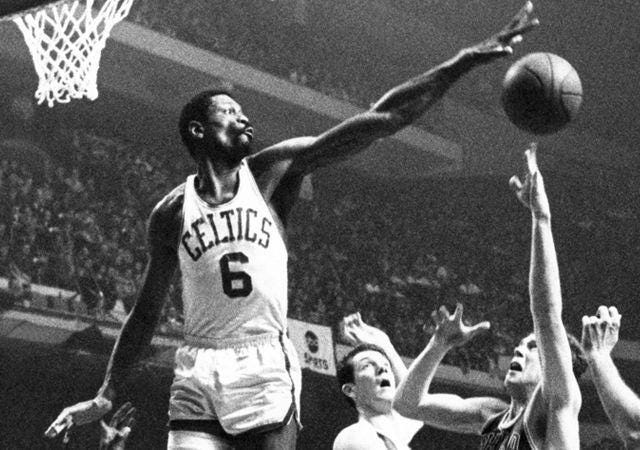
Bill Russell dominating with his blocking skills

Bill Russell is definitely one of the greatest players to have played in the NBA. After all, the NBA Final’s MVP trophy cannot be named after just any player. Bill Russell gave much to the game of basketball, both on and off the court which impacted the game heavily and revolutionized the NBA forever.

The first contribution Russel made was to the game of basketball on the court itself. Before Russell’s time, defence in the NBA was played quite differently. Players were encouraged to plant their feet on the ground and not jump when another player is going for a shot, lest you give away a foul. Russell disagreed with this form, he spent hours studying other player’s movements and game to understand how best to make sure he could shut his opponent down. He incorporated the jump into his defence, which allowed him to surprise the opponents and bring in a new aspect into the game. Initially admonished by his coaches for trying something so unorthodox, Russell fought against all odds and proved everyone wrong by becoming the best defensive player in the college basketball circuit while also averaging the highest number of blocks in history until then.

The second contribution that Bill Russell made not only changed the game but the history of Basketball. The period Russell was active in the NBA was also a time of huge turmoil in the United States due to the civil rights movement led by Martin Luther King Jr. Bill Russell heavily supported this movement as racism heavily impacted his career in sports as well as his personal life. While being an exceptional player in high school, Bill was offered only one college scholarship because of his race. He ended up playing for University of San Francisco as it was the only college to offer him a scholarship. Racism continued to impact him throughout his basketball career. In Bill’s 3rd year of college, for instance, despite averaging 20 points and 20 rebounds a game, and being the only player in college blocking shots as well as winning the National Championship, he was still not awarded Player of the Year in Northern California.

When Bill Russell was drafted in 1956 there were a total of 15 black players in the NBA. This was because there was a cap on the number of black players allowed in each team as well as the general racism in society, that made it difficult for black athletes to enter the sport. Bill Russell often spoke out against this rule of having limited black players in each team and the result was that by the time Bill Russell retired from the NBA in 1969, a majority of the league consisted of black players.

On and off the court, Bill Russell made massive contributions to the game of basketball and the NBA which would not make it strange to tout him as one of the greatest players of all time. No other player in history has probably contributed so much to the game as a whole, and it is only right to have the NBA Finals MVP trophy named after him to have his name set in the annals of basketball history.

Searching for Ashoka’s diversity: Myopic Miniatures by Priyanka Muniyappa

Nivedita Salar, Class of 2019

The Ashoka Art Gallery is currently running Myopic Miniatures, an exhibition of paintings by Priyanka Muniyappa (YIF 2018). The exhibition is a visual study of the plethora of insects found in and around Ashoka. The inauguration took place on Tuesday, 23rd January. It was an immersive audio-visual experience, where people could view Priyanka’s works as ambient tracks, composed by Karan Tuli (a member of the AAG Team), played in the background.

Poster for Myopic Miniatures | Source: Ashoka Art Gallery’s Facebook page

Priyanka’s paintings are done in muted, earthy colours. She tells me that most of it comes from her previous preference for illustrations. “I have always used black and white,” she says. This time, the subjects of her paintings forced her to step out of her comfort zone and use colours: “I needed to do justice to the insects.” This shift is evident in a lot of her works in Myopic Miniatures. Priyanka plays around with colours and textures to highlight or suppress different elements. For instance, she changes the colours of the backgrounds, creating them in grey scale, to highlight the brilliant colours of the insects. These colours become a little bit of Priyanka’s own touch in every painting. One of the paintings, “Dripping Like Honey”, features a snail with golden slime; “Jade Soldier” features a bug painted in a bright, jewel-toned emerald colour.

Priyanka also enlarges all the insects so the details are clearer to the viewer. This “blowing up” of the insects ties in with the purpose behind Priyanka’s exhibition; the creative process for Myopic Miniatures began after one of the many fumigation processes on campus. Priyanka recounts how she saw a dead wasp one day and decided to bring it to her room. On closer examination, she realised that the wasp was still alive. It was struggling in its last moments, frothing at the mouth. She felt helpless: “I just couldn’t do anything.” Priyanka professes that insects had always fascinated her, but after this incident she became keenly aware of the insect life on campus. She started out by photographing and recording these insects. As people learned about her interest, they began to tell her about the insects they found on campus; so there was soon a chain of people who were noticing the diversity of Ashoka’s insect life and, knowingly or unknowingly, preserving it.

Even then, a lot of the insects Priyanka would find one day would be dead the next day. She says that the fumigation is doing a lot of unintended damage to the insects, while the mosquitoes, even now, become resistant to the chemicals used for fumigation. People on campus are also unmindful of these tiny creatures; students would walk over insects without realising, or squash them if the insects so much as jumped on their arms. This lack of compassion for insects became a driving force for Priyanka; from tiny paintings and sketches in a journal, her works went to the full-fledged, multi-media exhibition at the AAG.

Image Courtesy of Ashoka Art Gallery

Some recurring elements in Priyanka’s paintings begin to make more sense as she explains this to me. For instance, there are recurring golden and silver threads winding around the insects’ bodies in many paintings. These golden and silver chains are representative of the fumigation that holds them prisoner. “Any of these insects in chains can die at any moment,” explains Priyanka. Another recurring symbol in the artworks is the third eye. Sometimes, it is hidden in the pattern on the insects’ wings; at other times, it is clearly visible as an addition. The purpose behind incorporating the third eye was to add an element of surrealism. The “eye” also represents the awareness of the insects. Priyanka narrates anecdotes where she felt like the insects were looking directly at her: “I’d look at them and they’d look back”. She felt like the insects were aware of her and were listening to her, giving her company. They weren’t just “creepy crawlies” that one could ignore as background elements. The third eye becomes a representation of the awareness she felt the insects possessed.

The experience of seeing the insects on such a magnified scale, with all their brilliant colours and patterns, makes me wonder why we are unable to see them everyday. Perhaps it is because we’ve forgotten to be mindful of things until they look us right in the eye. The fumigation process is a threat to Ashoka’s biodiversity, but so are many of us. A lot of the insects are out on the basketball court or in front of lifts, but we never realise when we walk over them and squash them to death.

The artist, Priyanka Muniyappa | Image Courtesy of Ashoka Art Gallery

Priyanka hopes that people take away feelings of compassion and empathy for Ashoka’s microscopic residents from her exhibition. She sums up her thought in a sentence when she says, “You are not the centre of the universe”. Seeing these artworks does the intended job of raising awareness about the dying insects. They are an important part of the natural ecosystem. Moreover, it is their land that we occupy. We should make efforts to be more considerate of the diversity that exists within the Ashokan campus — not just in the people, but in all living creatures.

Myopic Miniatures will be open for viewers for one month at the Ashoka Art Gallery (third floor, New Academic Block, YIF office).

Lightning’s Back: A solid new superhero

Srishti Agarwal, Class of 2019

The CW’s latest outing with DCTV, Black Lightning, premiered on January 16, 2018. It was their highest rated original series premiere in the last two years. On-campus viewers can catch it on Netflix, where new episodes will be available for streaming every week. Despite being from the same production team as the shows in the Arrowverse, this DCTV show is currently intended as being separate from them — a move to let it organically grow as a standalone show.

Promotional poster for the premiere | Source: IMDb

The show begins, impactfully, with an unapologetic and realistic portrayal of the injustice of racial profiling. Jefferson Pierce, a pillar of the community, has been working as the Principal of Garfield High School for the last seven years, and has been a retired superhero for the last nine. That’s right: unlike all the superhero shows currently on television, whether Marvel or DC, this show doesn’t glorify being young and reckless as the trademarks of a superhero. By focusing on the arc of a retired superhero living a family life, Black Lightning gives more of a The Incredibles vibe (sequel coming out this June; twelve years too late, but nonetheless). Pierce seems to believe that he can do more good as someone who takes care of his family and community than someone roaming the streets — a realisation that most superheroes seem to come to sooner or later in the DC Universe, *cough* Mayor Queen *cough*.

The show is set at a time when the rising terror of a gang, called The 100, demands the mask Pierce thought he had forgone. By beginning with this storyline, instead of leading up to it in a linear narrative, Black Lightning presents both an origin and a re-origin arc. The presentation adds to Pierce’s arc as it explores the storyline of a reluctant hero, which DC hasn’t done with its Arrowverse shows. Moreover, this allows the show to explore the pitfalls of being a superhero from the very beginning and skip the glorification montage. The first episode sets up a lot of interesting questions on the manifestations of violence — whether it is in the form of police brutality, activism, gang violence, or superheroism through vigilantism. The last question in particular seems to be one that the hero will be struggling with. Posing these questions in a city where violence is the truest, commonest factor in everyone’s lives elevates their importance and impact. These questions are raised and viewed in lieu of the supervillain this season, Tobias Whale, who is Black Lightning’s archenemy in the comics. The show employs the standard “personal enmity” trope along with a “does horrible things to the community” trope to establish this big bad. The cliche-ness of the villain seems to be one of the worst sins the premiere commits, but it’s too early to tell whether this indicates another Vandal Savage disaster.

A screenshot from the first episode

The performances of all the cast were realistic and greatly contributed to the impact of the premiere. The highlight, for me, was Nafessa Williams as Anissa Pierce, Jefferson’s daughter; she carried out the badass and softer elements of her role with conviction. The background score was quite catchy, though there were times when it felt forced. The cinematography struck a nice balance between the darkness that shrouds the activities of Black Lightning and the brightness of Pierce’s day-to-day life. The special effects felt a little unpolished, but, for better or worse, they didn’t appear too often. The overall feel of the show ends up being as dark as early episodes of Arrow, though the familial elements are reminiscent of The Flash.

We are in a time of change, where diversity seems to be a key factor in the popularity of new superhero content, whether it’s in terms of moving away from the white male as a superhero or the stoic standard that superhero stories try to hold themselves to. Black Lightning taps into the audience’s demand for something new while still holding onto the elements that make superhero stories compelling throughout the ages. Overall, while there is much development to be done on the plot points that have begun to be established, I’d give the premiere a solid 4 out of 5 for its ability to evoke emotions and grapple with a different brand of superhero.

Ashoka’s Edict is without a Pillar

This is our first Editorial, after taking over as the new team of The Edict.

Dear Ashokans,

Winter is a time for relaxation, introspection, wrapping up the year that has gone by and ushering in a new one. It is after indulging in the same, that we write to you, our first editorial after taking over as the new editorial team of The Edict. The beginning of the year provides an apt occasion to renew a promise, one that is perfectly put into words by Gulzar Sahab:

“Ahista chal zindagi, abhi kai karz chukana baaki hai.

Kuch dard mitana baaki hai, kuch farz nibhana baaki hai.”

(Move slowly, O Life, there are many debts yet to be repaid,

Some pain to be washed away, a few responsibilities yet to be fulfilled.)

However, before making any further promises, it is important to address certain well founded criticisms. We have chosen Gulzar Sahab’s lines for we realise that The Edict has fallen short of its pledge. To be a student newspaper requires careful reporting, incisive articles, a platform for airing all forms of opinions and most importantly, resilience. While we do believe that in the past we have failed to be whom we set out to be, we believe that The Edict has always remained resilient. With minimal audiences, far fewer writers, nominal praise and only token support (from the administration), The Edict could have shut down. Yet, the hard work and commitment of the previous editorial boards, ensured its perpetuity.

A new dawn is approaching our humble newspaper, and we hope to dust off the old allegations of being ‘biased, boring, qualitatively poor, quantitatively meagre and most importantly tabloid’ in nature. We are here to make The Edict an integral part of our campus.

Ashoka’s Edicts were inscribed on a Pillar. Our Pillar is you: the readers. The larger you grow in number, the more resilient our newspaper becomes. Our pledge is to ensure that we put out content not just to please audiences but to make them uncomfortable. The Edict shall be apolitical but shall offer a political platform. Debate, dialogue and dissent shall form our bedrock and we proclaim this far and wide. Let this be our undertaking to our readers and an invite to future writers. We shall strive to transform ourselves from being a ‘tabloid magazine,’ a charge often leveled against us, to being a full fledged newspaper.

It is also important to understand what a newspaper should be: when closing down as a mark of protest against the gag order issued by the British against the press in the aftermath of the Quit India Movement, the Indian Express issued a rather moving editorial by the name “Heart Strings and Purse Strings.” In their, so to say, farewell edition, they proclaimed: “The hard fact of the situation is that if we went on publishing, The Indian Express may be called a paper, but cannot be called a newspaper.” The Edict shall continue publishing. It will strive to be the robust newspaper that it set out to be and that this university deserves.

“Raftaar mein tere chalne se kuchh rooth gaye, kuch chhut gaye.

Roothon ko manana baaki hai, roton ko hasana baki hai.”

(In the swiftness that is Life, some are disappointed, some have been left behind,

The disappointed need to be made amends with, the distraught need to be made smiling again.)

This letter was directed towards Ashokans. Today, this refers to students (undergraduates and fellows), founders, administration and faculty, but in the future it shall evoke a sense of pride and excellence. In this future, that we are crafting together, The Edict forms an indispensable part. While the presence and flourishing of a meme group displays innovation, writing remains a noble pursuit of life, and the most important tool for articulation. The Facebook group can never replace the spot of a newspaper in any college campus, and the past year has reaffirmed this fact. However, it has been a failure of The Edict that so many had to resort to the Facebook group to raise important concerns that should have ideally been done through meticulously thought out articles. We are soon entering an era of less reading and more trolling, less absorption and more ridicule. In these times, only a newspaper can act as an antidote to the caustic comments that individuals have to face on their posts.

Let this be a reminder to those who might have forgotten that you do have a newspaper: if you wish to express an opinion, or even voice a concern (everything short of a rant, which after edits we promise to publish as well), approach the platform that you have created. While Facebook might offer an immediate venting ground, The Edict offers an opportunity of indelibility for it is only the written word which has the potential of immortality. We cannot be studying in a liberal arts college, taking multiple critical thinking and writing courses and not be devoting ourselves to reading and writing.

We have always believed that a carefully crafted letter can touch the right chords. This letter was meant to acknowledge, apologize, and reaffirm. We hope we have been able to fulfil the purpose with which we had begun this undertaking.

When the Yale Daily News, the oldest student newspaper in the United States started publishing in 1878, the newspaper’s first editors wrote:

“The innovation which we begin by this morning’s issue is justified by the dullness of the times, and the demand for news among us.”

Today, the editors of The Edict write:

“The Edict’s presence is a response to the unfortunate invasion of Ashokan discourse by a culture that encourages scrolling and ranting instead of reading and writing.”

We hope to assure our readers that we do take our work seriously, even though it might not have appeared so. As we step forward in this new year, here is our ailaan, which we hope to fulfill- by the year 2019:

1. At least 5 articles shall be taken from the Edict and published in external agencies

2. 100 students shall have contributed with at least one article

3. Faculty and founders writings shall become an integral part of The Edict

Kuch hasraatein abhi adhuri hain, kuch kaam bhi aur zaruri hai.

Aahista chal zindagi, abhi kai karz chukana baki hai!

(Some desires remain unfulfilled, some work is imminent,

Move slowly, O Life, there are many debts yet to be repaid!).


Signatories:

Nishant Kauntia (Editor-in-Chief)

Gauri Newatia, Himali Thakur, Ishaan Banerji, Aashay Verma, Ananya Damodaran, Arushi Jain, Zainab Ghafoor- Firdausi, Sparsh Agarwal (Managing Editors).

The Cost of Peace

I traded my empathy for peace. We all do.

I sometimes look at myself in the mirror and wonder if I did the right thing by putting up that post about gendered entitlement on Facebook. Was my tone too harsh? Was Facebook not the right medium to express myself? Should I just not have talked about the incident and only made my point? There is probably some degree of merit to all these questions, and I would really have appreciated perspective on each of these fronts. Sadly, the only criticism that came my way was in the form of memes and jokes attempted at trivialising what I was trying to say.

A meme shared by a fellow Ashokan

I am not going to take up time and space trying to explain why I believe that the incident was gendered. Mostly because, well, I don’t have the energy to engage in another one of those comment threads. What I really want to talk about is the manner in which I was responded to, which I believe stands in striking contrast to the kind of ethos that Ashoka, as a university space, represents. I had never expected everyone to respond positively to the post — in fact I was pleasantly surprised at how late a comment saying “this is not about gender” came up. And a large part of why I posted that statement in the first place, was to create conversation around it, because ever since I have been here, I get this sense from people at Ashoka that this is a place free of gender inequality and the problem really lies somewhere else. I wanted to initiate a debate about what I believe is one of Ashoka’s biggest problems. But fortunately or unfortunately, what I discovered was, if it may be possible, an even bigger problem.

I would not be writing this piece if I believed that this was a personal issue. Sadly, what I notice is that this has largely become our most favoured mode of interaction. As a student body, we have started not merely condoning, but in fact fetishising a manner of responding that merely trivialises others’ problems, without constructive engagement. And I do know that we all need a reason to laugh, and that laughter is infectious, but it often seems that our collective mindset, which is largely beginning to appear as a cultural attitude at Ashoka, is one that mocks at the concerns of others. Somewhere, in our heads, we have convinced ourselves that it is cool to joke about somebody else’s struggle or their adverse experience. And it makes me ask myself a question, which I hope all those who read this piece ask themselves: Are we becoming more and more feelingless? Is this the kind of community we wish to become? And why is it funny if someone cares about gender or caste or religion or the environment? Is it because we do not understand similar experiences?

For the longest time I believed that people genuinely do not get it; they just do not know. But then I looked inside and asked myself why any of this matters to me? Why do I call myself a feminist? Why did I ever put up that post? And the simplicity of the response surprised me. I care not because I’ve taken three courses with Professor Menon. Rather, I care because I know what it is to be afraid. I know what it is to be hurt. I know what it is to be judged. And I know what it is to be dismissed as irrational, as too sensitive, or as a matter of fact, throughout school, as too feminine. And I refuse to believe that there is a single person on this campus, who has not experienced, known and felt these things in some form or the other. Does that give us the knowledge or the right to claim to know or understand the experience of being from a smaller town, an underprivileged class or an oppressed gender? It does not. But it does give each of us the ability to get a sense of their experience, even if that sense is largely deflated. It makes each one of us capable of some form of empathy.

Another Meme made on the contents of my post

One would expect this realisation to make me feel optimistic. Blame it on the cynicism of someone who identifies at least partly with activism, but it actually really scares me. If each one of us is capable of empathy, where have we lost it? Why have we hidden it? Why are we sharing offensive humour when we could be shedding tears? All these questions are, as I am sure you can tell, rhetorical. Somewhere deep down, however powerfully we suppress it, we all know what is up. We have forgotten how to express and how to feel. We look down upon the ability to emote; we see it as a sign of weakness (another thing that is gendered, but for the sake of the 50 odd men whose blood boils at the mention of “gender”, let’s put that aside for now). But before we try to find some righteousness in our decision to celebrate hyper-rational, stoic, hypermasculine (at this point I slip these words in just to get under some characters’ skins) behaviour, let me, as someone who has for a large part of my 21 years been complicit in this celebration admit, that we do it only because it is convenient. We do it so that we can put ourselves to sleep at night and drown out the guilt of inaction.

When I was a kid, I would be moved to tears everytime I saw my mother unreasonably scream at the domestic help, and her (the help) stare at the ground in silence, forced by the limitations of her class, to suffer unjust humiliation. Over the years, I stopped caring and the tears stopped rolling. I found some explanation to convince myself that my mother was right and that the woman deserved it. I traded my empathy for peace. We all do. And the next time we think that everything is fine at Ashoka and people are just blowing things out of proportion, we should probably remember that.


Arush Pande is a 2nd year UG studying English at Ashoka and contributing frequently to The Edict.

Cardcaptor Sakura — The Clear Card Arc: A Review

Cardcaptor Sakura — The Clear Card Arc: A Review

by Himali Thakur, Class of 2019

The successful magical girl anime returns to our screens after nearly two decades. While the first episode is a great start, it raises questions whether the anime is ready to explore new domains.

Cardcaptor Sakura (abbr. CCS) was a wildly successful magical girl anime in the late 1990s, created by the manga studio CLAMP. After nearly eighteen years off air, Cardcaptor Sakura is back for a new series Cardcaptor Sakura — The Clear Card Arc.

Sakura commands a card; a shot from the original series | Source: Pinterest

The original series followed the adventures of Kinomoto Sakura, an elementary schoolgirl who accidentally breaks the seal of a book containing magical cards. The guardian of the Book of Clow, Kerberos, tells Sakura that she must now capture the cards lest they wreak havoc in her town, Tomoeda. I watched this original series as a child, so the anime was drenched with the nostalgia of ‘the good old days’. Cardcaptor Sakura was a good show even otherwise; the anime had beautiful visuals, good characters, and a fun plot driven by the development of those characters. Naturally, I had high expectations for The Clear Card Arc.

For the existing fans, the cardcaptor world feels like familiar territory from the very beginning; before the opening, Kero-chan gives a hurried rundown of the series in the segment “Leave it to Kero-chan!” — a throwback to an aftershow segment that ran with the first season of the show. The new series picks up a year after the events of the original anime. Sakura is now a middle school student; the cards are all secure, and we are assured in flashbacks and conversations that the supporting cast from the previous seasons are enjoying happy lives. Things have changed, but CLAMP drops us into a Tomoeda that is in sync with the Tomoeda of Cardcaptor Sakura Movie 2: The Sealed Card. But when Li Syaoran — Sakura’s elementary school crush — comes back from Hong Kong, things do begin to change.

The moment where Sakura and Syaoran reunite is beautiful. It has heartfelt dialogues, delivered with a truckload of nostalgia: the opening song from season three, Platinum, plays in the background of this reunion. But the visuals take the cake. Animation has changed a lot since CCS last aired; it has become softer, abandoning the heavy, dark, almost sketch-quality of the 1990s. This lean towards the softer style really works for Sakura and Syaoran’s reunion. Lighter shades of pink give the scene an adorable dream-like appeal.

Sakura and Syaoran reunite | Source: YouTube

Another scene that boasts fantastic visuals is the dream in which Sakura meets the antagonist of the series. Dream sequences are a favourite with CLAMP, and they have used dreams multiple times in CCS. These sequences would take place against the backdrop of the brightly lit Tokyo Tower. They imparted a feeling of hope and power, where Sakura would be reaching out for her new magical abilities. However, the dream in Clear Card is set in a dark void. Sakura hovers, defenceless, while the hooded figure is clearly in command. It’s a clever use of visuals to impart fear and awe.

With this scene, the first episode also neatly sets up the conflict for the entire season. A mysterious hooded figure turns all the Sakura cards clear, rendering them useless. Tomoeda is under threat from this entity. We are told that the coming together of all cards was just the beginning of the end, while new ‘clear’ cards start to appear.

Sakura reveals the new sealing wand | Source: YouTube

Despite this constant stream of new information, the episode does not feel overwhelming. In fact, the episode is cleverly written so that it functions as a jump-on point for new viewers. Short interactions between the characters reveal telling details about the story and characters. Touya and Sakura’s banter shows Touya’s caring side for his younger sister; Syaoran and Tomoyo’s interaction paints them as mature characters who care deeply about Sakura.

All said, the episode is not perfect. Despite the stunning visuals, the new sequence for sealing a card is awkward; the 3D animated crystal is ugly and makes me cringe every time. Further, we have no explanation as to why everyone in the show suddenly has touchscreen gadgets, even though it should ideally be the early 2000s. A landmine I see for The Clear Card Arc is a gimmicky and cutesy overemphasis on Sakura and Syaoran’s relationship, rather than the troubles it should naturally face. There is also a worry that the new series may refuse to do anything adventurous with the plot. Sakura capturing cards isn’t something new; it is a repetition of the first season.

I listed the similarity of the episode to the original series as a positive point, but it obviously has a negative side. It feels like the characters were caught in a time warp — they haven’t changed at all. This could be a problem for the future. To keep the show’s existing fans overdosed with nostalgia, CLAMP might choose to ignore the elephant in the room: Sakura is growing up. The series will have to face its characters’ growing pains at some point if it wants to remain honest.

However, these are either fixable or minor flaws in what remains a promising start for an already strong anime. Perhaps the avoidance of these issues is just throat-clearing that Madhouse (the production house) and CLAMP need before taking a beloved series into new directions. CLAMP has the ability to address these problems. They have already displayed, in works such as xxxHolic and Legal Drug, that they can work with mature themes. Hopefully, they will bring their experience to The Clear Card Arc, and keep the Cardcaptor Sakura series riveting and fresh.

Verdict: 3/5

The Edict’s AAA Election 2018 Coverage


Over the past week, we have had the pleasure of covering the Alumni Association elections with a Presidential Debate and Discussion and analysis of candidate manifestos. Here’s everything we wrote to aid you in the process of deciding who to vote for –

1) 6 Visions for Ashoka’s Alumni Association

A slightly poetic beginner’s guide to our presidential candidates, and their vision for the AAA.

#CandidateSpeak

We figured that not all of you will have the time to go through a 2 hour debate, so we turned the candidate’s answers to article format to give you easy access to the answers you seek.

2) On the Role of the AAA President

Q — What do you think is the role of the President of the Alumni Association? What will be your role in the next two years? What will be your first action item/executive order as President?

3) On The Relationship Between the Alumni and the University

Q -How do you view the relationship between the association and the university? Additionally, what do you think is the role of any alumnus towards the university, in our current stage of professional lives?

4) What Sets You Apart

Q — What is truly unique about your candidature? What sets you apart from the other candidates?

5) On Trust, Sexual Harassment and Mental Health

Q — What will you do to build trust? How would you engage with issues of sexual harassment and mental health?

6) On Their Manifestos and Promises

Perhaps the most important in the series, this is the part where Mr. Karan Bhola, outgoing president of the AAA, asks the candidates specific questions about the promises they have made in their manifestos.

A couple questions are yet to be transcribed, and will be added to this article as and when that happens. We hope that you make an informed choice for the future of the Ashoka Alumni Association.

In the meanwhile, we would like to thank Karan Bhola, Samyak Shami, Shivangi Tikekar, Vedhika Anoora Krishnakumar, Debayan Ghosh, George Jacob and Arunima Singh for making this all possible.