#CandidateSpeak — On Trust, Sexual Harassment and Mental Health

Transcribed below are answers given by the candidates in the Presidential Debate and Discussion organized by The Edict in collaboration with the Ashoka Alumni Association.

What will you do to build trust? How would you engage with issues of sexual harassment and mental health?

Jasmine Luthra

I think that’s a fantastic question. So how I see it is, when we talk about the community vibe, there is this friendship and love that transcends across cohorts, but at the same time we’re putting a lot of trust in these people who are, one can say, strangers on some level. And how do we ensure that this trust is not misused? I would like to address this with the two examples you cited, of sexual harassment and mental health. I think as it has come out in the recent few months with emails and the discourse at the weekender, sexual harassment is a big problem, not just at campus, in our community, but in the world, and we’re all seeing the watershed movement that’s happening across the globe. I think the first step towards this is building safe spaces where people can talk about these things. This was already attempted at the weekender, and personally for me, as an alum, to be in that session, and learn about those grim realities, it was quite a revealing experience. I have been personally very moved by it, and I’ve had several conversations with the administration about it, on a personal level, not as a council member, just personally. So I think that was something which was just initiated and we need to build on that — build these safe spaces at local chapter levels, batch levels, community, council level, wherever it’s possible. Aishwarya Muralidharan, who’s a fellow council mate, started something called Circle of Trust, which was her attempt of reaching out to people struggling with mental health issues, to give them a space. These guys have regular Skype sessions where they talk to each other and it’s just beautiful.

Coming back, there is a strong need to build sensitization on these things. A very actionable point is, I feel, that local chapters are something which can be involved in this. So maybe, in the funding to local chapters, set aside some funds which can be used in engaging professionals into this and conducting workshops for the fellows, and building a safe space where you can talk about these issues. I don’t have an answer on how do we solve this, but considering how passionate people are about this, I’m sure we can get these amazing people on our task force and start thinking about it. I know that we want to do a lot with the CASH committee, the university. Again, I’m not sure if that’s the best way to go. I would personally prefer if as a community we could get together, sort of build best practices among ourselves for addressing this, and then transfer that to the university to take it forward and replicate from our model.

Lav Kanoi

So to the first part, building trust. Trust is a very, very big word, and it’s the foundation, the fabric of society. One of the reasons people trust is that things happen as per expectations, expectations are met. So the first thing would be to define these expectations. So for example, when fellows, undergraduates, masters’ students, PhD students, become alums, they need to know how the alum body functions. Who do they go to talk to for what kinds of issues? What is the channel of action to be taken for a variety of things, mark sheets for example on the one hand, to references on the other hand, to starting an interest group; it could be a number of issues. So to define what those channels are. Second thing is, to have these processes in place by which those results are actually delivered, and have metrics in place to make sure we’re doing those things right. So for example, Gaurav, a little while ago, had spoken about mentorship satisfaction metrics, if people are satisfied with their mentorship. The thing is, if you’re able to then, track how, from a service delivery perspective, how the association is delivering these services consistently over the years, it will continue to build faith and trust in the system of the association. That’s one part of the building trust aspect. The second aspect about delicate issues such as mental health or sexual abuse. The former, this is by extension again, the idea of a family. But the family is a feeling, right? The ethos. Realistically, we’ll be at 2000 people in a very, very short time, in two years. We’ll be at 2000 people. It’s a very, very large number. How do we retain, how do we make the family feeling real? Again, using systems and processes that are delivering on their various mandates. So to have these little — this group that Aishwarya had started, I didn’t know about this, which is a shame, because I would imagine myself to be active and generally aware of what the association is doing, but I didn’t know of this. Maybe there was a transmission loss of some kind. But to have these kinds of fora where people can get together and support each other. A family is a family when it loves and supports its constituents. And so it must be with the association as well.

Again with things like sexual abuse, to an email that was shared by an alum last night, there are a number of things I think the association can do to make a sort of safe space, some of which have already been listed on that email. From holding gender sensitization workshops to having an ombudsman facility. Obviously the association is not a legal entity, so the association cannot take decisions on this but it can create conversation and dialogue in a structured manner for people to feel comfortable having certain issues. I think a 2014 batch alum just shared something on module wise or training workshops before people can graduate or something like that which can build a culture of openness and of trust even at the student stage. Alumni can play a role there as well. So for me this circle of trust is, building trust is, again, process. Process and systemic dependent. And we will continue to to build metrics, review processes to make sure that we’re actually delivering on all those fronts and as we grow in numbers that is what I think will continue to have the community keep its faith in the association.

Parushya

The question is actually addressing something more philosophically first. And so going in with that, the first person, very fundamentally, that we trust in our life would be our mom and then our parents, and our close family and then friends. And how does that develop? Breaking down that process it’s a lot bit of transparency we see. We trust our parents blindly just because we know that by de facto they are transparent with us and they are going to take whatever rewards or whatever outcomes come out of their action, that accountability part. And then it develops into fraternity where we have our friends. Going by that analogy, I think right now, in the association where we are going to be dealing with a thousand members, and soon enough there will be 5000 members in the coming six to seven years. At that point, again I think we have to again break this down fundamentally into the association. The association is like some — Transparency and accountability is something we have to push for. I mean, as Gaurav rightly mentioned, having metrics for mentorship module. Then, as Jasmine did mention about the point or any penalty and the trust that we already have. To harness that I think that is also going to functionally break down into batches and chapters. We feel more comfortable with people we share a common background of education with, or where we have spent some time with them, and also where we are living. So strengthening those batches and chapters is an essential part towards building broader trust.

Yes, there are critical issues regarding sexual harassment and mental health even amongst the alumni in their workplaces. And a lot of alumni in the recent times in their individual groups or amongst friends have shared that. We can come up with these resources, I mean, the task forces at the level of chapters, at the level of batches. But that’s going to be only effective when we get them together. The recent Secret Santa event for that matter, well it was just a gifting campaign where you met other people. The feedback was that people made a lot of new friends and not just across their professional imperative points but that’s also going to be some of those long lasting friendships where people can share these things so I think breaking these things down, localizing, even the fraternity, the localization of a support system is going to go a great way. And so getting the self sufficient local chapters, getting the batches to function, I think the batch reps initiative that was started by the first alumni council is a great step towards that and we have to further that more by building resources financial and functional to make them, I mean, not just as one off secret santa event or one off initiative but also the forums where people can come together, people can come actually talk about these things. So community, as I would feel is that Alumni Association or council cannot put all the thrust but right now the seed should be on developing these systems.

Simran Rana

When it comes to trust-building you tend to trust someone that you know. And I think that even in my batch of 200 people I’d be very honest, I don’t know everyone in my batch. But I still feel like whenever I think of someone, when I have to ask for help, something that I cringe about doing. When I know that it’s a fellow and even if it’s not someone from my batch I still have the courage to go and ask someone for help. And like Lav had said, when your expectations are met and more often than not, I do receive help and whatever I ask. So I think because it gets reinforced so often, I encourage other people to ask for help even if they don’t know fellows from other batches. And I try and be a good network for someone, like someone else was for me. And so I think that going further, we might not all be able to physically meet each other. As alumni keep increasing, our annual weekenders will not be able to have everybody meet everybody. So like Parushya mentioned that local chapters need to be very good at making people feel like, okay I’m from this chapter and I know people from my chapter. And that we should try and increase in person time as much as possible, and have, not events but have themes, that run longer than maybe one meeting or two meetings and that engage people for a longer period of time. So it could be any one thing, knowing your city better, and we could do that through a walk one week, or having a meal together, or planning a trip together. And in terms of virtually building trust, I think our app could help us there. So if we move cities can you automatically see which fellow is situated there in the city, and what’s happening in terms of this weekend or next weekend. I think that if we know fellows better then we’ll be able to trust them better.

And in terms of mental health and sexual harassment, I think that the conversation around both is definitely more open than other universities and that people are aware of at least mental health issues that they’re suffering from, and their vocabulary is I think better enriched than other people I know who are not from Ashoka. And that Ashoka is doing what it can to help people get better but I don’t think that the center for well-being is enough as it is. And that apart from doing workshops I think that it’s important for people to really understand the terms that they use and what depression really means. It’s a word that is very loosely thrown around and not properly understood. And the same way with sexual harassment, how does one recognize that one is in a situation of being harassed, what all does it entail, how you should protect yourself, or I mean things can get very fuzzy and I think that we should start from there in terms of better being able to understand things that we talk about so that everybody is on the same page in terms of what we think. I think that we can start there as a community.

Ashweetha Shetty

So I believe then you like any community, when you share a common identity then automatically there is trust. So I would better trust a young india fellow than someone, right? So basically, helping us to understand like, that identity and also building that connection in the sense, like building that connection how, in the way of reiterating our shared lived experiences. Like we all have same kind of lived experiences. I think if we have portals, we have platforms where we can share those experiences, I think trust can be built a lot more. And I also feel like transparency is the way to go. We need to be transparent about everything that is happening. Also, whenever I feel that a community, like I can trust a community when I see people like me that I can connect to, there are people who are standing there for me. So I think like ensuring diversity in that way, I think all these are ways that we can build trust among our own community.

In terms of very critical issues like sexual harassment and mental health, I think we truly as a community need to do something on that. And I also feel on these issues need a lot of expertise and also a lot of research to be done. And for me, if I would have to take a decision on that, I would actually start or create a task force around this and get all the alumni who are having some kind of experience and also who have lived experience, like create a diverse group, and then start addressing these issues and create something very unique for our own community. And in terms of mental health, I think like given I have TA’d for Dwight and Professor Kenwyn, there is so much of help I think alumni can do in terms of helping the current fellows. And even in alumni itself I think because we are a community of diverse people and lot of people are going out and reaching much in their life the others would feel there is a lot of mental health issues in the alumni community as well. I believe that really taking external help and learning the best practices that is happening across the world, I think that is something which I would personally want to do.

Gaurav Mohta

So I’m saying that the key way to build trust within the community, within the ever-growing community, is to be as transparent with your decision-making, with what you’ve delivered so far, and what you intend to deliver in the future. So this is the primary way that you build trust within the community. Secondly is to be responsive to the alumni, you know, alumni issues and requests. For example, I stretch it with the sexual harassment point. Let’s say somebody comes up to the association with a case of sexual harassment, right? This might not even necessarily be an alumni, this might be a student. He or she might have approached the university administration but nothing would have been done there. So we need to ensure that firm action, firm and quick action is taken on that. And to substantiate on that you know I am being part of — I’ve led the creation of an anti-sexual harassment committee in my office. We did this proactively after the recent incidents which came into picture and we did this proactively and there was a — there was one case which came up. It was not really a major case of harassment but we ensured that corrective action was taken against the employee and he was fired within 24 hours, right? You cannot hold on to such issues, you cannot form committees after committees and hold such issues or weeks and months together. You need to take firm and quick action. So that these are two ways that you build trust with.

And the second part of the question is how do you handle issues like sexual harassment and mental health. I think one of the — so for sexual harassment, how you handle it on campus is going to be very different then how you handle it for alumni who are not on the campus. When on the campus you need to first gauge what the current situation is and the best way to do that is via both a qualitative and quantitative assessment. We can float surveys and understand how many people are aware about the existing policies including the redressal policies, right? So if people are not aware about that, that is the issue I’d like to tackle first. And if people are aware about that but still not approaching the administration, let’s say, then that is another — that is a different problem. Then I’m looking at that problem in that light and attack it from there, right? So we need to first gauge what is the extent of the problem. Similarly for mental health as well, like what are the reasons for mental health issues cropping up in campus and outside. We need to be aware about that, whether it is career related or whether it is about a relationship going sour or whether it is about, let’s say, a family member being lost or you know you not being happy with what the community around you looks like. So we need to understand all of those things and then prioritize them in order of how you can fix them, right? And having worked at a healthcare startup and actually, one which connects doctors and patients online as well, I’ve seen that a lot of people respect privacy, they want others to respect their privacy. And for mental health issues I think an online consultation platform like …(inaudible) would be a good place to get professional help from. And I mean independent of what happens in the elections, I’d be happy to enforce that partnership with Ashoka for the students as well as for the alumni body.

We are deeply thankful to Shivangi Tikekar from the UG’17 batch for transcribing these answers.
#CandidateSpeak — On Their Manifestos and Promises

Mr. Karan Bhola, the outgoing President of the Ashoka Alumni Association, prepared one question for each candidate specific to their candidature and manifesto. Here are the questions, and the candidates’ answers to them.

Gaurav Mohta

With respect to the fundraising that you’ve spoken about, what is your plan towards generating the corpus amount that you indicated by 2020? What do you think would be the biggest challenges for you in reaching this goal?

Karan, you rightly mentioned that the fundraising metric that I mentioned is very ambitious. 1 crore by 2020, while other candidates have set that target for 8–10 years. I think this is very achievable, given my past experience with fundraising. In the first alumni fund that we created back in 2013, we collected over four lakh rupees within just the first two batches. So what I think needs to be done is two things: one is constant engagement with the alumni community. Right now it’s a one-off gifting program which happened during the course of the Alumni Weekender, so constant engagement like Karthik Gulati put up a video where he said that 50 students called up all the fellows to invite them to the weekender. So why not those engage with the alumni body even in terms of fundraising? Secondly, donor trust founders and trustees and other stakeholders. In fact, I want to announce it right now, I have a commitment to Rs. 10 lakh from one of the founders, a gift matching commitment. These things make me believe that we can achieve you know the one crore target within the next two and a half years itself.

Simran Rana

What would be an actionable plan in terms of engaging with communities outside of Ashoka, especially in the context of fundraising and events? External engagement is one of the key mission areas of the Association and I would be very interested in understanding how you plan to enable this.

From what I understand, the Alumni Association is mainly to raise funds for the university that it’s is associated with, and to help the alumni. Also, the Alumni should be able to give better opportunities for people who will graduate after them. So, I felt that if the local chapters have to become independent and the Alumni Association has to become financially independent, then can we in a small way start having events that fundraise already with the talent that the Ashoka community already has. Local chapters can start hosting events which are talent based, which would be musical shows or plays, and could invite people that are outside of ashoka community in the form of either tickets or food or something simple so that 1) there would be an audience to YIF and also 2) it would widen the kind of people that we meet. I see that YIF people and Ashoka people become too comfortable with each other and then find it very difficult to engage with people outside the community. In simple terms, if the events that YIF local chapters have where only YIF people are called, it could be a plus-one event where you get a friend or someone who is not a YIF just so that you meet people outside of the 10–15 people in a particular city.

Ashweetha Shetty

You’ve put out some great ideas about how to make of the alumni accounts transparent, talking about getting ten different alumni to be part of it. How you would go about implementing this? What would be some of the criteria you use for identifying diverse alumni?

What I mean by diversity in the first place is gender, social class, opinions and so many so many other ways I define diversity. We all know from our experience of the fellowship that diversity works. When diverse people come together then great ideas come and all voices are heard, so I think that’s my that’s my mission. There are very similar voices I hear all the time from many task forces or the meetings which we have. I believe if we could include that diverse voice, that will be great. The criteria for selecting that diverse voice will have to come from the alumni community, but I also feel that I have certain ideas about how this whole thing works — just inviting them to absorb conversation so that it is is it is because very conscious for us that there are diverse people sitting there so our intention is to hear all the voices and to take decisions after that. I think that’s that’s my intention of putting diverse voices and I personally believe in Drive diversity. It really has been my personal value, and I would love to see that reflect in the Association.

Parushya

There’s this really cool idea that you’ve spoken about — Alumni Hour, where twice every month people will sign up to sit with key decision makers of the university to discuss the functioning, resources, concerns etc. How do you plan to implement it? How do you think this will feasibly work, on a consistent basis? If you are talking about senior administrators and faculty from the university, getting them every month twice would not be an easy task.

Sure Karan. I think you’re bringing a lot on board here with your experience about the challenges that come with such an initiative. I must admit that it’s an ambitious baby step that we’re talking about right now. Yes, the founders, the administration and the broader alumni community are all awfully busy. So just from a very functional perspective, it’s going to be setting up more of an engagement platform for later on. Every month twice is going to be for once let’s say the UGs, the other time CASH, and then next month’s will move on to another department like GCWL. So you’re engaging them and channel I think this is going to be a challenge except but I think the broader e thousands that this will bring people into a zone where they they can raise their individual views and not get bogged down by a broader conversation and making sure that they are on the right side.

Logistically, we have had town-halls during Ashoka times. The founders and senior management do take time out for a or for a mentorship session. I think it’s all about channelizing that energy into a more structured form where we can also let alumni engage on their own individual views. Also, it’s not always about the head of the admin being there. We can also get representatives as proxies. That is where the accountability part comes in, that those views are communicated to the relevant people and the Alumni Office. It is an ambitious step. The new council will require your support and also your experiences with you but it is going to be a functional thing.

Jasmine Luthra

You’ve spoken about mapping each alum to the nearest local or regional chapter by July 2019. Considering that you have been on the council and you’ve seen how difficult it is to maintain and update a database, how do you think you’re going to achieve this goal?

As we all know, we are moving towards numbers which are just unimaginable, so you can’t have things happening in Delhi or Sonepat. So we need to move towards decentralization, we need to have local chapters. Now I know it will be a challenge and somewhere I’m going to bring this to the community because we can create platforms but they have to engage. Eventually, the local chapter mapping and major communication has to move to the portal, so the portal should be the Facebook for all of us. Based on the information that we have, we will try to map everyone to an existing chapter. I plan to launch an lot of chapters during my tenure. The aim is to have a chapter in every city with five plus alums, or have regional chapters like the east coast or the west coast in the US, and map everyone at once based on a location they provided to us on the portal. Then it should be a rooster thing happening periodically. We should also really encourage alums to update the portal when you move cities the way you update your Facebook. (Cut off there for time constraints)

Lav Kanoi

Given that you work at Ashoka University and in the office of the Vice Chancellor, how do you plan to tackle situations that might arise, where there is a different viewpoint that you build consensus on (with the council and the alum body), while there might be a different administrative view?

To get to the heart of the matter, it’s a symbiotic relationship. The question presupposes that there will be conflict between the Association and the university or the administration. I’d like to point out how the debate today began. I said that this would be a symbiotic relationship. I think on most occasions there should be a degree of parallelism because really it’s the same interest. Our strength is the university’s strength. Occasionally when there are differences again, there are two different routes. I don’t see this being a problem at all. On the contrary, I see this position as being a strength to the alumni association because I have the university and its processes well understood. I’ll be in an influential position to actually build consensus with the administrative staff as well. Second point is that the role with Pratap is on for another nine months or so, that’s that’s the the visibility we have at this moment. Who knows what’s going to happen after that? This is the critical period of the next council, and I’m hoping that in these six to nine months, we’ll be able to set up those processes and systems that I spoke of earlier. It will actually help us become a thriving family which I so hope that we will be. In summation, it’s a strength.

#CandidateSpeak — What Sets You Apart?

Transcribed below are answers given by the candidates in the Presidential Debate and Discussion organized by The Edict in collaboration with the Ashoka Alumni Association.

What is truly unique about your candidature? What sets you apart from the other candidates?

Jasmine Luthra:

I’ve worked on the interim council and the founding council. I have the insider’s view, a deep understanding of how things work, what are the gaps and what needs to be done. Although new energy must come in at this nascent age, I think having some continuity would have its own advantage.

Lav Kanoi:

I have had the experience of working in varied fields like Business Consulting, Government Advisory, Teaching and Research. In addition to the various languages I speak, I’m also familiar with ‘languages’ of the fields I’ve just mentioned. I have made sustained contributions to the Association and the larger community. As chapter head, I’ve worked and delivered on a number of different initiatives. I am uniquely positioned in Ashoka. At the moment I am a part of the Vice Chancellor’s office. My position and proximity ensures that the right systems and processes get integrated with the larger university.

Parushya

I’ve closely engaged with more than three batches: my own batch and the batches post mine. I’ve taken advice from all the batches during the course of making my manifesto. I consider my ability to collaborate a strength. Tangibly working with international universities, I’ve seen and studied the stages of development of Alumni Associations. I believe that with the help of both these qualities I will be able to achieve the common vision that we all have.

Simran Rana:

I’m not the most illustrious candidate running for President: I haven’t been associated with the previous councils. I’ve only been associated as a TA a couple of times but just like all the other candidates I have a lot of integrity and a lot of heart. I think that I would be able to bring in something fresh and a little bit new. I’m an outsider who does not exactly understand what the Alumni Association really does. I’d like to figure that out for myself and for a lot of people like me. I think my running for President will always be in the direction of involving everybody and reengaging with people who are dropping off of our radar and bringing them back

Ashweetha Shetty:

After the Fellowship I’ve come to Ashoka every single year. In the last five years I’ve interacted with several fellows from diverse backgrounds. I’ve understood what an alumni community means for others and for me. I feel I am someone who is far away from Ashoka in many ways. I work at the grass root level and I think I have a very unique perspective of looking at Ashoka. I add a lot of diversity to my batch and I want to ensure that it exists in all platforms. I am from the second batch and we experienced a lot of soul. This got diluted over the years and I want to bring back some of those things. These are some of things that make me very unique to this position.

Gaurav Mohta:

Over the last two years the current Association has done a wonderful job of setting up and strengthening the processes and systems of university and alumni relations. Things have improved since 2015–16. While we need to ensure that there is continuity in terms of what was planned we also need to accelerate the impact. The first council laid the foundation to create but we also need to consider the different viewpoints among the alumni, the fast evolving priorities of the university and the association and the virtual boundaries we have or will create for ourselves. I call this process driving on the highway. I’ve been a part of three early stage startups and I can say that we will make mistakes and even big blunders. It’ll be important to remain humble about making mistakes and openly accepting and learning from them. This will allow us to move forward in the right direction keeping the community’s trust intact. My key strengths are empathy, influencing without authority and my experience of leading multiple large and diverse teams through challenging situations at work and outside as well. I think these skills would be very useful to the association in its current stage and structure.

We are deeply thankful to Samyak Shami from the UG’19 batch for transcribing these answers.
#CandidateSpeak — On The Relationship Between the Alumni and the University

Transcribed below are answers given by the candidates in the Presidential Debate and Discussion organized by The Edict in collaboration with the Ashoka Alumni Association.

How do you view the relationship between the association and the university? Additionally, what do you think is the role of any alumnus towards the university, in our current stage of professional lives?

Parushya

I think this is there in the minds of all of us right now. To define the relationship between the alumni association and the university right now — not disagreeing that we have been financially dependent on the university and moreover we have all came from the same ecosystem so we have emotionally attachment also. Right now at this juncture what is important is once we are trying to develop into an independent body, one that is even related to Ashoka but also has a distinct voice on its own functioning and even on matters which are pertaining to the university but do affect the Alumni. I think the first step is that we define a thumb rule — that what are our terms of engagement. How are we going to be engaged with the university and that is coming right from the preamble, right from the ethos of the Alumni Association. That it is about first the alumni — every particular Alum matters here. So if something in Ashoka matters to alumni — something going out in the media, or just being reported, but even if a single alumni feels about it, we have to go about with addressing that — giving every Ashokan a voice right now, because, lets accept it, right now we are stakeholders who are not invested in terms of funding the university, but we do have a voice in terms of having it like as an alumni who has studied there. As the previous batches are coming to the university in terms of mentorships and in terms of jobs. So at this juncture defining when we are going to interact, when we are going to say things.

Answering the second question, I think that all alumni are at different stages in their careers and their lives. But it’s not just about money or network. I think it ranges across 4 distinct classifications which I would put as individual alumni to the university in terms of money, talent, network and time. Some of us work as TA’s while others bring jobs here, some of us work in fund raising while others work with connecting our own organizations and building up the university’s upcoming batches base for them. Those are 4 distinct characteristics and moreover a single alumni should also be able to contribute even a single opinion. Like what I mentioned in my manifesto is about Alumni Hour where every single idea and voice should atleast get a platform to be heard and pondered upon. I think across those four areas — money, talent, network and time; and having a distinct platform to put forth opinion — that is how we play a role right now at this juncture as alums.

Simran Rana

So how alumnus have their relationship with the university is definitely one that feels homely and coming back home, which is why I think a lot of YIFs and undergraduates keep coming back to Ashoka in whatever capacity they can — as TA’s or ASP programs — because we can’t get enough of Ashoka and I don’t think that anybody has a better education experience in their years before because it’s so welcoming and you feel like everything that you say is heard which is why I think that most of us are more vocal than we were ever in institutions that we’ve been associated with before. And I feel that, again, like Parushya has already spoken very well, that none of us have very well established careers right now but I think that in whatever we can contribute, even if it is being a good connector in terms of “Oh I know this person from this batch and he/she will be able to help you” Just helping people meet people from other batches or just across our network would be a great way to connect with our university. And also that we should continuously give feedback to Ashoka and scaling up and every year they have new challenges and something that worked 6 months ago doesn’t work anymore — bigger classrooms, too many electives, not enough classroom space and I think the task force was one very successful thing, when it did work , and even if there is time when we should engage with Aniha, or any professor or even YIFs or UGs on campus in terms of saying what we think and keeping the conversation going.

Ashweetha Shetty

For me, I feel my hope for Ashoka Alumni Association specially was to be a really critical voice in shaping in the institution — a really critical voice. Every single decision we have to earn, for sure; but that’s what I feel is the relationship that I am hoping for — is to be that voice which will help the institution forward. I think we as alumnus know that things like diversity works in fellowship and we need to include people. These are things that we have seen so it is important for us to be that voice telling the institution that this is working and this isn’t and this is where we are.

I also feel that as alumnus where our contribution could be is that — especially when it comes to YIF — we are going out and doing great things, travelling the world, studying in different universities, and I think if we can get back those best practices to really build the institution and also contribute in any ways possible because this institution needs us as it has just been 7 years. Basically in terms of getting the best practices and contributing as much as possible in the initial stages to really build the institution, I feel that every one of us can do something.

Gaurav Mohta

I think the primary objective of the Alumni association should be to act as a bridge between the university and the student, the alumni and the community — to help alumni be connected to the university irrespective of where they are in their lives right now. That to me is the most important role of an Alumni Association. And when we talk about the relationship between the association and the university, I think the association needs to ensure that it is in alignment with the university’s goals and other priorities at any given point in time. For example, one very important point that Lav mentioned just now was that probably at this point in time the university needs us to go out and be the brand ambassadors, champion the university’s cause. So I think the association needs to be in the alignment with the university’s priorities and at the same time — this relationship is something which will keep evolving over time. For example, we are at a very nascent stage right now as an association and I don’t think we are in a position where we can call the shots on most of the things that the university does. We can obviously constructively engage with the university and the administration, including the founders, put forward our concerns and provide constructive feedback. But beyond that I think that at the moment, we are not in a position to drive decision making significantly. In probably eight to ten years down the line, we might be there, and that should be the target the Alumni Association council should work towards.

To answer the second part of the question. I think one of the roles of alumni is to be that of a role model and mentor to the current students. Being such a young university where the numbers are increasing significantly year on year — it is very important for the alumni to come back and give back as much as possible in terms of their time and putting in more efforts to get more internships, more ELMS, careers opportunities; and high quality ones — we need to be mindful of that as well. So I think along with that, like I mentioned in my response to the previous question, that they need to be brand ambassadors and champions for the university at this point in time.

Jasmine Luthra

So, I have seen that the university till now has been very forthcoming of the association. Likee if we go back and remember in April 2015 when the first Alumni event happened at Ashoka, it was the founders especially Pramath who got all of us together in the MPH, got us to brainstorm and start thinking about the Alumni Association. And that is where this idea germinated and then turned into an interim council and the first council and today we are here.

Even in the last 2 years as a council member I can say that the university has been extremely supportive. They have tried to involve the alumni in almost everything that happens on campus whether it is events or the orientation of the new batch or getting us as TA’s etc. You do feel that there’s always a space you can go back to. I also belong to a college in Delhi University but you know the kind of warmness and welcome type of a feeling you feel at Ashoka is very very unique. Now, coming back, we are in a very unique position because I believe we are one of the few universities in the world which is so young and has an Alumni Association. If you look at most of the Alumni Associations in other institutions they are usually composed of many senior people who are at the top of their careers. They sort of contribute in terms of giving direction and money etc to the organization. So in that sense we are at a very unique position and I think we have made a lot of progress in defining a role for ourselves. And yes, we are not in that position in our life that we can contribute financially very strongly, but all of us have gotten together and built this culture of giving back, as Parushya said, at an individual level, as a TA, in terms of getting our companies to hire at Ashoka, the ELM clients, work as council volunteers so on and so forth. So this role is sort of already in the making. We definitely have to work towards strengthening the show and making it more streamlined and ensure that every alum is a part of it. The other role I see for ourselves as alums of Ashoka and the Young India fellowship and the undergrad program is that we are also torch bearers and kind of the representatives of the university for the outside world. So how we conduct ourselves at our workplace, in our social lives, how we engage with other matters of the society kind of reflects back at Ashoka and we have to be mindful of how we conduct ourselves and contribute to building the credibility that Ashoka already has for itself. I would also like to address the elephant in the room. So, I know that in a lot of conversations I feel that line about giving back to the university or being involved in matters kind of blurs a bit and it transcends over to the administrative issues of the university which in the general sense are not considered “matters of the alumni”. But of course we won’t comply to that convention because we are not conventional. I really support it. I think it is great that we are critical of everything that happens at Ashoka and it just goes on to show that we support and love the institution. Our Liberal arts education is coming to play where we are thinking about things, critical about things and we want to be involved in each and every thing. In all these matters I mean. But at the same time we have to be a little mindful of this. Of our actions. I mean, I’m not saying that we shouldn’t be critical, we definitely should be. But we should definitely go back and reflect and try to think as a community on how we want to do these engagements. Now one thing is to sort of point fingers, but the other thing is that harnessing on the diversity and the backgrounds and the experience that we have, we can get together, have honest conversations and actually build sort of consensus on especially the controversial and political issues. Just come together, collate our opinions, unpack and more meaning fully contribute to the discourse.

Lav Kanoi

2 words –symbiotic relationship. We are strong when the university is strong and the university is strong when we are strong. In our progress is the university’s progress and the university’s progress is our progress. Secondly, the other word I would use is a theme, so to speak, is family — a family of love, and pun intended. This is not to say that we don’t be, as Jasmine said and a bunch of others have also said, be critical. We do have our different opinions, we will create a different identity, but we will do this in a constructive manner. So the relationship of the association and the university is to be in a constructive partnership for each other. Play a shaping role, but within an ambit of the association. This is something that requires more conversation. Jasmine for example already pointed towards this issue, the elephant in the room she called it, about how we define the scope of the association. It has something that would be strange to have a say in — for example faculty recruitment. And there would be issues for us to not have a say in it. So someone had raised an issue of workers’ rights. In my year at the fellowship there was an incident that had happened, me and a bunch of fellows had gotten together and first spoken of these issues, and then the contractors were forced by the university to provide safety harnesses for the workers. So things like that are constructive kinds of conversations that we should and necessarily must have.

The second thing however, and the institution is supporting this, is for building a distinct alumni association, distinct identity, Because I think our founders, the administrative body, and the leaders that the university has had in people like Pratap, Shankar, Mahesh and the entire people who are leading the university now, and the remarkable founder cohort, is that they want us to be independent. And this points me to the second questions — What is the role of the alumnus towards the university? It is simply to be the best that we can be individually. We are the greatest, as it were, missionaries, advertisements, flag bearers — call it what you want of the university. So when we do what we do with heart, we will be upholding the university’s ethos. If this requires criticizing the university so be it, but we shall do it from a position of love and family. That would be my position on this.

We are deeply thankful to George Jacob from the YIF’18 batch for transcribing these answers.
#CandidateSpeak : On the Role of The AAA President

Transcribed below are answers given by the candidates in the Presidential Debate and Discussion organized by The Edict in collaboration with the Ashoka Alumni Association.

What do you think is the role of the President of the Alumni Association? What will be your role in the next two years? What will be your first action item/executive order as President?

Ashweetha Shetty

I believe that any leadership position has to set the culture and the values of the institution. So I believe in the last two years we have not done much on understanding what is our shared culture and what is our value and what we stand for as a community. I think my role as a President is mostly on that- really understanding what is the value system we hold for ourselves and on that basis I wrote my whole manifesto.

My executive decision, if I become the President, will definitely be reaching out to all the alumni and really coming up with a solution to understand the values we hold. For example, transparency, diversity, inclusivity are the values I feel are already there. What more values are there? How can we make decisions for the future? I think that’s the role of a President and that will be my priority.

Jasmine Luthra

So how I see the role of the President is to sort of set the broad vision, set the broad direction in which the association is moving. Secondly, as an association we are dealing with three stakeholders. One is the University. Second is the community. Third is the outside world. For me, I see the President as setting the ethos and the relationship between these three communities and managing these three stakeholders and making sure how to keep everyone engaged. The beauty of our community is the love and the vibe that we share. How do we harness that, how do we harness our diversity and collective experiences and take it forward for each one of us. In the next two years, there is a two-fold role for the President. One is that the first Council has already done a lot of work. So taking that forward, at the same time, there were some lapses and gaps and issues that have come up in the last two years, how to address those and keep everyone engaged and set the tone for the future.

My first executive order would be to first to take forward from where the council left which is at the last weekender these two task forces were announced- the diversity increasing task force and the gender and sexual harassment task-force and the charter of these two task-forces have been in the making. So my first executive order would be to launch those two task-forces and get them started.

Lav Kanoi

So a couple of other candidates have mentioned this. The Alumni Association is positioned between various stakeholders. The first and foremost is the Alumni Body, then is the University and then you might say is the larger world. But within the University as well there are multiple (as it were) stakeholders- existing student body, administration, faculty and such. The role of the President as I see it would be to first and foremost to build consensus in a participatory manner about the scope of the Association. What does it mean to say that the Association mediates between these stakeholders? What are the different areas that the Association can actually effect action upon and where can it actually speak, what should be the protocols of speaking, how do we build those systems in place?

As a result then, I think the first executive order is to define the channels by which this would happen. This would involve for starters the communication protocols, both for sending messages out to the larger community and for inviting opinions in a structured cohesive constructive manner to be able to arrive at a largely consensus. The larger role of the President of course to my mind the Manifesto role descriptions have already defined this is to represent the Association but more importantly I think its about continuing to bring the community together. My personal point of view is that the President should be able to personalize what we are calling the family of Ashoka. So it’s about creating this family feeling and bringing everyone together in this respect.

Parushya

The role of President, as I have been able to understand, is that of a facilitator and someone who sets the vision of the community and the Alum Association. Every other individual, every person in the Ashokan Community. In the end it shouldn’t be something where only a particular view is harnessing more traction. Getting a facilitator role is the prime importance we should place on a President’s order.

Now about the executive order. I think something that was mentioned yesterday that did move a lot of us was the mail by the alums about the gender and sexual harassment issue on campus. While there is a case of prerogatives where the university stand and where the alum Association stand. But even in the case of alums the first thing would be how do we build a support system? How do we set things right on campus? A director from the alum council going ahead and involving with the issues raised on campus- that would be the first step I would really want to take there. The CASH has to be strengthened by the involvement of the alumnus. Someone from one of the batches mentioned that right now whether there is CASH or broader community, we do need a lot of training dealing with sexual harassment cases. So I think going ahead and involving the alumni who have the training and experience would be the first priority.

Simran Rana

I think as the President of the Alumni Association, my role would be one to really set the tone in terms of what the Alumni see themselves play in our organization. I feel that we don’t understand our responsibilities and the roles that alumni can play in building Ashoka, and must set a strong base on what we can and cannot do as Alumni and how we can better contribute to our community. There are things that we can’t change and what those things are needs to be more clear.

I feel that one thing I would like to do from the word go is to try and have a conversation with every alumnus possible to really understand what they understand by being part of the Alum Association and what they think it means to be an alumnus and what they think the Association does, because I feel there is a lot of mismatch in the two. So one is to really clear the air I feel that there is still some confusion as to what the Alum Association can do.

Gaurav Mohta

I think the role of the President of the AAA is primarily that of a builder as well as that of a hustler. Consensus- builder because the President needs to keep being a hustler throughout the process and at the same time ensure that there is effective communication happening. I use the word hustler because a President should do whenever whatever wherever is required to help other members of the council to function more effectively. Absorbing pressure. I think the role of a President is to help his team function more effectively. That’s how I’d define the role of the next council.

Things I’d like to do are strong integration between programs at Ashoka and between different batches. I think one of the things that has not been done effectively so far is the inter-batch and inter-group connect. If you look at the Whatsapp group, the UGs are not present. If you look at the mailing list, it’s hard to reach out to the UGs. Being in the first batch, I’m not connected to those in the 2016, 2017 batches. And I’m one of the most connected people in my batch and if I’m not connected, then that’s an issue. So this is one of the first things that I’d like to do as part of the council.

We are deeply thankful to Vedhika Anoora Krishnakumar from the YIF’18 batch for transcribing these answers.

The Alumni Association Elections: All You Need to Know

The Ashoka Alumni Association (AAA) Elections are back this year. The first elections for the Alumni association were held in 2015. This time, the first batch of Ashoka undergraduates, who are now officially considered alumni, will also be participating in the elections.

The Student Government set up an Alumni Relations Ministry recently, being lead by Samyak Shami, second year undergraduate at Ashoka.

These developments would naturally prompt questions regarding the who, what, why of the elections and the body itself. The Edict is here to decode.

The dates of the entire election cycle are:

19th December: Nominations Open

26th December: Nominations Closed

29th December: Campaigning Begins

11th January: Campaigning Ends

13–14th January: Voting Days

What is the structure of the Council of the Ashoka Alumni Association?

The Alumni Council of the AAA constitutes a President and six other elected Directors.

Who is contesting to be a part of the Council this election cycle?

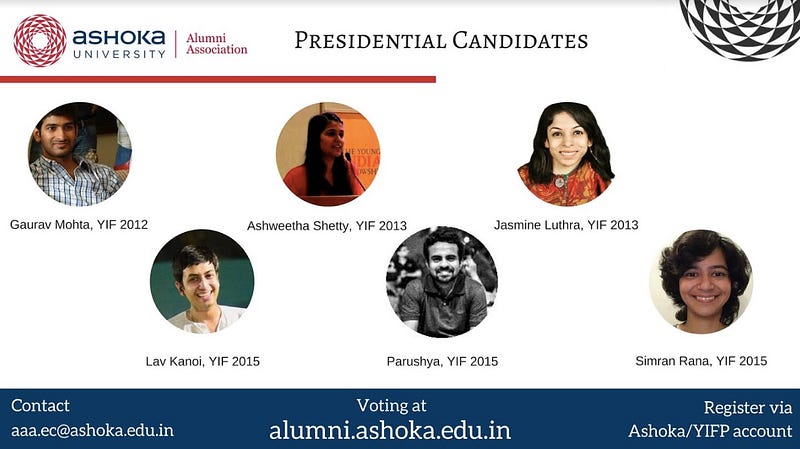
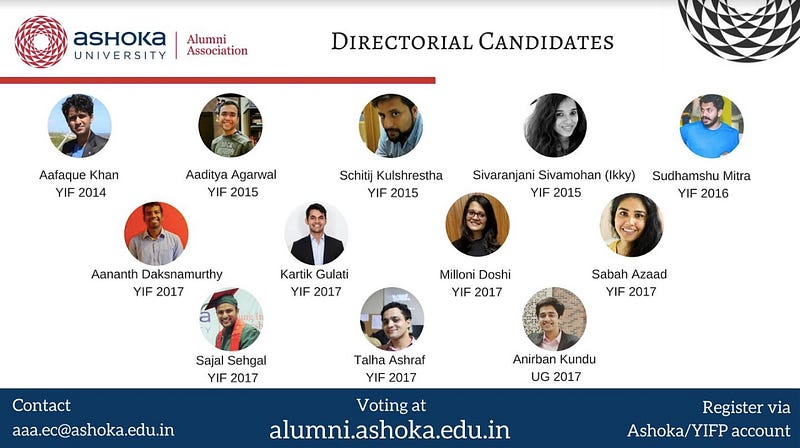
Here is the official list of candidates –


Who are AAA Batch Representatives?

Ashoka Alumni Association Batch Representatives are also nominated and voted for alumnus but are not members of the AAA Council. They simply represent the interests of the batch of which they are members. Each elected individual represents one hundred alumnus from his/her batch, hence smaller batches of YIFs would require only one representative (minimum number of representatives for an undergraduate student batch is two since the founding class comprised over a hundred students). An alumni who has pursued more than one academic programme at Ashoka can only contest as a member of one batch in a particular election cycle.

Which alumnus members are contesting to be Batch Representatives this election cycle?

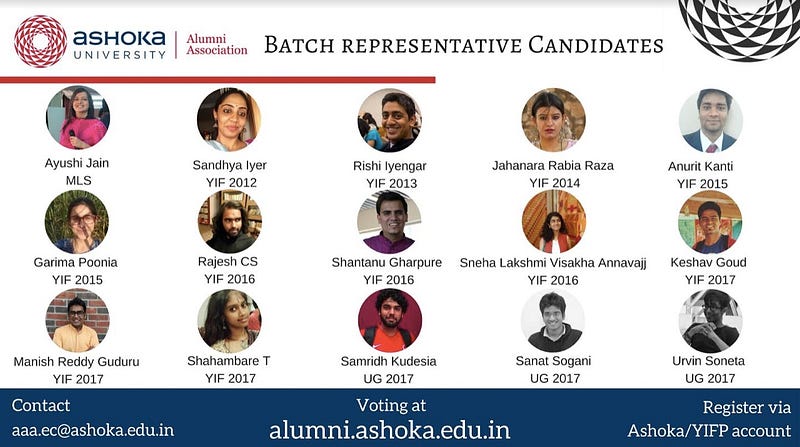
Here is the list of candidates contesting to be Batch Representatives for their particular batch –


Who is eligible to be nominated?

Any individual who is an alumnus is eligible to contest as a directorial candidate. However, one is only eligible to run for president if he/she has been an alumnus for at least two years.

Who is officially considered an alumnus?

Any student who has graduated from the undergraduate programme or the Young India Fellowship qualifies as an alumnus. Fourth year undergraduates (Ashoka Scholars Programme) are also considered alumni. Masters in Liberal Studies students are also considered YIF alumni, and can contest as the same.

Do students of the Ashoka Scholars Programme (ASP) need to “graduate” again to be a part of the Council?

No, they do not. ASP students already become Ashoka alumnus at the end of the three year programme, and will hence have the opportunity to vote for this election cycle.

Who votes?

Any alumnus of the YIF or Undergraduate programme is eligible to vote in the AAA Elections. This year, ,members of the previous batches of the YIFs and the first batch of undergraduates will be voting.

Why is the Alumni Association for UGs and YIFs the same?

The Alumni Association aims to forge a strong Ashokan identity by expanding the definition of Ashoka to include alumni from every batch of every programme. All graduates are instilled with with the same skills and values. Compartmentalizing alumni into different associations would significantly reduced the resource pool at one’s disposal and leave little scope for interaction between graduates of different programmes.

Lastly, the elections are carried out and overseen by the AAA Election Commission, which comprises of a Chief Commissioner of Elections, a Returning Officer and up to five Election Officers (including two incumbent Alumni Council members). The Chief Commissioner is appointed by the Alumni Board of Ashoka University following a recommendation by the incumbent Alumni Council.

Catch the previous year’s election results at: https://thepatritimes.wordpress.com/2015/08/30/yifaa-election-results-out-karan-bhola-becomes-the-president/

Know Your Professor: Aparajita Dasgupta

Gahena Gambani and Rochak Jain, Class of 2020

Professor Aparajita Dasgupta had been a science student throughout school. Choosing to study Economics was a gamble that paid off — something that the risk-taker in her is proud of in retrospect. While nobody can deny her love and passion for economics, the fact that there aren’t many universities like Ashoka in the country today, where students have the freedom to choose and explore their interests, disappoints her. She often wonders whether a university like Ashoka when she went to college could have led her to become a biologist or a museum curator.

Source: ashoka.edu.in

Music has always played an important role in professor’s life. As a child, however, she didn’t like going for music classes. After growing up, she found a teacher who helped her reconnect with music. Today, it is her stress-buster. However, time constraints due to a busy schedule rarely give her a chance to practice. She considers listening to good music meditation and it is her preferred way to unwind after a long day. She is proficient in playing the flute. An encounter with a street vendor selling the instrument piqued her interest, and soon, she was playing songs by ear.

Professor Dasgupta is an avid photographer, too. This, combined with her love for travel, has resulted in some great pictures and memories. A couple of her clicks:


Her most memorable vacation is when she was in Peru to present a paper at a World Bank conference, and decided to explore the country. She ambled through the ruins of Machu Picchu and Mira Flores, learning more about the rich cultural heritage of the Inca civilization — given a chance, she would love to take her students on this same trip.

As a professor, she defines success as when her students are able to apply the concepts of economics to everyday phenomena. “After all, economics is all around us, and what better way to gauge how effective my teaching has been?” she says. She is very vocal about her happiness of being in academia — the flexibility it offers her, she feels, can be paralleled by no other profession.

As the interview came to an end, we felt compelled to ask her a question that was inspired in part by her discussions surrounding causation and correlation, and in part by our curiosity: Why are close to 50% of the economics professors at Ashoka Bengali? Professor Dasgupta laughs for a full minute before answering. She credits this to the quality of professors most of our faculty had, the emphasis placed on economics and academia in West Bengal, and the fact that several of the economists India has given the world are Bengali, serving as role models for young students in the state and the country.

Favourite genre of music: Jazz
Favourite food outlet on campus: The Dhaba
Next book on wishlist: Sapiens: A Brief History of Humankind by Prof. Yuval Noah Harari
Song she knows all the lyrics to: Ye Sama from Jab Jab Phool Khile (1965)
Spirit animal: Horse

Aparajita Dasgupta is an Assistant Professor of Economics at Ashoka University. Her research interests lie in the fields of development economics, health economics and public policy.

Know Your Professor: Swagata Bhattacharjee

Smriti Agiwal, Class of 2019

“Yes. Yes. Yes,” said Professor Bhattacharjee, when I asked her if she always wanted to teach. “I love teaching. The best thing about my profession is that my time is my own and I can use it the way I like. There is a lot of flexibility and freedom. I learn a lot from my students and interacting with them, in a way, makes me feel younger. I’m growing old, right? I get to know what you guys are thinking and what kind of things you do.”

Source: Google Sites

As a child, she used to read a lot, and was often classified as a bookworm. She maintains that she was a quiet child: she says that there were times when people wouldn’t believe there was a child in the house. She lived in a joint family, in a house with 20 rooms and around 40 other people. “Having meals together was incredible because there were so many people. Since there were so many people, trying to remember what the exact relations were was also a task. That was fun, but then we had to move. We sold the house. Now when we meet everyone is surprised to see that I have grown up! People grow up, that’s what they do! Unfortunately you can never say, ‘By the way, you have also grown old.’ You have to be polite.”

When I asked her why she chose to come to Ashoka University, she said, “I wanted to come back to India after my PhD because my husband was already here. Within the country, Ashoka was the best opportunity.” Even though she describes this story as “trivial,” she has never regretted her decision. She feels that the academic model at Ashoka is both interesting and exciting, providing her with an experience of constant growth and fulfillment. “We’re all growing. Our economics department is also growing. We’re going in the right direction and that is very important.”

Apart from Economics, she is interested in learning History, Philosophy and foreign languages. She stated that she would love to take a course with either Professor Nayanjot Lahiri or Professor Pratyay Nath. “Unfortunately,” she said, “I realized I have so little time.”

She has made it a point to enter a new class with zero expectations. “Every class is new. Every person is unique, and you have to keep that in mind when interacting with a new person. If you start presuming something before you even meet the person, you actually lose out on a lot of experience.” In an attempt to get to know her better, I asked her to say one thing about her that her students might find surprising to know. She said, “In class, you just meet one side of me, so maybe you’ll be surprised to find out the real person.” After a second of silence, she whispered, “I’m scared of ghosts.” But, that doesn’t stop her from watching horror movies. In the company of friends, some of whom are as scared as her, she builds up the courage to face her greatest fear at least once a year. Occasionally, she also enjoys reading horror stories for the thrill of it.

Her current favorite quote is “Happiness can be found even in the darkest of times if only one remembers to turn on the light”, by J.K. Rowling. She has a small section of her office dedicated to quotes from Harry Potter. She calls herself an “ardent” fan, and says, “That’s probably another thing you’ll be surprised to know about me.” She is “certainly a Ravenclaw with maybe, a touch of Slytherin.”

When I asked her about her favorite dish at the mess, she was silent for a couple of seconds after which she replied, “I’m not a Gryffindor. I’m not brave enough to face the mess. Please do something about it.”

Favorite authors: Toni Morrison, Stephen King, J.K. Rowling, Tolstoy, Agatha Christie
A must-have smart phone app: Amar Chitra Patrika — “I cannot digest the news unless and until it is written in Bengali. Just one of the idiosyncrasies I have.”

Swagata Bhattacharjee is an Assistant Professor of Economics at Ashoka University. She completed her PhD in May 2016 from the University of Texas at Austin, and is currently working in Applied Microeconomic Theory and Experimental Economics.

Open Doors: Why Refugees Are Good For Economies

Shashank Mattoo, Class of 2020

In 2016, The Oxford University Press’ Children’s Word of the year was “Refugee.” Oxford’s choice served to demonstrate just how much the refugee crisis had captured the consciousness of the global media and citizenry, ever since their plight was highlighted against the backdrop of the Syrian civil war in 2015.

The mass exodus of refugees from the Middle East evoked strong reactions in nearly every corner of the world, and formed a large part of the wave of popularity that several populist candidates rode, from Donald Trump in the United States to Marine Le Pen in France. The ensuing poisonous political climate and anti-immigration rhetoric has distorted public opinion about refugees. Despite the extensive media coverage it has received, the impact refugees have on their host countries’ economies is little understood and is highly controversial. Through this article, I hope to demonstrate the massive potential for growth that migrants bring with them, as well as dispel some commonly held myths regarding the negative impacts of taking in refugees.

MYTH 1: Refugees take jobs meant for locals

A large part of the opposition to accepting refugees stems from a widespread fear that refugees undercut locals and steal jobs from them. World Bank economist Caglar Ozden recently looked into the matter and found little truth to the claim. Ozden stated that immigrants mostly took jobs that natives either couldn’t do or didn’t want to do. During the course of my own research, I found that in countries where a strong welfare system was already in place, such as the US or Greece, natives preferred to apply for welfare benefits rather than take up low paying jobs. Refugees don’t have the same options open to them, and therefore fill up the excess demand in these low pay-low skilled jobs.

So where does this image of the job stealing immigrant emerge from? 
The answer lies in the “Lump Labour Fallacy”, which by its very definition, is incorrect. The idea is that there exists a fixed amount of work to do in any economy and therefore, any influx of new job seekers will undercut existing workers. But the Lump Labour theory fails for a very simple reason: the amount of work in an economy is never fixed. By this I mean that if refugees enter an economy, they will invariably demand food, clothing and other services, thereby boosting demand for the same, which will in turn create jobs. Unfortunately, this fallacy has been misused time and again by those opposed to immigration. Traditionally, whenever the economy is experiencing sluggish growth, the theory is brought out to pin the blame on immigrants and to galvanise public opinion in support of tougher immigration laws.

MYTH 2: Refugees force wages down for everyone

Ozden also found that unskilled migrants didn’t create a downward pressure on local wages, as is so often claimed by anti-immigration activists. He used the example of Malaysia, where the influx of a large number of migrants allowed several high school educated locals to become junior managers of immigrant labour rather than to become labourers themselves. The migrants not only didn’t drive down wages but created a new and higher paying job for the natives. David Card, an economist from the University of California, Berkeley, provided further evidence by studying the Mariel boatlift of 1980, during which close to 45,000 Cubans moved to Miami, causing the city’s labour supply to increase by 7%. Card found that the influx of immigrants had no discernible impact on wages or employment for existing job holders in Miami.

MYTH 3: Refugees take out more than what they put in

Some opponents of taking in refugees have claimed that refugees are a drain on the resources of the government. They believe refugees extract benefits from the welfare system in the country, while staying unemployed in government shelters for extended periods of time. Yet, an independent study carried out by PNAS found that, on average, an adult refugee who received aid from the government would increase annual real income in the local economy by $205 to $253, significantly more than the $120–126 in aid that each refugee receives.


The above graph, supplied by the Cato Institute, shows that relative to their native counterparts, immigrants tend to have higher employment rates, something of immeasurable value to any economy.

Therefore, we have addressed the concerns regarding refugees paying into the system and their rates of employment in the economy. This, however, doesn’t usually convince people. Their constant rebuttal is:

Do refugees boost the GDP growth rate of the country? If so, how?


As this graph illustrates, in the short run, accepting refugees has a negative impact on the economy of the country. The reasons are simple: settling refugees in as well as finding them housing and employment takes both time and resources, and as such, short term pain is to be expected. But as even the most conservative estimates show, the arrival of refugees has a demonstrable positive impact on the economy of the host country. Here again, the reasoning for accepting refugees seems apparent: The influx of motivated individuals fills up demand for workers. When they spend money on consumption of goods and services, it increases aggregate demand in the country, which in turn boosts the GDP growth rate.

Immigrants also have a well-documented history of boosting productivity in their host countries. The most notable example of this is the United States, where immigrants own 25% of new businesses, despite only comprising 13% of the population. But let’s take a moment and step away from the quantitative measures we have and simply observe the examples of immigrants we know who’ve made it big. Steve Jobs at Apple and Sergey Brin of Google, both second generation immigrants from Syria and Russia respectively, are just two examples of immigrants who have redefined the playing field in their profession. Today, the companies they founded have become the backbone of the global technology industry.

The success of the immigrant community in the US is by no means an isolated incident. Turkey, which has borne the brunt of the Syrian refugee crisis, has seen close to 4,000 Syrian refugee-owned businesses pop up, which are estimated to have a capital base of $220 million, with cash flows from Syria into Turkey coming up to approximately $10 billion.

The X Factor: Rapidly Aging Populations

In my opinion, the fact that the workforce is aging rapidly in most countries is probably the most important reason for countries to seriously re-examine their migration policies. A short while back, I read the book “Rise and Fall of Nations” by Ruchir Sharma. Sharma carried out a case study of 56 countries in his book, all of which had maintained a sustained economic boom for at least a decade. He found that all the countries that achieved an economic boom shared one common characteristic: a rapidly growing and young workforce. But this vital driver of economic growth is fast disappearing with global demographics shifting. Added to the problem of a rapidly aging workforce is the fact that global population growth rates have begun to decline. As a result, Sharma pointed out that it was going to become nearly impossible for countries to generate the same level of economic growth that they have now become used to.

As the European Commission warned in 2005, “Never in history has there been economic growth without population growth”. Yet, there is a silver lining in this gloomy economic picture, and it comes in the form of refugees. Chancellor Angela Merkel realised this quite early in the game, and despite the political backlash she has suffered by throwing open Germany’s doors to refugees, it is ultimately the smartest way for her country to maintain its competitive edge, as it battles against an aging and shrinking workforce. Japan, by contrast, seems to have become the anti-Germany, closing its borders as tightly as can be for a modern nation. Many have seen Japan’s unwillingness to accept refugees as a return to its ancient isolationist foreign policy called sakoku. This could be a potentially disastrous combination for Japan, as it possesses not just the fastest aging workforce in the world but also cripplingly low fertility rates.

I don’t intend to downplay the challenges of cultural integration that many countries that open their doors to refugees will face, especially in ethnically homogeneous nations like Japan. Yet, throughout the annals of history, we find nations that have successfully surmounted these obstacles and emerged from their ordeals stronger: not just socially, but also economically. It seems to me that despite the political price that the governments of Canada, Germany and other similarly open minded countries are having to pay, it will be these countries that turn out to be the major drivers of economic growth in the 21st century. For their own sake, I can only hope Donald Trump and others like him are watching and learning.

Overbooking on Flights: A Profitable Game of Chance

Aashay Verma, Class of 2019

(This was originally published in January 2017)

Flying is the safest mode of transport. According to The New York Times, a traveller could fly everyday for 123,000 years and still be safe. In India, air travel is gaining popularity, with 300 Million people in the middle class that can afford at least one trip a year. According to Airports Authority of India, the passenger traffic between April-November 2016 was more than 170 Million, both domestic and international. This figure was up by a little more 19% over the same period in 2015. The Government, too, is taking measures to expand air travel in the country. It had announced a project to build “low cost, no-frills” airports in Tier-II and Tier-III cities to enhance connectivity, and earmarked Rs.1500 Crore for the same.

Source: Pinterest

Airlines regularly overbook their flights in an attempt to maximise efficiency. They give out more tickets than there are seats in the flight. They take such a chance because they know that there will be some passenger who won’t turn up for the flight. They make some extra bucks because of this. In the event that their estimation backfires and more passengers turn up than estimated, they have pay the passenger compensation either in cash, airline vouchers and sometimes even meals or hotel accommodation to pay for the “inconvenience caused.” The compensation often amounts to more than the cost of the ticket itself. Why will any airline overbook a flight then? There’s a mathematical explanation:
 Let’s take the cost of a ticket to be Rs. 5,000 (non-refundable) and the compensation amount to be Rs. 10,000. For the sake of simplicity, let’s assume that all the passengers are travelling alone, i.e. no one has come with their families. 
 If there are 180 seats on an aircraft, and the airline has estimated that 15 passengers won’t show up
 If the airline sells 180 seats, its revenue is: 
 5,000*180 = Rs. 9,00,000, and the flight takes off with 15 empty seats.
 If the airline sells 195 seats, its revenue is:
 5,000*195= Rs. 9,75,000, and the flight takes off with no empty seats. 
 Clearly, overbooking has caused the airline’s revenue to increase considerably. However, this is the best case scenario, when the airline’s estimate is accurate.
 What if all 195 passengers turn up?
 Revenue= Rs. 9,75,000
 Penalties= 10,000*15= Rs. 1,50,000
 Net Revenue= Rs. 8,25,000. This is the worst case scenario. The airline ends up with revenue lesser than if it had sold exactly 180 tickets also. 
 Why take this risk though? Airlines don’t take such decisions at random. Parsing through years of passenger flight statistics, they use computers to determine how many extra tickets to sell in order to maximise the revenue. Legally, airlines are allowed to sell seats up to 15% above the aircraft’s seat capacity. This often backfires though. Data suggests that in November 2016 alone, more than 2,100 passengers had to be “bumped” off their flights despite having confirmed tickets. Among the worst affected airlines were Jet Airways, with a little over 1600 cases, SpiceJet (434) and Air India (106), according to a report by Directorate General of Civil Aviation (DGCA). This turns out to be a costly affair. In November alone, airlines had to pay a little of Rs. 84 lakhs to passengers as compensation. 
 Another problem that exists is that people aren’t aware of their rights, allowing airlines to get away without compensating passengers. With a growing number of people starting to use air transport and new airports coming up all across the country, it is important to educate everyone about their rights as fliers. Let’s generate wider awareness about safest mode of transport in the world.