The Ashoka Alumni Weekend, an event where alumni from Ashoka’s undergraduate, YIF, MLS programmes will come together to party and network, is taking place on campus this weekend (from 1st to 3rd June). Here are some of the events being organized to make this Weekender fun and rewarding for alumni from the undergraduate and fellowship programmes alike.
1. Gala Night
Do you miss parties at Ashoka already? The Weekender can take care of that. There will be a prom night taking place on Saturday (2nd June) where alumni from the fellowship and undergraduate programmes can ask each other out for a dance.
2. Talks by our Alumni
We all know that Ashokans like to give gyaan. At the Alumni Weekend, you can enjoy a variety of talks from the YIF alumni community, ranging from ‘Careers in Government’ to ‘Sex and Related Anxieties’. Here are posters for all 20 talks that are scheduled to be delivered during the weekend.
3. The First Ashoka Film Festival
There will be 9 films in total that will be screened during the Weekender, but the highlights will be two National Award Winning Films from our Alumni themselves. These films are Unreserved by Samarth Mahajan (YIF ’17) and Maacher Jhol — The Fish curry by Abhishek Verma (YIF ‘18).
From the undergraduate alumni, a film made by Gia Singh Arora from the founding undergraduate batch called Nani Ka Ghar Nani Ke Bina will also be screened.
Do make sure to get some popcorn along.
4. Food Arrangements
Have you always wanted to know what ICS chefs can do at full potential? The Alumni Association has made arrangements for ICS to cook especially delicious food for the Weekender. There will also be additional food stalls during the day to keep you full and ready to party and network.
5. Lassi
It seems that the Alumni Association is also very aware of the kinds of drinks that Ashokans prefer. Lassi (which is not really lassi, we’ve been told) will be omnipresent during the Weekender.
6. Relaxed Rules
The Alumni Committee has also miraculously managed to get the administration to calm down about rules regarding free movement across hostels and pool timings. As a result, there will be free movement throughout the Weekender. You can also jump into the pool at 3am if that’s what you feel like doing after having all that lassi.
7. Cultural Performances
In your time at Ashoka, music, art and dance were a part of regular life. You can relive the spirit of performance with open mic nights, Ashokapellas and two special events — a recital by Ustad Iqbal Ahmed Khan of Delhi Gharana, and a performance by our very own Abhilasha Sinha and her band ‘No Honey’.
8. Vision 2030 with Founders
A crucial part of the Alumni Weekend will be to bring the alumni community together and ideate about the future of Ashoka. You can look forward to sessions with Mr. Vineet Gupta, Mr. Pramath Raj Sinha, Mr. Pratap Bhanu Mehta, Mr. Sanjeev Bikchandani and Mr. Sankar Krishnan. They will be talking about their ideas and listening to yours regarding the future of the university.
From what we’ve been told till now, the Ashoka Alumni Weekend seems like it’s going to be a blast. It is maybe not the best idea to miss out on this chance to bond with the larger Ashoka community.
Over the past week, we have had the pleasure of covering the Alumni Association elections with a Presidential Debate and Discussion and analysis of candidate manifestos. Here’s everything we wrote to aid you in the process of deciding who to vote for –
A slightly poetic beginner’s guide to our presidential candidates, and their vision for the AAA.
#CandidateSpeak
We figured that not all of you will have the time to go through a 2 hour debate, so we turned the candidate’s answers to article format to give you easy access to the answers you seek.
Q — What do you think is the role of the President of the Alumni Association? What will be your role in the next two years? What will be your first action item/executive order as President?
Q -How do you view the relationship between the association and the university? Additionally, what do you think is the role of any alumnus towards the university, in our current stage of professional lives?
Perhaps the most important in the series, this is the part where Mr. Karan Bhola, outgoing president of the AAA, asks the candidates specific questions about the promises they have made in their manifestos.
A couple questions are yet to be transcribed, and will be added to this article as and when that happens. We hope that you make an informed choice for the future of the Ashoka Alumni Association.
In the meanwhile, we would like to thank Karan Bhola, Samyak Shami, Shivangi Tikekar, Vedhika Anoora Krishnakumar, Debayan Ghosh, George Jacob and Arunima Singh for making this all possible.
Mr. Karan Bhola, the outgoing President of the Ashoka Alumni Association, prepared one question for each candidate specific to their candidature and manifesto. Here are the questions, and the candidates’ answers to them.
Gaurav Mohta
With respect to the fundraising that you’ve spoken about, what is your plan towards generating the corpus amount that you indicated by 2020? What do you think would be the biggest challenges for you in reaching this goal?
Karan, you rightly mentioned that the fundraising metric that I mentioned is very ambitious. 1 crore by 2020, while other candidates have set that target for 8–10 years. I think this is very achievable, given my past experience with fundraising. In the first alumni fund that we created back in 2013, we collected over four lakh rupees within just the first two batches. So what I think needs to be done is two things: one is constant engagement with the alumni community. Right now it’s a one-off gifting program which happened during the course of the Alumni Weekender, so constant engagement like Karthik Gulati put up a video where he said that 50 students called up all the fellows to invite them to the weekender. So why not those engage with the alumni body even in terms of fundraising? Secondly, donor trust founders and trustees and other stakeholders. In fact, I want to announce it right now, I have a commitment to Rs. 10 lakh from one of the founders, a gift matching commitment. These things make me believe that we can achieve you know the one crore target within the next two and a half years itself.
Simran Rana
What would be an actionable plan in terms of engaging with communities outside of Ashoka, especially in the context of fundraising and events? External engagement is one of the key mission areas of the Association and I would be very interested in understanding how you plan to enable this.
From what I understand, the Alumni Association is mainly to raise funds for the university that it’s is associated with, and to help the alumni. Also, the Alumni should be able to give better opportunities for people who will graduate after them. So, I felt that if the local chapters have to become independent and the Alumni Association has to become financially independent, then can we in a small way start having events that fundraise already with the talent that the Ashoka community already has. Local chapters can start hosting events which are talent based, which would be musical shows or plays, and could invite people that are outside of ashoka community in the form of either tickets or food or something simple so that 1) there would be an audience to YIF and also 2) it would widen the kind of people that we meet. I see that YIF people and Ashoka people become too comfortable with each other and then find it very difficult to engage with people outside the community. In simple terms, if the events that YIF local chapters have where only YIF people are called, it could be a plus-one event where you get a friend or someone who is not a YIF just so that you meet people outside of the 10–15 people in a particular city.
Ashweetha Shetty
You’ve put out some great ideas about how to make of the alumni accounts transparent, talking about getting ten different alumni to be part of it. How you would go about implementing this? What would be some of the criteria you use for identifying diverse alumni?
What I mean by diversity in the first place is gender, social class, opinions and so many so many other ways I define diversity. We all know from our experience of the fellowship that diversity works. When diverse people come together then great ideas come and all voices are heard, so I think that’s my that’s my mission. There are very similar voices I hear all the time from many task forces or the meetings which we have. I believe if we could include that diverse voice, that will be great. The criteria for selecting that diverse voice will have to come from the alumni community, but I also feel that I have certain ideas about how this whole thing works — just inviting them to absorb conversation so that it is is it is because very conscious for us that there are diverse people sitting there so our intention is to hear all the voices and to take decisions after that. I think that’s that’s my intention of putting diverse voices and I personally believe in Drive diversity. It really has been my personal value, and I would love to see that reflect in the Association.
Parushya
There’s this really cool idea that you’ve spoken about — Alumni Hour, where twice every month people will sign up to sit with key decision makers of the university to discuss the functioning, resources, concerns etc. How do you plan to implement it? How do you think this will feasibly work, on a consistent basis? If you are talking about senior administrators and faculty from the university, getting them every month twice would not be an easy task.
Sure Karan. I think you’re bringing a lot on board here with your experience about the challenges that come with such an initiative. I must admit that it’s an ambitious baby step that we’re talking about right now. Yes, the founders, the administration and the broader alumni community are all awfully busy. So just from a very functional perspective, it’s going to be setting up more of an engagement platform for later on. Every month twice is going to be for once let’s say the UGs, the other time CASH, and then next month’s will move on to another department like GCWL. So you’re engaging them and channel I think this is going to be a challenge except but I think the broader e thousands that this will bring people into a zone where they they can raise their individual views and not get bogged down by a broader conversation and making sure that they are on the right side.
Logistically, we have had town-halls during Ashoka times. The founders and senior management do take time out for a or for a mentorship session. I think it’s all about channelizing that energy into a more structured form where we can also let alumni engage on their own individual views. Also, it’s not always about the head of the admin being there. We can also get representatives as proxies. That is where the accountability part comes in, that those views are communicated to the relevant people and the Alumni Office. It is an ambitious step. The new council will require your support and also your experiences with you but it is going to be a functional thing.
Jasmine Luthra
You’ve spoken about mapping each alum to the nearest local or regional chapter by July 2019. Considering that you have been on the council and you’ve seen how difficult it is to maintain and update a database, how do you think you’re going to achieve this goal?
As we all know, we are moving towards numbers which are just unimaginable, so you can’t have things happening in Delhi or Sonepat. So we need to move towards decentralization, we need to have local chapters. Now I know it will be a challenge and somewhere I’m going to bring this to the community because we can create platforms but they have to engage. Eventually, the local chapter mapping and major communication has to move to the portal, so the portal should be the Facebook for all of us. Based on the information that we have, we will try to map everyone to an existing chapter. I plan to launch an lot of chapters during my tenure. The aim is to have a chapter in every city with five plus alums, or have regional chapters like the east coast or the west coast in the US, and map everyone at once based on a location they provided to us on the portal. Then it should be a rooster thing happening periodically. We should also really encourage alums to update the portal when you move cities the way you update your Facebook. (Cut off there for time constraints)
Lav Kanoi
Given that you work at Ashoka University and in the office of the Vice Chancellor, how do you plan to tackle situations that might arise, where there is a different viewpoint that you build consensus on (with the council and the alum body), while there might be a different administrative view?
To get to the heart of the matter, it’s a symbiotic relationship. The question presupposes that there will be conflict between the Association and the university or the administration. I’d like to point out how the debate today began. I said that this would be a symbiotic relationship. I think on most occasions there should be a degree of parallelism because really it’s the same interest. Our strength is the university’s strength. Occasionally when there are differences again, there are two different routes. I don’t see this being a problem at all. On the contrary, I see this position as being a strength to the alumni association because I have the university and its processes well understood. I’ll be in an influential position to actually build consensus with the administrative staff as well. Second point is that the role with Pratap is on for another nine months or so, that’s that’s the the visibility we have at this moment. Who knows what’s going to happen after that? This is the critical period of the next council, and I’m hoping that in these six to nine months, we’ll be able to set up those processes and systems that I spoke of earlier. It will actually help us become a thriving family which I so hope that we will be. In summation, it’s a strength.
Transcribed below are answers given by the candidates in the Presidential Debate and Discussion organized by The Edict in collaboration with the Ashoka Alumni Association.
What is truly unique about your candidature? What sets you apart from the other candidates?
Jasmine Luthra:
I’ve worked on the interim council and the founding council. I have the insider’s view, a deep understanding of how things work, what are the gaps and what needs to be done. Although new energy must come in at this nascent age, I think having some continuity would have its own advantage.
Lav Kanoi:
I have had the experience of working in varied fields like Business Consulting, Government Advisory, Teaching and Research. In addition to the various languages I speak, I’m also familiar with ‘languages’ of the fields I’ve just mentioned. I have made sustained contributions to the Association and the larger community. As chapter head, I’ve worked and delivered on a number of different initiatives. I am uniquely positioned in Ashoka. At the moment I am a part of the Vice Chancellor’s office. My position and proximity ensures that the right systems and processes get integrated with the larger university.
Parushya
I’ve closely engaged with more than three batches: my own batch and the batches post mine. I’ve taken advice from all the batches during the course of making my manifesto. I consider my ability to collaborate a strength. Tangibly working with international universities, I’ve seen and studied the stages of development of Alumni Associations. I believe that with the help of both these qualities I will be able to achieve the common vision that we all have.
Simran Rana:
I’m not the most illustrious candidate running for President: I haven’t been associated with the previous councils. I’ve only been associated as a TA a couple of times but just like all the other candidates I have a lot of integrity and a lot of heart. I think that I would be able to bring in something fresh and a little bit new. I’m an outsider who does not exactly understand what the Alumni Association really does. I’d like to figure that out for myself and for a lot of people like me. I think my running for President will always be in the direction of involving everybody and reengaging with people who are dropping off of our radar and bringing them back
Ashweetha Shetty:
After the Fellowship I’ve come to Ashoka every single year. In the last five years I’ve interacted with several fellows from diverse backgrounds. I’ve understood what an alumni community means for others and for me. I feel I am someone who is far away from Ashoka in many ways. I work at the grass root level and I think I have a very unique perspective of looking at Ashoka. I add a lot of diversity to my batch and I want to ensure that it exists in all platforms. I am from the second batch and we experienced a lot of soul. This got diluted over the years and I want to bring back some of those things. These are some of things that make me very unique to this position.
Gaurav Mohta:
Over the last two years the current Association has done a wonderful job of setting up and strengthening the processes and systems of university and alumni relations. Things have improved since 2015–16. While we need to ensure that there is continuity in terms of what was planned we also need to accelerate the impact. The first council laid the foundation to create but we also need to consider the different viewpoints among the alumni, the fast evolving priorities of the university and the association and the virtual boundaries we have or will create for ourselves. I call this process driving on the highway. I’ve been a part of three early stage startups and I can say that we will make mistakes and even big blunders. It’ll be important to remain humble about making mistakes and openly accepting and learning from them. This will allow us to move forward in the right direction keeping the community’s trust intact. My key strengths are empathy, influencing without authority and my experience of leading multiple large and diverse teams through challenging situations at work and outside as well. I think these skills would be very useful to the association in its current stage and structure.
We are deeply thankful to Samyak Shami from the UG’19 batch for transcribing these answers.
Transcribed below are answers given by the candidates in the Presidential Debate and Discussion organized by The Edict in collaboration with the Ashoka Alumni Association.
How do you view the relationship between the association and the university? Additionally, what do you think is the role of any alumnus towards the university, in our current stage of professional lives?
Parushya
I think this is there in the minds of all of us right now. To define the relationship between the alumni association and the university right now — not disagreeing that we have been financially dependent on the university and moreover we have all came from the same ecosystem so we have emotionally attachment also. Right now at this juncture what is important is once we are trying to develop into an independent body, one that is even related to Ashoka but also has a distinct voice on its own functioning and even on matters which are pertaining to the university but do affect the Alumni. I think the first step is that we define a thumb rule — that what are our terms of engagement. How are we going to be engaged with the university and that is coming right from the preamble, right from the ethos of the Alumni Association. That it is about first the alumni — every particular Alum matters here. So if something in Ashoka matters to alumni — something going out in the media, or just being reported, but even if a single alumni feels about it, we have to go about with addressing that — giving every Ashokan a voice right now, because, lets accept it, right now we are stakeholders who are not invested in terms of funding the university, but we do have a voice in terms of having it like as an alumni who has studied there. As the previous batches are coming to the university in terms of mentorships and in terms of jobs. So at this juncture defining when we are going to interact, when we are going to say things.
Answering the second question, I think that all alumni are at different stages in their careers and their lives. But it’s not just about money or network. I think it ranges across 4 distinct classifications which I would put as individual alumni to the university in terms of money, talent, network and time. Some of us work as TA’s while others bring jobs here, some of us work in fund raising while others work with connecting our own organizations and building up the university’s upcoming batches base for them. Those are 4 distinct characteristics and moreover a single alumni should also be able to contribute even a single opinion. Like what I mentioned in my manifesto is about Alumni Hour where every single idea and voice should atleast get a platform to be heard and pondered upon. I think across those four areas — money, talent, network and time; and having a distinct platform to put forth opinion — that is how we play a role right now at this juncture as alums.
Simran Rana
So how alumnus have their relationship with the university is definitely one that feels homely and coming back home, which is why I think a lot of YIFs and undergraduates keep coming back to Ashoka in whatever capacity they can — as TA’s or ASP programs — because we can’t get enough of Ashoka and I don’t think that anybody has a better education experience in their years before because it’s so welcoming and you feel like everything that you say is heard which is why I think that most of us are more vocal than we were ever in institutions that we’ve been associated with before. And I feel that, again, like Parushya has already spoken very well, that none of us have very well established careers right now but I think that in whatever we can contribute, even if it is being a good connector in terms of “Oh I know this person from this batch and he/she will be able to help you” Just helping people meet people from other batches or just across our network would be a great way to connect with our university. And also that we should continuously give feedback to Ashoka and scaling up and every year they have new challenges and something that worked 6 months ago doesn’t work anymore — bigger classrooms, too many electives, not enough classroom space and I think the task force was one very successful thing, when it did work , and even if there is time when we should engage with Aniha, or any professor or even YIFs or UGs on campus in terms of saying what we think and keeping the conversation going.
Ashweetha Shetty
For me, I feel my hope for Ashoka Alumni Association specially was to be a really critical voice in shaping in the institution — a really critical voice. Every single decision we have to earn, for sure; but that’s what I feel is the relationship that I am hoping for — is to be that voice which will help the institution forward. I think we as alumnus know that things like diversity works in fellowship and we need to include people. These are things that we have seen so it is important for us to be that voice telling the institution that this is working and this isn’t and this is where we are.
I also feel that as alumnus where our contribution could be is that — especially when it comes to YIF — we are going out and doing great things, travelling the world, studying in different universities, and I think if we can get back those best practices to really build the institution and also contribute in any ways possible because this institution needs us as it has just been 7 years. Basically in terms of getting the best practices and contributing as much as possible in the initial stages to really build the institution, I feel that every one of us can do something.
Gaurav Mohta
I think the primary objective of the Alumni association should be to act as a bridge between the university and the student, the alumni and the community — to help alumni be connected to the university irrespective of where they are in their lives right now. That to me is the most important role of an Alumni Association. And when we talk about the relationship between the association and the university, I think the association needs to ensure that it is in alignment with the university’s goals and other priorities at any given point in time. For example, one very important point that Lav mentioned just now was that probably at this point in time the university needs us to go out and be the brand ambassadors, champion the university’s cause. So I think the association needs to be in the alignment with the university’s priorities and at the same time — this relationship is something which will keep evolving over time. For example, we are at a very nascent stage right now as an association and I don’t think we are in a position where we can call the shots on most of the things that the university does. We can obviously constructively engage with the university and the administration, including the founders, put forward our concerns and provide constructive feedback. But beyond that I think that at the moment, we are not in a position to drive decision making significantly. In probably eight to ten years down the line, we might be there, and that should be the target the Alumni Association council should work towards.
To answer the second part of the question. I think one of the roles of alumni is to be that of a role model and mentor to the current students. Being such a young university where the numbers are increasing significantly year on year — it is very important for the alumni to come back and give back as much as possible in terms of their time and putting in more efforts to get more internships, more ELMS, careers opportunities; and high quality ones — we need to be mindful of that as well. So I think along with that, like I mentioned in my response to the previous question, that they need to be brand ambassadors and champions for the university at this point in time.
Jasmine Luthra
So, I have seen that the university till now has been very forthcoming of the association. Likee if we go back and remember in April 2015 when the first Alumni event happened at Ashoka, it was the founders especially Pramath who got all of us together in the MPH, got us to brainstorm and start thinking about the Alumni Association. And that is where this idea germinated and then turned into an interim council and the first council and today we are here.
Even in the last 2 years as a council member I can say that the university has been extremely supportive. They have tried to involve the alumni in almost everything that happens on campus whether it is events or the orientation of the new batch or getting us as TA’s etc. You do feel that there’s always a space you can go back to. I also belong to a college in Delhi University but you know the kind of warmness and welcome type of a feeling you feel at Ashoka is very very unique. Now, coming back, we are in a very unique position because I believe we are one of the few universities in the world which is so young and has an Alumni Association. If you look at most of the Alumni Associations in other institutions they are usually composed of many senior people who are at the top of their careers. They sort of contribute in terms of giving direction and money etc to the organization. So in that sense we are at a very unique position and I think we have made a lot of progress in defining a role for ourselves. And yes, we are not in that position in our life that we can contribute financially very strongly, but all of us have gotten together and built this culture of giving back, as Parushya said, at an individual level, as a TA, in terms of getting our companies to hire at Ashoka, the ELM clients, work as council volunteers so on and so forth. So this role is sort of already in the making. We definitely have to work towards strengthening the show and making it more streamlined and ensure that every alum is a part of it. The other role I see for ourselves as alums of Ashoka and the Young India fellowship and the undergrad program is that we are also torch bearers and kind of the representatives of the university for the outside world. So how we conduct ourselves at our workplace, in our social lives, how we engage with other matters of the society kind of reflects back at Ashoka and we have to be mindful of how we conduct ourselves and contribute to building the credibility that Ashoka already has for itself. I would also like to address the elephant in the room. So, I know that in a lot of conversations I feel that line about giving back to the university or being involved in matters kind of blurs a bit and it transcends over to the administrative issues of the university which in the general sense are not considered “matters of the alumni”. But of course we won’t comply to that convention because we are not conventional. I really support it. I think it is great that we are critical of everything that happens at Ashoka and it just goes on to show that we support and love the institution. Our Liberal arts education is coming to play where we are thinking about things, critical about things and we want to be involved in each and every thing. In all these matters I mean. But at the same time we have to be a little mindful of this. Of our actions. I mean, I’m not saying that we shouldn’t be critical, we definitely should be. But we should definitely go back and reflect and try to think as a community on how we want to do these engagements. Now one thing is to sort of point fingers, but the other thing is that harnessing on the diversity and the backgrounds and the experience that we have, we can get together, have honest conversations and actually build sort of consensus on especially the controversial and political issues. Just come together, collate our opinions, unpack and more meaning fully contribute to the discourse.
Lav Kanoi
2 words –symbiotic relationship. We are strong when the university is strong and the university is strong when we are strong. In our progress is the university’s progress and the university’s progress is our progress. Secondly, the other word I would use is a theme, so to speak, is family — a family of love, and pun intended. This is not to say that we don’t be, as Jasmine said and a bunch of others have also said, be critical. We do have our different opinions, we will create a different identity, but we will do this in a constructive manner. So the relationship of the association and the university is to be in a constructive partnership for each other. Play a shaping role, but within an ambit of the association. This is something that requires more conversation. Jasmine for example already pointed towards this issue, the elephant in the room she called it, about how we define the scope of the association. It has something that would be strange to have a say in — for example faculty recruitment. And there would be issues for us to not have a say in it. So someone had raised an issue of workers’ rights. In my year at the fellowship there was an incident that had happened, me and a bunch of fellows had gotten together and first spoken of these issues, and then the contractors were forced by the university to provide safety harnesses for the workers. So things like that are constructive kinds of conversations that we should and necessarily must have.
The second thing however, and the institution is supporting this, is for building a distinct alumni association, distinct identity, Because I think our founders, the administrative body, and the leaders that the university has had in people like Pratap, Shankar, Mahesh and the entire people who are leading the university now, and the remarkable founder cohort, is that they want us to be independent. And this points me to the second questions — What is the role of the alumnus towards the university? It is simply to be the best that we can be individually. We are the greatest, as it were, missionaries, advertisements, flag bearers — call it what you want of the university. So when we do what we do with heart, we will be upholding the university’s ethos. If this requires criticizing the university so be it, but we shall do it from a position of love and family. That would be my position on this.
We are deeply thankful to George Jacob from the YIF’18 batch for transcribing these answers.
Transcribed below are answers given by the candidates in the Presidential Debate and Discussion organized by The Edict in collaboration with the Ashoka Alumni Association.
What do you think is the role of the President of the Alumni Association? What will be your role in the next two years? What will be your first action item/executive order as President?
Ashweetha Shetty
I believe that any leadership position has to set the culture and the values of the institution. So I believe in the last two years we have not done much on understanding what is our shared culture and what is our value and what we stand for as a community. I think my role as a President is mostly on that- really understanding what is the value system we hold for ourselves and on that basis I wrote my whole manifesto.
My executive decision, if I become the President, will definitely be reaching out to all the alumni and really coming up with a solution to understand the values we hold. For example, transparency, diversity, inclusivity are the values I feel are already there. What more values are there? How can we make decisions for the future? I think that’s the role of a President and that will be my priority.
Jasmine Luthra
So how I see the role of the President is to sort of set the broad vision, set the broad direction in which the association is moving. Secondly, as an association we are dealing with three stakeholders. One is the University. Second is the community. Third is the outside world. For me, I see the President as setting the ethos and the relationship between these three communities and managing these three stakeholders and making sure how to keep everyone engaged. The beauty of our community is the love and the vibe that we share. How do we harness that, how do we harness our diversity and collective experiences and take it forward for each one of us. In the next two years, there is a two-fold role for the President. One is that the first Council has already done a lot of work. So taking that forward, at the same time, there were some lapses and gaps and issues that have come up in the last two years, how to address those and keep everyone engaged and set the tone for the future.
My first executive order would be to first to take forward from where the council left which is at the last weekender these two task forces were announced- the diversity increasing task force and the gender and sexual harassment task-force and the charter of these two task-forces have been in the making. So my first executive order would be to launch those two task-forces and get them started.
Lav Kanoi
So a couple of other candidates have mentioned this. The Alumni Association is positioned between various stakeholders. The first and foremost is the Alumni Body, then is the University and then you might say is the larger world. But within the University as well there are multiple (as it were) stakeholders- existing student body, administration, faculty and such. The role of the President as I see it would be to first and foremost to build consensus in a participatory manner about the scope of the Association. What does it mean to say that the Association mediates between these stakeholders? What are the different areas that the Association can actually effect action upon and where can it actually speak, what should be the protocols of speaking, how do we build those systems in place?
As a result then, I think the first executive order is to define the channels by which this would happen. This would involve for starters the communication protocols, both for sending messages out to the larger community and for inviting opinions in a structured cohesive constructive manner to be able to arrive at a largely consensus. The larger role of the President of course to my mind the Manifesto role descriptions have already defined this is to represent the Association but more importantly I think its about continuing to bring the community together. My personal point of view is that the President should be able to personalize what we are calling the family of Ashoka. So it’s about creating this family feeling and bringing everyone together in this respect.
Parushya
The role of President, as I have been able to understand, is that of a facilitator and someone who sets the vision of the community and the Alum Association. Every other individual, every person in the Ashokan Community. In the end it shouldn’t be something where only a particular view is harnessing more traction. Getting a facilitator role is the prime importance we should place on a President’s order.
Now about the executive order. I think something that was mentioned yesterday that did move a lot of us was the mail by the alums about the gender and sexual harassment issue on campus. While there is a case of prerogatives where the university stand and where the alum Association stand. But even in the case of alums the first thing would be how do we build a support system? How do we set things right on campus? A director from the alum council going ahead and involving with the issues raised on campus- that would be the first step I would really want to take there. The CASH has to be strengthened by the involvement of the alumnus. Someone from one of the batches mentioned that right now whether there is CASH or broader community, we do need a lot of training dealing with sexual harassment cases. So I think going ahead and involving the alumni who have the training and experience would be the first priority.
Simran Rana
I think as the President of the Alumni Association, my role would be one to really set the tone in terms of what the Alumni see themselves play in our organization. I feel that we don’t understand our responsibilities and the roles that alumni can play in building Ashoka, and must set a strong base on what we can and cannot do as Alumni and how we can better contribute to our community. There are things that we can’t change and what those things are needs to be more clear.
I feel that one thing I would like to do from the word go is to try and have a conversation with every alumnus possible to really understand what they understand by being part of the Alum Association and what they think it means to be an alumnus and what they think the Association does, because I feel there is a lot of mismatch in the two. So one is to really clear the air I feel that there is still some confusion as to what the Alum Association can do.
Gaurav Mohta
I think the role of the President of the AAA is primarily that of a builder as well as that of a hustler. Consensus- builder because the President needs to keep being a hustler throughout the process and at the same time ensure that there is effective communication happening. I use the word hustler because a President should do whenever whatever wherever is required to help other members of the council to function more effectively. Absorbing pressure. I think the role of a President is to help his team function more effectively. That’s how I’d define the role of the next council.
Things I’d like to do are strong integration between programs at Ashoka and between different batches. I think one of the things that has not been done effectively so far is the inter-batch and inter-group connect. If you look at the Whatsapp group, the UGs are not present. If you look at the mailing list, it’s hard to reach out to the UGs. Being in the first batch, I’m not connected to those in the 2016, 2017 batches. And I’m one of the most connected people in my batch and if I’m not connected, then that’s an issue. So this is one of the first things that I’d like to do as part of the council.
We are deeply thankful to Vedhika Anoora Krishnakumar from the YIF’18 batch for transcribing these answers.
The Ashoka Alumni Association (AAA) Elections are back this year. The first elections for the Alumni association were held in 2015. This time, the first batch of Ashoka undergraduates, who are now officially considered alumni, will also be participating in the elections.
The Student Government set up an Alumni Relations Ministry recently, being lead by Samyak Shami, second year undergraduate at Ashoka.
These developments would naturally prompt questions regarding the who, what, why of the elections and the body itself. The Edictis here to decode.
The dates of the entire election cycle are:
19th December: Nominations Open
26th December: Nominations Closed
29th December: Campaigning Begins
11th January: Campaigning Ends
13–14th January: Voting Days
What is the structure of the Council of the Ashoka Alumni Association?
The Alumni Council of the AAA constitutes a President and six other elected Directors.
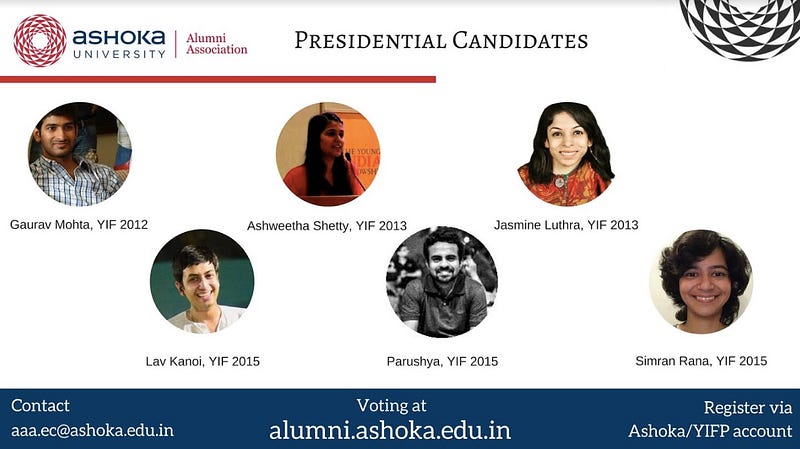
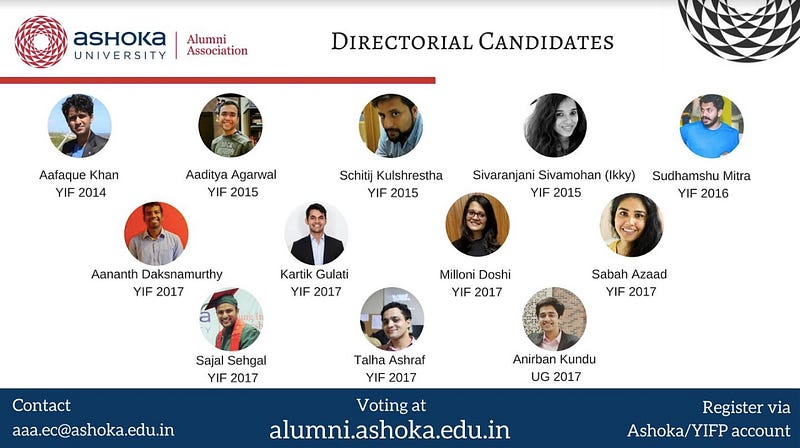
Who is contesting to be a part of the Council this election cycle?
Here is the official list of candidates –
Who are AAA Batch Representatives?
Ashoka Alumni Association Batch Representatives are also nominated and voted for alumnus but are not members of the AAA Council. They simply represent the interests of the batch of which they are members. Each elected individual represents one hundred alumnus from his/her batch, hence smaller batches of YIFs would require only one representative (minimum number of representatives for an undergraduate student batch is two since the founding class comprised over a hundred students). An alumni who has pursued more than one academic programme at Ashoka can only contest as a member of one batch in a particular election cycle.
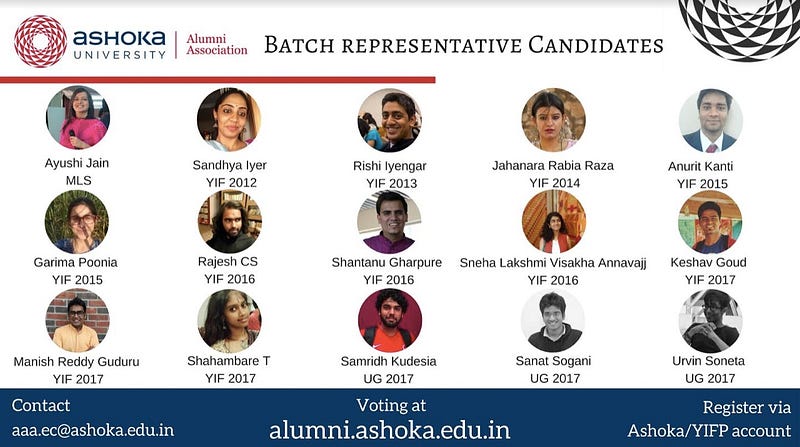
Which alumnus members are contesting to be Batch Representatives this election cycle?
Here is the list of candidates contesting to be Batch Representatives for their particular batch –
Who is eligible to be nominated?
Any individual who is an alumnus is eligible to contest as a directorial candidate. However, one is only eligible to run for president if he/she has been an alumnus for at least two years.
Who is officially considered an alumnus?
Any student who has graduated from the undergraduate programme or the Young India Fellowship qualifies as an alumnus. Fourth year undergraduates (Ashoka Scholars Programme) are also considered alumni. Masters in Liberal Studies students are also considered YIF alumni, and can contest as the same.
Do students of the Ashoka Scholars Programme (ASP) need to “graduate” again to be a part of the Council?
No, they do not. ASP students already become Ashoka alumnus at the end of the three year programme, and will hence have the opportunity to vote for this election cycle.
Who votes?
Any alumnus of the YIF or Undergraduate programme is eligible to vote in the AAA Elections. This year, ,members of the previous batches of the YIFs and the first batch of undergraduates will be voting.
Why is the Alumni Association for UGs and YIFs the same?
The Alumni Association aims to forge a strong Ashokan identity by expanding the definition of Ashoka to include alumni from every batch of every programme. All graduates are instilled with with the same skills and values. Compartmentalizing alumni into different associations would significantly reduced the resource pool at one’s disposal and leave little scope for interaction between graduates of different programmes.
Lastly, the elections are carried out and overseen by the AAA Election Commission, which comprises of a Chief Commissioner of Elections, a Returning Officer and up to five Election Officers (including two incumbent Alumni Council members). The Chief Commissioner is appointed by the Alumni Board of Ashoka University following a recommendation by the incumbent Alumni Council.


 edict backup