A few months ago, I stumbled upon an image which was making rounds on Instagram. It was an illustration of a woman looking at a mirror, and staring right back at her from inside the mirror was a fierce looking Goddess Kali. This image made Samyuktha Madhu (handle: @sam_madhu) an overnight success. This was also my introduction to a part of Instagram that features artists, illustrators, and photographers who are trying to create an identity for the “modern, brown woman”. While feminist illustrators and artists started using Instagram much earlier to feature their works and bring forth new ways of imagining the female body, white-centric feminist art forced Indian artists to create their own niche to redefine and reinvent their identities in the global space.
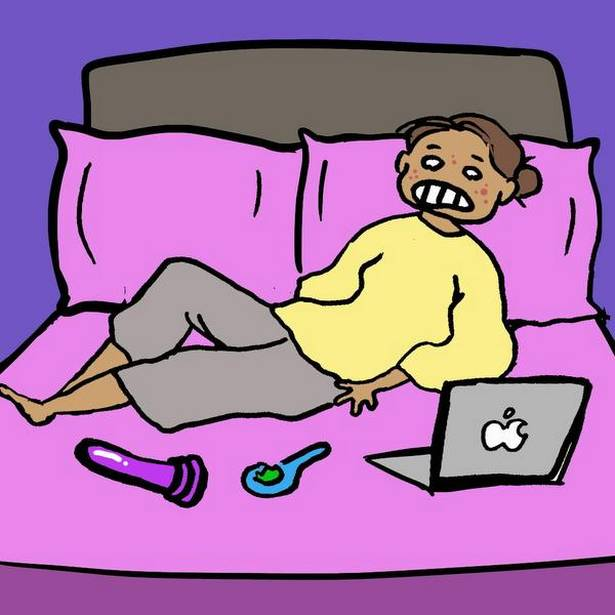
“Brown Art” is an effort to depict the brown woman, who has unfortunately found little representation in today’s world both inside and outside the country. Several Indian and Indian-born artists have imagined a “modern, brown woman” — one who is fiercely independent, confident and aware of her own self. Their works range from colourful and trippy pop art, illustrations, doodles, drawings, and photography. The struggles of the Indian woman as she navigates through the intricacies of the modern day is a prominent theme in these works. The illustrations are brutally honest and show the ridiculousness of societal impositions on women. These Instagram artists pull down benchmarks of beauty, like hairless bodies and thin waist, by realistic depictions of women with body hair, stretch marks, acne and myriad of regular features for which women are shamed every day.
In an interview for SheThePeople.tv, Samyuktha says that, at first, her art served merely as an outlet to document the funny and irritating bits of her life. But seeing how her work resonated with thousands of other young women like her, she now uses it to address topics like sexual liberation and body standards. Where the majority of representation of women comes from the male gaze, seeing women’s lives from the eyes of female artists is a welcome change. The rawness in the representation of the female body is a strong step towards de-sexualising the female form. By highlighting women’s bodies for coarseness and naturalness, Samyuktha seeks to shatter representation of women as highly sexualised bodies. The individuality of the woman, the work she does, the decisions she makes, and the emotions she feels are what occupy the center stage in her images.
Other artists have explored different ways of representing the brown woman and her individuality. The invocation of myths and cultural symbols seems to be a popular method. For instance, the Goddess Kali figures prominently in several artists’ works. This is significant because Kali embodies strength and power, qualities that are usually denied to women in popular representations. It is an overturning of traditional cultural ideas of the delicate and dependent woman. One of my favorite illustrations is of a very confident looking woman holding up a cigarette. She bears a tattoo of a lotus on one arm and “Om” on the other. Placing contradictions in view of each other, thereby showcasing the absurdity of societal expectations, is another feature of this art.The art then, becomes an exploration for the space between tradition and liberation, and differentiates brown art from white feminism. The effort, I believe, is towards creating another kind of feminism — one that acknowledges the interaction between religion, culture, and liberal values.
Instagram has proved to be fantastic space for artists to explore new, unconventional forms to represent Indian women. However, it is also imperative to explore the limitations of Brown Art on Instagram in its breadth and scope. The art is consumed by a modern, upper-class, (possibly) English-educated population that uses social media extensively. It is, by no means, accessible and open to most people in India. The question thus arises: is it possible for Brown Art to represent women who do not fit into the category of the ‘modern’ and the ‘educated’? I am hopeful and excited to see how Brown Art will take these differences and assimilate them to produce new kinds of identities, based on the realities we live in.
The author is an Arts & Culture staff writer at The Edict.
I sometimes look at myself in the mirror and wonder if I did the right thing by putting up that post about gendered entitlement on Facebook. Was my tone too harsh? Was Facebook not the right medium to express myself? Should I just not have talked about the incident and only made my point? There is probably some degree of merit to all these questions, and I would really have appreciated perspective on each of these fronts. Sadly, the only criticism that came my way was in the form of memes and jokes attempted at trivialising what I was trying to say.
A meme shared by a fellow Ashokan
I am not going to take up time and space trying to explain why I believe that the incident was gendered. Mostly because, well, I don’t have the energy to engage in another one of those comment threads. What I really want to talk about is the manner in which I was responded to, which I believe stands in striking contrast to the kind of ethos that Ashoka, as a university space, represents. I had never expected everyone to respond positively to the post — in fact I was pleasantly surprised at how late a comment saying “this is not about gender” came up. And a large part of why I posted that statement in the first place, was to create conversation around it, because ever since I have been here, I get this sense from people at Ashoka that this is a place free of gender inequality and the problem really lies somewhere else. I wanted to initiate a debate about what I believe is one of Ashoka’s biggest problems. But fortunately or unfortunately, what I discovered was, if it may be possible, an even bigger problem.
I would not be writing this piece if I believed that this was a personal issue. Sadly, what I notice is that this has largely become our most favoured mode of interaction. As a student body, we have started not merely condoning, but in fact fetishising a manner of responding that merely trivialises others’ problems, without constructive engagement. And I do know that we all need a reason to laugh, and that laughter is infectious, but it often seems that our collective mindset, which is largely beginning to appear as a cultural attitude at Ashoka, is one that mocks at the concerns of others. Somewhere, in our heads, we have convinced ourselves that it is cool to joke about somebody else’s struggle or their adverse experience. And it makes me ask myself a question, which I hope all those who read this piece ask themselves: Are we becoming more and more feelingless? Is this the kind of community we wish to become? And why is it funny if someone cares about gender or caste or religion or the environment? Is it because we do not understand similar experiences?
For the longest time I believed that people genuinely do not get it; they just do not know. But then I looked inside and asked myself why any of this matters to me? Why do I call myself a feminist? Why did I ever put up that post? And the simplicity of the response surprised me. I care not because I’ve taken three courses with Professor Menon. Rather, I care because I know what it is to be afraid. I know what it is to be hurt. I know what it is to be judged. And I know what it is to be dismissed as irrational, as too sensitive, or as a matter of fact, throughout school, as too feminine. And I refuse to believe that there is a single person on this campus, who has not experienced, known and felt these things in some form or the other. Does that give us the knowledge or the right to claim to know or understand the experience of being from a smaller town, an underprivileged class or an oppressed gender? It does not. But it does give each of us the ability to get a sense of their experience, even if that sense is largely deflated. It makes each one of us capable of some form of empathy.
Another Meme made on the contents of my post
One would expect this realisation to make me feel optimistic. Blame it on the cynicism of someone who identifies at least partly with activism, but it actually really scares me. If each one of us is capable of empathy, where have we lost it? Why have we hidden it? Why are we sharing offensive humour when we could be shedding tears? All these questions are, as I am sure you can tell, rhetorical. Somewhere deep down, however powerfully we suppress it, we all know what is up. We have forgotten how to express and how to feel. We look down upon the ability to emote; we see it as a sign of weakness (another thing that is gendered, but for the sake of the 50 odd men whose blood boils at the mention of “gender”, let’s put that aside for now). But before we try to find some righteousness in our decision to celebrate hyper-rational, stoic, hypermasculine (at this point I slip these words in just to get under some characters’ skins) behaviour, let me, as someone who has for a large part of my 21 years been complicit in this celebration admit, that we do it only because it is convenient. We do it so that we can put ourselves to sleep at night and drown out the guilt of inaction.
When I was a kid, I would be moved to tears everytime I saw my mother unreasonably scream at the domestic help, and her (the help) stare at the ground in silence, forced by the limitations of her class, to suffer unjust humiliation. Over the years, I stopped caring and the tears stopped rolling. I found some explanation to convince myself that my mother was right and that the woman deserved it. I traded my empathy for peace. We all do. And the next time we think that everything is fine at Ashoka and people are just blowing things out of proportion, we should probably remember that.
Arush Pande is a 2nd year UG studying English at Ashoka and contributing frequently to The Edict.
Disclaimer: I have not written in detail about gender identities other than male and female. This is in no way to insinuate that I do not recognise the gendered struggle of non-binary identities. I just think that they are politicised differently and including them in this article would not do justice to their concerns.
I write this as some “Liberal Teen” tags me in a meme about the Egg-Throwing Incident. When people first started responding to my post with memes, I was a little disturbed — mostly because my politics was being trivialised, being reduced to a joke aimed at social media validation. About three weeks after the Incident, it pleases me that a bunch of people (“coincidentally” mostly men) still feel the desperate need to ridicule what I was saying. It further strengthens my belief that I raised something important, something that they are happy to sweep under the carpet.
I identify as a male feminist (the equivalent of an “anti-national” in the world of gender). No, this does not mean that I think that men do not experience sexual harassment. I do, however, think that they enjoy structural privilege that manifests in the form of entitlement over public spaces. This is not to say that all men are — pardon my candour — assholes that are out to reinforce their superiority over other genders. But it is to say that our innocent seeming actions — be it the repeated use of gendered words like “mankind” and “hysterical”, or the kind of leverage we assume with women in the name of “fooling around” — are often driven, facilitated and/or catalysed by deeply internalised gender norms. And as much as that does not give rise to “culpability”, it is useful to think about the ways in which each one of us is responsible for the reinforcement and strengthening of gendered power dynamics.
It did not come as a surprise to me that people were disturbed by my decision to gender my post. After all, wouldn’t we all like to believe that Ashoka University is this La La Land where human civilisation has reached the pinnacle of egalitarianism and all forms of identity-based oppression have been left far behind? And the outrageous number of CASH cases that come up every semester — the “larger” issues that everybody is a lot more comfortable talking about — are merely unfortunate, inexplicable aberrations of behaviour that arise in this otherwise Feminist Utopia? The problem lies in us looking at these incidents in isolation as opposed to examining them structurally, which would involve scrutinising our own behaviours and seeing how they might contribute to a culture where some bodies aren’t considered equally important. The normalisation of sexist humour, the lack of gender inclusivity in our usage of pronouns, and the systematic derision of marginalised gender identities through the use of cuss words — to name a few — are as much causes as they are products of the patriarchy. Sexual harassment does not stem from a mere delegitimization of consent; it is the result of a systematic delegitimization of certain bodies and identities. It cannot be tackled without identifying and weeding out from our social fabric these seemingly innocent but deeply internalised norms.
My disturbance with Ashoka, which is one of the reasons why my friends and I decided to initiate a feminist collective, does not arise merely from the existence of these problems. It is hardly a surprise that gender relations that have been established and reified over a gargantuan expanse of time are reproduced in a public space like the university campus. My discomfort lies in the conviction with which we disavow the existence of these relations, wrapped in the warm and cosy shawl of our privilege, pretending as if Ashoka doesn’t need feminism. We restrict our critical thinking to the classroom, refusing to point fingers at ourselves — to start saying “I’m sorry I made you feel uncomfortable” as opposed to “I’m sorry you felt uncomfortable” (spot the subtle difference). It is not the rampant sexism but the refusal to recognise and the mental lethargy to overcome it that is appalling. The unfortunate fact — and this is the part that nobody wants to acknowledge — is that we cause those CASH cases that we admonish from a distance. We may not be culpable, but we are most definitely responsible because we refuse to question and critique our everyday, normalised actions that feed into a structure which manifests most obviously in the form of sexual harassment.
I understand that this has become a common defense mechanism: make memes when life gives you gender. But it will not make the problem disappear, nor will it successfully bully into silence those determined to draw attention to it.
Manjari Sahay, a student in the Ashoka Scholar Program, sent out a simple one-question survey to the student body on 30th October. With the promise of anonymity, she implored women on campus to reply to the following question: “Are you afraid to mention/speak up about gender-related concerns on the Ashoka Undergraduates Facebook group or on campus at large?”. Within a week, she released the results of the survey, which showed that 36.8% of the respondents did feel afraid to speak up about gender-related concerns. Third-year undergraduate Neha Mehrotra sat down with her to ask her about the survey, and about her opinions of gender politics at Ashoka University at large.
Please find below the transcript of the entire interview. Any edits made were only for clarity’s sake.
Neha: What motivated you to send out the survey that you did?
Manjari: Well, I guess one answer to this question would be that it was my experience of gender at Ashoka and in the world. But I suppose people like finding a more immediate point [because of] which I decided to do this. I guess the push for me was the post that Arush [Pande, Class of 2019] put on the Facebook group, about the whole egg-throwing incident and how his claim was that it was an act that reeks of male-entitlement and typically something that men do.
But, anyway, I don’t want to get into the post as much as what concerned me were the responses to that post. And I think what I found really disturbing was that firstly, most of the people commenting on that post were men. Secondly, they seemed to have no problem with claiming what are gendered and non-gendered acts for women. Thirdly, they thought it was okay to claim what the larger issues of gender are for women. And, honestly, I am not somebody who has any problem with boys kind of giving their two cents, but what disturbed me was the skewed ratio of the men and women commenting or voicing their opinion on the subject. I just couldn’t understand why no women would want to say anything. Or why they wouldn’t want to kind of “own their own experiences” — for the lack of a better phrase.
But on some level, I mean, I had an inkling which was confirmed when I had conversations with girls the next day, and a lot of them would kind of come up to me and just be like, “You know, we completely agreed with what you were saying or what Arush was saying. But we’re sorry, we couldn’t voice our support vocally.” Or they would send him private messages being like, “We’re in complete agreement, but we’re sorry [we can’t say anything publicly].” So I wondered how many women felt like they needed to keep checking themselves and what they say, and how many of them experience this inability to voice their views publicly. Especially on a platform like Facebook but also, more generally, on campus on issues of gender, given the kind of an environment that exists or is known to exist when somebody does bring this issue up. So, I think that was what motivated me to send out the survey. I really just wanted to get a sense of how big of a problem this may or may not be, or if it’s a problem at all.
Neha: When you got the results back, where you surprised [by] what you saw? What did you expect?
Manjari: Yes and no. I was not surprised that these had been the experiences of women because, of course, I’ve had some of those experiences myself, and I have had in-person conversations with girls. But what did surprise me was the anger in those comments and just how much they had, kind of, kept to themselves so much so that it had come to the surface in this particular way. So, I was surprised at not the fact that they had had the experiences that they had stated but the fact that a) they had felt that the only way that [this was the only way] they could voice it, and [b)] that when they did chose to voice it in this anonymous way, there [would be] so much anger in their voices.
Credit: Manjari Sahay
Neha: The response rate — how many responses did you get?
Manjari: I think there were 133 responses, which is alarming given that, I think, if we have about nine hundred to a thousand students of both undergraduate students and [Ashoka Scholar Program] students, then at least five hundred of them should be women, if we assume half-and-half, even though there are more women [in these programs] than there are men. But the response rate was only about, say, 133, and in that way it’s not necessarily a representative survey. But, I think, the reason for that could’ve very easily just been the fact that, you know, whether or not women have this anonymous platform, often there are so many forces acting on them that stop them even before they get to responding to the survey. For example, if I’m a girl and I’m just sitting at a dining table, and I hear one of my male friends being like, “Oh, have you heard of the survey sent out by this feminazi?” Then, of course, I’m instantly going to be like, “Okay, maybe if I try to respond to that survey, maybe my friends won’t think I’m so cool.”
A display in the Mess Hall of all the comments received in Sahay’s Form | Photo Credit: Devashree Somani
Neha: It’s just like a slow conditioning.
Manjari: Yeah. I mean, obviously, there’s a kind of want for social-sexual acceptance, but also a sense of apathy that I think really does exist at Ashoka, which is that, “the survey doesn’t matter; my response doesn’t matter. The problem is so great that nothing I do matters.” I feel like that’s a problem I’ve noticed, especially amongst senior girls, this total feeling of apathy, where they’re just like, “We don’t know what can be done anymore”. And, among junior girls it’s a lot of fear, that will eventually turn into apathy. And I think that has something to do with the response rate.
Neha: So, did you go through the responses alone, or did you do it with someone? Because [they] must’ve been really draining to go through.
Manjari: Yeah… I felt like it was something that I had to do alone, mostly to preserve the anonymity of the respondents. I didn’t want anybody who was reading it with me to know who had given what response. I feel like if they have chosen to respond, they’re placing their trust in me, and not me and my closest friends. So I did feel that sense of responsibility where I was like, “Okay, I need to do this by myself.” But, of course, it was a deeply emotional experience for me because there’s a way in which you know these things exist, but when you read them you realise how palatable they are and how real these experiences are. Of course, I did have to seek out my friends after doing the reading, and be like “I can’t believe the world is this way,” even though, of course, the world is this way. And I needed that emotional support afterwards. But during the process, I just thought that it was a better idea to do it by myself.
Neha: So, since the four years that you’ve been at Ashoka, have you noticed a sort of change in the gender politics that you’ve seen on campus?
Manjari: I think it’s playing out on a much larger scale now, given that there are more students. And even though there are more girls on campus, I think a cultural problem — which has always existed; I’m not going to say it’s the new batches that brought it with them. It’s, say, girls being talked over in classes or the general disregard for their occupation of public space versus your own. These problems, I think, have always kind of been there but they’ve obviously grown as the size of this place has grown.
Then what becomes shocking, given that all this time has passed and there are so many more students now, is that there is still a total lack of a student-led response to things like this. It’s the fact that we need faculty members to tell us that we need to have a town hall on something in order for us to discuss it. That nobody feels like this is a problem, or that the only time they talk about it is to say that, “Bro, stop making a big issue out of this.” So I think that the problem has become more glaring, for me personally, and it has become more disappointing, but I don’t think the problem itself has changed fundamentally.
Neha: What do you think qualify as gendered acts versus non-gendered acts?
Manjari: [laughs] Wow, I’m going to get so much shit for this, but — so I guess I just come from the school of thought, and my education leads me to believe, that we exist in a political world, which is to say that we exist in a world that is not devoid of power dynamics. Power plays out in a lot of different ways, often mediated by social structures of gender, caste, class, and so on and so forth. And so I think when two people of different or same genders are together, there exists a power dynamic between them which can be gendered. So I feel like there is a potential for almost all acts, given that we all have genders, unless we choose to identify otherwise — although that is also a political move — that all of these have the potential to be gendered. So I will not concede that such a thing as a non-gendered act exists, because we don’t exist in a vacuum. To say that there is such a thing as a non-gendered act, I think, is an extremely privileged claim to make because then you haven’t really had to feel the weight of your gender or the weight of another person’s gender; it’s just been a bit of a non-consideration for you, and the fact that you haven’t had to consider of it says something.
Neha: What are some of the ways in which you think women’s voices are being policed on campus, and, to some extent, are the women doing it to themselves? What is it primarily that seems to be policing women’s voices on campus?
Manjari: I mean, as step one, I don’t think campus is devoid of the the world that it exists in. And I know we like to assert that Ashoka is a bubble, but this is one of the ways in which it is not a bubble — which is to say that the gender dynamics that you see outside, you’ll find here as well. The problem is not outside Ashoka, the problem is not in Assawarpur, the problem is here, too. There is a way in which we exist in a larger ecosystem. And so problems of gender, which pertain to, say, women not feeling like they can speak publicly as much, or low women representation, etc. you find the world over and of course you find here as well.
But I feel like there haven’t been enough remedial measures to help women overcome things like that, because there is a way in which we have been conditioned our whole lives to stay silent, to listen, to obey. And, while there is a way in which our classroom education pushes us against that, there is only so far it can take us if there isn’t something outside the classroom that is helping us as well. And the problem then exists at the larger level of student discourse; so whether it’s in smaller actions like how we treat our women friends, how we talk about girls, locker room talk — whatever that is supposed to be — or the kind of space we let them occupy, how dismissive we are of their concerns we they do voice them without realizing that, you know what, that’s their lived experience. These are all ways in which they are policed, and of course we come to internalize those ways, because how could we not? You don’t even want to let yourself get that far where someone else has to police you. You say, “Okay, so, in order to make myself more palatable for everybody involved, let me just police myself.” And that’s the easiest way to exist way in the world. But that’s it then, you’re just existing.
Neha: So, is there something about the structures at Ashoka, take the political parties for example — very scant female representation. Why is that? Because these are… I mean, is there something about the structures of these bodies that limits their participation? Or is it just a general thing?
Manjari: I think political parties, some of them at least, I don’t know if I can speak for all. You know what, I’m not going to speak for all. Some of them have been proactive in recruiting women and giving them an equal platform. I know that the political party that I am a part of has really given me space where I can voice my opinion.
But there exists a problem, obviously, at the level of these women being taken seriously by the people who are voting for them. I’ve heard of instances where when a girl is standing for elections, for example, her sex life becomes the point at which you’re like, “Okay, you know, this doesn’t make her a great candidate. How good a political representative could she possibly be, given the how much sex she’s having?” That’s never a question that arises with a boy. I mean, I really hope that the male candidates from these parties are also having a lot of sex, but it’s not something that anybody considers, right?
And so, I think, the problem lies at the level of perception. I think political parties have tried, historically speaking. But these women are just not getting voted in. Even if most of our lists are women, people will systematically overlook the women on the lists and will vote for the men. Because men are seen as the thinkers, the occupiers of public space. And it’s their opinions that are valued in a certain way. When women representatives do actually come into the house, there are like four, every year. They’re either, you know, fetishized — which is to say that this one really enigmatic female leader — and sexualized in this very odd way. Or they’re seen as these kind of stuck-up prudes that not nobody really wants to listen to. They invite an eyeroll, like, every single time. So, at every step of political representation women are fighting some battle or the other, in order to be taken seriously, and that’s pretty unfair.
Interviewer: Okay. Thank you so much for your time.
Full disclosure: I should have spoken up at the open house. I think I would have if I was not absolutely overwhelmed, worked up and unable to decide at what point to begin. That is no excuse and I take full responsibility for accompanying my presence with awful silence. I’d like to thank the History Society for publicly acknowledging what had been an embarrassing hush-hush, and take their cue to continue the conversation through a medium I find comfortable and, I hope you do too.
When I first found out about the List, it was strewn over my laptop screen in the middle of a class. What followed were some intense, anxious, fluctuating and nerve-wracking days for so many of us. To feminists who initiated conversation and helped each other unconditionally in dealing with the disappointment or triggered moments — thank you. My solidarity with the list remains unwavering, and here’s my two cents on why:
Facebook is not antithetical to nuance; holding individual perpetrators of violence accountable and thinking about our complicity in the larger patriarchal conditioning are not mutually exclusive. There is something to be said about immediate, impulsive reactions. I was threatened by the list when I first saw it, and caught myself thinking: “Holy shit, this isn’t the way to do things at all!”. There could be a flaw in evaluating these cases as harassment, women could be unfairly accusing an innocent person, proof/evidence is missing, we know nothing about the incidents and are wrongfully merging different degrees of harassment, the list is anonymous, and most importantly — shaming is unkind and achieves nothing. Surely there are more civil courses of action!
There is no undermining that these are valid apprehensions. But I believe revisiting our concerns is crucial.On further introspection, I realized that my initial reactions were eerily similar to textbook dudebro arguments against the calling out of sexual harassment. False accusations. Severity as credibility. A somewhat anal insistence on accessing evidence. Tone-policing. What is it about Facebook — despite not transforming into a legal institution, or into evidence on the basis of which verdicts could be meted out — that is so radical, so dangerous and so seemingly antithetical to our politics-procedure?
It’s important to recognize the source of these bewildering concerns. I could place mine partly on my internalized misogyny, and caste-class hegemonies. I possessed a sense of disproportionate entitlement to survivors’ stories, the evidence behind it, the women who came forward, the truth and verifiability of their statements against an objective (which also means, in many cases, masculine or non-feminist) code of law. I wanted to know everything before I decided to show solidarity. Although it isn’t as if access to full knowledge (or the lack thereof) hasn’t been a point of contention before for resulting in political action on campus.
These are men in positions of power and privilege, particularly on caste and class lines. Their body of academic work has given them an almost intractable credibility and admiration. It is hard to see our ally-ships being let down. It is hard to resist a feeling of betrayal. Really, who do we trust now? When men — particularly liberal or Leftist or feminist allies — prove that they can conveniently separate their politics from their personal behaviour, when they seem to let go of the one tenet of being good allies i.e. to be self-reflexive and willing to learn, we find it hard to believe there are no safe spaces. You know, the “Ashoka University is a private institution whose values are progressive. Men are educated here, they come from great backgrounds and intellectual accomplishments. There’s no way this could happen here. This is a problem outside — where the Haryana men are, where the construction workers are from, where the uneducated or ‘monstrous’ men are”? This is where analogies help.
We know of instances where auto-drivers, Uber drivers and conductors have been called out on social media for being inappropriate. Instances of naming and calling out stalking, predatory behaviour, and cyber sexual harassment at the hands of right-wing trolls are common. That too, in a similar vein as of the List’s, to warn and protect fellow-women and not act as legal verdicts. If these instances were converted into lists, would we be as vehemently against them as we are about academics? It wouldn’t be far-fetched to expect asymmetry. People would hardly bat an eye over the risk of falsely accusing (despite the slim chances of that) a lower-class/lower-caste man for the benefit of convicting dozens of men who are rightly accused. Accusations are also pushed more easily to fruition: one can imagine a driver easily being out of a job, whereas academics will predictably go scott-free (apart from temporary reputation drops) even in cases of serial, predatory behaviour. Moreover, these accusations have always existed in the realm of Chinese-whispers. The moment rumoured warnings have names and faces, it becomes too real and shattering.
There is so much privilege acting behind how we respond to the lists, who we put the onus on, and whom we reserve our most basic albeit hesitant solidarity towards. One finds reliability where one tries: Raya invited only responses from first-hand survivors or direct observers. They engaged in conversation that more often than not entailed proof with screenshots, context and given that Raya is a law student themselves, ascertaining legal boundaries. If one meets them with suspicion due to internalized caste prejudices or methodological concerns, there have been more important sources. In response to lack of details, some survivors have been substantiating charges, and acknowledging long-standing stories, despite threats and gaslighting. One survivor, for instance, wrote about being groped in the middle of her sleep by Germany-based historian Benjamin Zachariah, one of the accused men on the list.
In some sense, the most productive thing about the Kafila response to me are the jokes on due-process! One need not elaborate on the inefficiency of the legal system, broader gender sensitization or whatever takes away the focus from actually holding these men accountable while also examining our positions as allies. That is, the two are not mutually exclusive or separate. They must be done together. I am highly skeptical of patronizing arguments that give social media any less credit than it deserves. Sure, everything is too rapid to take in. But one look at the online media and Facebook discourse will tell you that it is rich and intersectional. People are examining the list in relation to caste, class, postcolonialism, due process, disagreement on the grounds of infeasibility of short-cuts and perpetual punishment. Moreover, there is no guarantee that situations would be any less reactionary if conducted in-person or through “due process”. People are angry, and they are talking in somewhat unprecedented ways. Deal with it.
Like someone pointed out, the genius of this list really is that there is no way to reserve solidarity from it without one’s privilege glaring back at you from your silence, elongated confusion, want of self-awareness, apathy, or disgust. Of course, there is no perfect response that the accused can give out without sounding obnoxious or being met with upset. Journalists who have covered this know that perhaps the Zachariah way is the best option available, if they are unwilling to introspect. And yes, the harassers are flawed human beings shaped by a larger misogynistic system. Yes, sexual harassment entails grey areas, dilemmas around drunkenness, and the nature of power intersecting with desire. How in the patriarchal hellhole does any of this absolve perpetrators of their responsibility? How does nuancing these discussions take away from the simple fact that someone feels violated? Why is the empathy always reserved for perpetrators, and all onus thrust on survivors? We must beware of conflating or equalising our responsibility in the larger system that sustains these men, and the culpability of the perpetrators over those particular acts of harassment. In other words, it is possible to be born in a misogynistic world and not be a misogynist.
Paromita Vohra explained in her incisive piecewhy the list causes a disruption; it names “implicit imbalance” in both consensual heteronormative relationships, and explicit harassment. Finally, the women are able to voice to men in power that what they perhaps think is ‘cool’ or ‘passionate’ might look completely different to them. For once, we are not taking a man’s word for it. Considering that most cases entail female victims, she gets to name the relationship, not he.
Lastly, Raya Sarkar is not the “source” of the list. We would be better off abandoning that bizarre notion. They aren’t pretending to be an arbitrator of justice, or a sole harbinger of a feminist utopia. I’d like to acknowledge the immense emotional labour they have undertaken in order to keep at this. Raya has received abuse, rape threats, sharp condescension/patronizing op-eds, prejudiced attitudes — none of which they signed up for. I am grateful for them for sticking through and for demanding self-care when they needed it.
I do feel unfulfilled in many ways by the list and conversations derived from it. The list isn’t an end in itself. It isn’t a perfect, scratch-free model for action. We do need to have conversations that answer the question: given the list, now what? How do we want to create systems of support to avoid bullying of survivors who have opened up? What are the alternative, non-legal forms of healing/support we can assist with? How do we ensure that these men aren’t still being predatory, and resolve to work on themselves? And since many of them are directly involved in our lives — how are we going to interact with them? Some of them are “woke” and “bright” and “Left”; how are we going to rethink what it means to be those things?
Being radical isn’t necessarily being unproductive. The power of this list is precisely that it ruptures everything we consider to be true of ourselves and our environments. It renders us incapable of making excuses, or derailing/sugarcoating the issue. In no way is the multiplicity in feminist responses a fatal divide to the movement. God, if anything, it helps us plunge forward.
Over the past month, allegations of sexual assault have taken the world by storm. They started with Harvey Weinstein, and the dominos fell one after the other, followed by Kevin Spacey and then Dustin Hoffman.
Raya Sarkar, before the 24th of October, was an ordinary law student at University Of California, Davis. On 24th October, they* published a list of known but unprosecuted sexual harassers on Indian campuses on Facebook, creating a tidal wave no one saw coming. Inji Pennu added fuel to the fire, creating a spreadsheet inviting others to add names to the list. These lists had the names of academics working in Indian universities, both private and public, who had sexually assaulted their students. The list also accused a professor from Ashoka University of sexual harassment. The name of the accuser and the reason for the accusation was not provided. These are people who control the future of India, by way of controlling education and the educated. The names, on both the lists, are no longer public —both sheets cannot be accessed.
As of today, it has been fourteen days since the List was published. As of today, no real action against those accused on the List has been taken.
The History Society of Ashoka, on Monday, 6 November, organised an open house on sexual harassment in academia. Their primary concerns, as outlined in their email, were: “What constitutes sexual harassment? How do we respond to such allegations? What role does social media play in cases of harassment? Where do we go from here?”
Interestingly, the History Society of Ashoka organised the seminar, as opposed to the administration, or even Committee Against Sexual Harassment (CASH). When asked why, Kaagni Harekal, a member of the History Society and a former member of both the House of Representatives and the CASH, said, “Someone had to take the first step. It just happened to be us.” She added that after a class with Prof. Pratyay Nath, wherein the List was mentioned for the first time in an official capacity, the idea of the Society organising the seminar came into being. She argued that no one at Ashoka has spoken about the List in two weeks, and it’s high time that someone does. Calling the town hall an “open meeting”, she hopes conversation will help bring the gravity of the revelations to light.
Both students and faculty were present at this open meeting. Kaagni began the Townhall, and then Prof. Nath, in his capacity as the Programme Coordinator for History and as the moderator of the session, introduced the aims of the gathering — sexual harassment in academia (not limited to women), whether this form of harassment is different than that faced in other situations, and how gender violence plays out in the everyday. The List was brought up, as were questions regarding anonymity — is it good or bad? Does it weaken an argument? The presence of social media as the medium of information and the implications of the same were also on the agenda. The meeting ended with a discussion on CASH. The fact that a professor from Ashoka University was mentioned on the List was not addressed in any capacity.
The room opened to discussion which revolved around what constitutes sexual harassment — a question that is so muddled and difficult to answer that no definitive answer was reached. Prof. Nath asked whether texting someone late at night, even if it is about work, constitutes as harassment or, whether complimenting someone on their shirt does. Where must one draw the line?
One of the greatest revelations that came from the discussion was that most of the student body remains unfamiliar with the functioning of CASH. Students are not privy to the “due process”, or how one goes about lodging a complaint with the Committee. Prof. Vaiju Naravane, the chair of CASH, addressed these questions before she took over the meeting, discussed the CASH support group, her views on anonymity and the Ashokan principle of sealing records. The subject of anonymity sparked a lot of debate, with someone asking for a reveal of names so as to protect themselves better, while Prof. Naravane argued for, and cited examples of, Ashoka’s stringent rules of anonymity.
This town hall hopefully is the first of many to come. It was the beginning of a conversation that was long overdue — a conversation that will continue in classrooms and corridors alike. It’s time for the world to speak up about sexual harassment, a problem that is systemic and deeply rooted in power structures we operate within. These power imbalances are all the more prominent in academic spaces, and so these conversations have great implications on Ashoka University. It’s impacts are already being felt, with the introduction of Students against Sexual Harassment (SASH) — this is only the first step.



 edict backup